Why Does Hayagriva Have a Horse Head? The Strange Meaning Behind His Name
chenHenry🐴 Why Is There a Horse on Hayagriva's Head?
Look at Hayagriva's face and you'll see a fierce Buddhist deity.
Fangs.
Multiple eyes.
Wild expressions.
Flames and dynamic tantric imagery.
Then look above his head.
There's a horse.
It is one of the strangest and most recognizable details in Vajrayana Buddhist art—and it isn't there because the artist needed another decoration.
The horse is so important that it is built into Hayagriva's very name.
So why would a wrathful Buddhist deity have horse imagery emerging above his head?
And what does a horse have to do with protection, compassion and the overcoming of obstacles?
The answer begins with the name itself.

🐴 What Does “Hayagriva” Mean?
Hayagriva (Hayagrīva) is a Sanskrit name closely connected with horse imagery, commonly translated with meanings such as “Horse-Necked” or “Horse-Headed.”
The horse is therefore not a minor attribute added to an otherwise unrelated deity.
It is central to his identity.
This also explains why English-language Buddhist sources frequently describe Hayagriva through phrases such as:
horse-headed wrathful deity
or refer specifically to the horse imagery appearing above his principal head.
For someone learning to recognize Buddhist figures, this makes Hayagriva unusually memorable.
You may forget the name at first.
You probably won't forget the horse.
👹 Who Is Hayagriva in Buddhism?
Hayagriva is a wrathful Buddhist deity found especially in Vajrayana traditions and closely associated with powerful protective and compassionate activity.
His appearance can be startling.
Different forms may show multiple faces, arms, eyes, ritual implements and intense wrathful imagery.
But fierce appearance in Vajrayana art does not automatically mean:
evil.
Nor should Hayagriva be interpreted simply as a demon.
Wrathful Buddhist imagery uses terrifying visual language to express powerful activity directed toward obstacles and harmful conditions.
That distinction becomes particularly important when we later consider Hayagriva's relationship with Avalokiteshvara, the bodhisattva of compassion.
🐎 Why Does Hayagriva Have a Horse Above His Head?
The horse is one of Hayagriva's defining iconographic attributes.
Rather than treating it as a generic symbol of:
speed,freedom, or strength,
it is better to begin with the more important fact:
the horse identifies Hayagriva.
In different forms and artistic traditions, the precise appearance can vary.
But horse imagery remains so strongly connected with Hayagriva that it functions almost like a visual signature.
This is especially useful in a complex Thangka.
When several wrathful figures have:
flames,fangs,multiple arms,skull ornaments,and ritual implements,
the horse provides an immediate clue.
🔊 Does Hayagriva's Horse Make a Sound?
This is where the story becomes even stranger.
Traditional descriptions and practices surrounding Hayagriva can include the neighing or sound of a horse.
For someone encountering the tradition for the first time, that may sound almost bizarre.
A Buddhist deity associated with the sound of a horse?
But again, the horse is not a random animal placed beside Hayagriva.
Its identity is woven into his name and iconography.
The horse's cry can be understood within the broader powerful and forceful character of Hayagriva's activity.
The important point is not to turn this into a modern magical claim such as:
“Horse sounds remove every problem.”
Instead, the horse imagery and sound belong to a specific Vajrayana religious context.
👁️ Why Does Hayagriva Look So Terrifying?
This is probably the second thing people notice after the horse.
Hayagriva does not look peaceful.
He may appear with:
👹 fierce faces,
👁️ multiple eyes,
🔥 wrathful energy,
💀 skull imagery,
👐 multiple arms,
and ⚔️ ritual implements.
To someone unfamiliar with Vajrayana Buddhism, the natural reaction may be:
“Is this an evil deity?”
No.
Wrathful Buddhist imagery often expresses forceful enlightened activity, not ordinary hatred or uncontrolled rage.
The terrifying appearance is intentional.
The image communicates that this is not passive activity.
Something is being confronted.
Something is being overcome.
🛡️ What Does the Horse Have to Do With Protection?
It is tempting to assign every visual detail one simple benefit:
Horse = protection.
But Buddhist iconography is rarely that mechanical.
Hayagriva's protective associations come from the broader deity tradition, not from a simple equation in which the horse functions as a protection symbol by itself.
The horse identifies Hayagriva.
Hayagriva's wider religious identity connects the image with powerful protective and obstacle-confronting activity.
This distinction matters.
Otherwise Buddhist art becomes a list of symbols where:
one object = one benefit.
Thangka imagery is much richer than that.
🪷 Why Is Hayagriva Connected With Compassion?
This is perhaps the most surprising part.
A figure this fierce is closely connected in Vajrayana traditions with Avalokiteshvara, one of Buddhism's most famous embodiments of compassion.
At first, that sounds impossible.
Avalokiteshvara is often shown peacefully.
Hayagriva can appear terrifying.
How can both belong to the language of compassion?
The answer involves the Vajrayana idea that compassionate activity does not always need to appear gentle.
Sometimes it can be represented as fierce, immediate and forceful.
We've explored that relationship separately:
→ Why Does Hayagriva Look Terrifying if He Is Connected to Avalokiteshvara?
Once you understand that connection, Hayagriva's entire image begins to change.
🎨 How Can You Recognize Hayagriva in a Thangka?
Start with the most unusual clue.
🐴 Horse Imagery
Look above the main head for the distinctive horse feature associated with Hayagriva.
Then examine the rest of the composition.
Depending on the particular form, you may notice:
👹 Wrathful Faces — expressing powerful activity
👁️ Multiple Eyes — appearing in complex tantric forms
👐 Multiple Arms — holding different ritual attributes
🔥 Dynamic or Fiery Imagery — reinforcing the wrathful atmosphere
💀 Skull Ornaments — appearing in certain wrathful forms
⚔️ Ritual Implements — specific meanings depend on the form and tradition
The exact number of faces, arms and attributes can vary.
This is why the horse remains such a useful clue.
📿 Why Choose a Hayagriva Thangka Pendant?
Hayagriva's imagery may resonate particularly with someone drawn to:
🛡️ Protection
⚡ Courage
🔥 Overcoming Obstacles
🐴 Distinctive Horse-Headed Iconography
🪷 Wrathful Compassion
For Vajrayana practitioners, Hayagriva belongs to specific religious traditions and practices.
For collectors and others interested in Buddhist art, his image offers something equally fascinating:
a visual reminder that sacred Buddhist art does not always look peaceful.
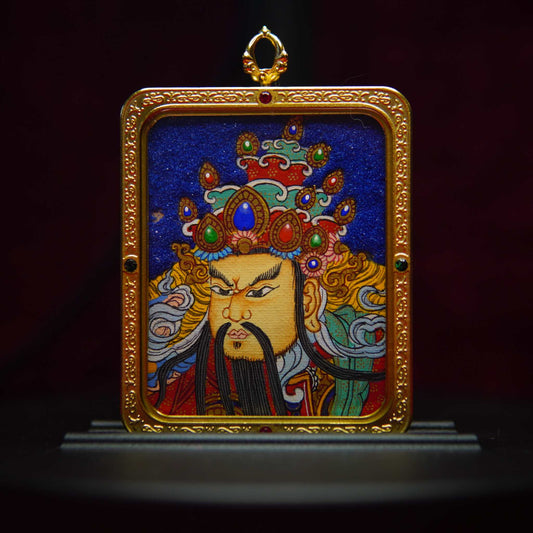
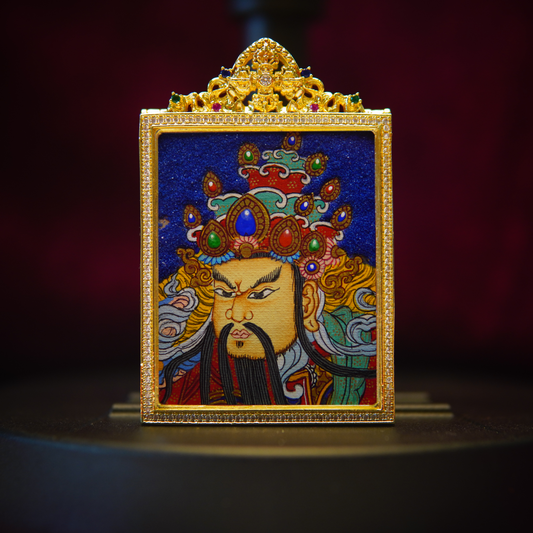
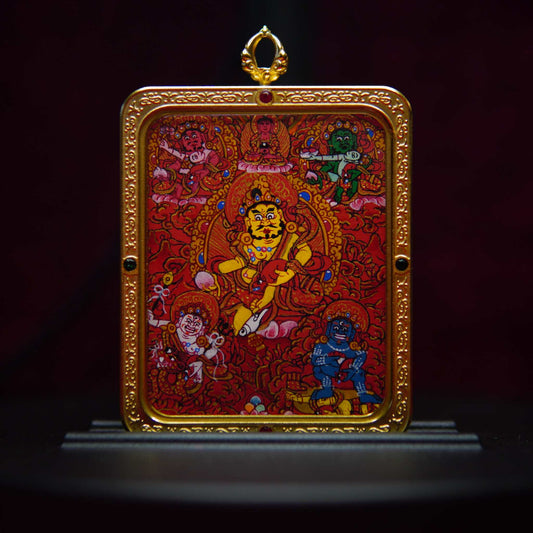
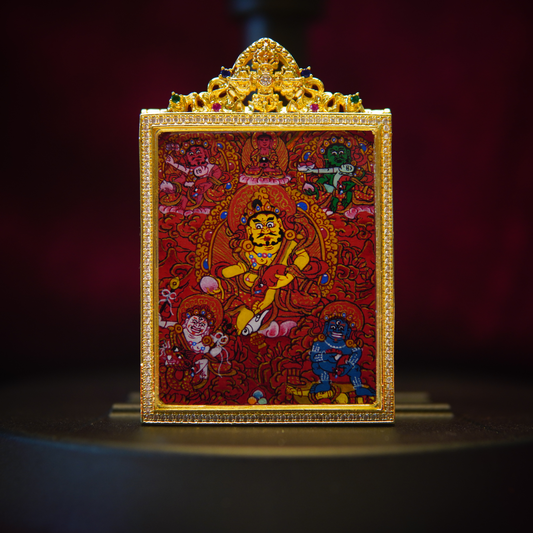
Our hand-painted Hayagriva Tibetan Thangka pendant preserves the fierce faces, dynamic forms, horse imagery and intricate ritual details within a miniature painting only a few centimeters across.
Each piece is individually painted by hand, so subtle differences in expression, linework and color naturally occur.
→ Explore the Hand-Painted Hayagriva Tibetan Thangka Pendant

❓Quick Questions About Hayagriva
What does Hayagriva mean?
Hayagriva is a Sanskrit name strongly associated with horse imagery, commonly translated through meanings such as “Horse-Necked” or “Horse-Headed.”
Why does Hayagriva have a horse head?
The horse is one of Hayagriva's defining iconographic features and is closely tied to his name and identity.
Is Hayagriva an evil deity?
No. Hayagriva belongs to the wrathful visual language of Vajrayana Buddhism. Fierce appearance does not automatically mean evil.
What does Hayagriva represent?
Hayagriva is especially associated with powerful protective activity, overcoming obstacles and wrathful compassionate activity in Vajrayana traditions.
How can I recognize Hayagriva in a Thangka?
The horse imagery above the head is one of the strongest clues, alongside wrathful faces and other tantric attributes that vary by form.