Which Thangka Should You Choose? Find the Buddhist Figure That Speaks to You
chenHenryWhich Thangka Should You Choose?
You see a Green Tara.
Then a golden Yellow Jambhala.
A blue Medicine Buddha.
A peaceful Shakyamuni.
A sword-bearing Manjushri.
They are all beautiful.
And then comes the difficult question:
Which one is actually right for me?
If you're new to Tibetan Buddhist art, don't begin by trying to memorize every deity.
Begin with yourself.
Ask one question:
What quality do I want to cultivate or remember in my life right now?
Wisdom?
Compassion?
Courage?
Prosperity?
Peace?
Determination?
Your answer gives you somewhere to begin.

🪷 Find Your Thangka by Meaning
If you want the short answer, start here:
| What Speaks to You? | Consider |
|---|---|
| 💰 Prosperity & Generosity | Yellow Jambhala |
| 💚 Compassion & Courage | Green Tara |
| 🤍 Longevity & Serenity | White Tara |
| 💙 Healing Symbolism & Compassion | Medicine Buddha |
| 🧠 Wisdom & Clarity | Manjushri |
| 🪷 Awakening & Inner Peace | Shakyamuni Buddha |
| 🙏 Compassion & Mercy | Four-Armed Avalokiteshvara |
| 🌌 Wisdom & Expansive Awareness | Akashagarbha Bodhisattva |
| 🌸 Practice & Virtuous Action | Samantabhadra Bodhisattva |
| ✨ Spiritual Strength & Wisdom | Mahasthamaprapta Bodhisattva |
| 🔥 Determination & Protection | Acala |
| ❤️ Peace & Pure Land Tradition | Amitabha Buddha |
But meaning is more personal than a table.
So let's choose another way.
💰 “I Want to Build Prosperity”
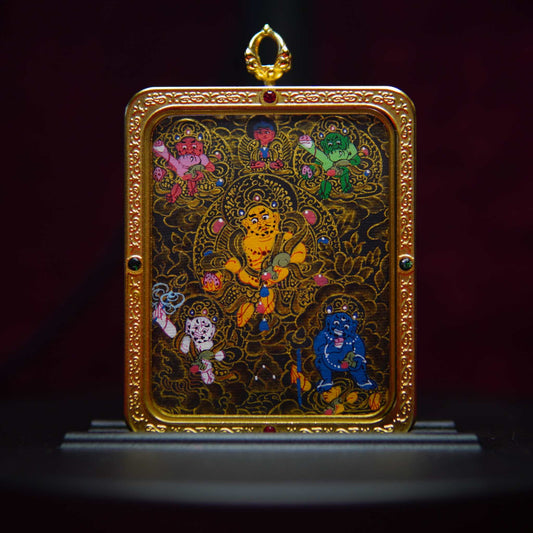
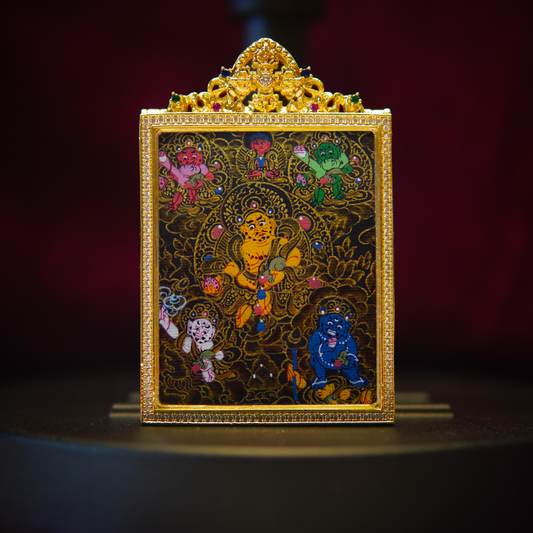
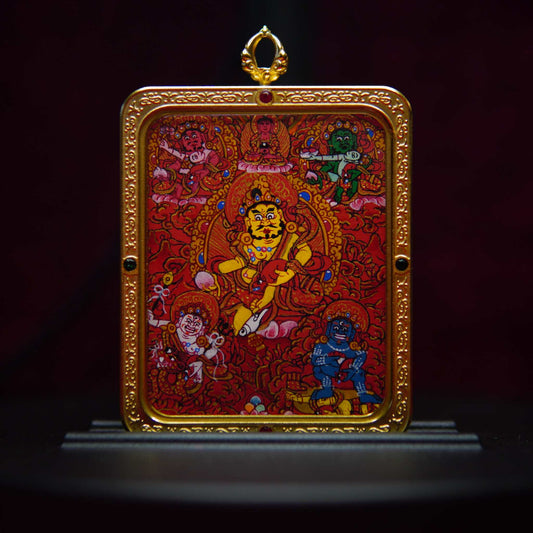
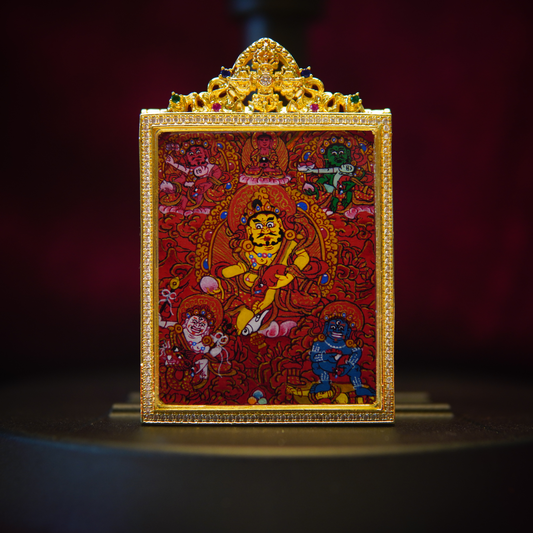
Yellow Jambhala
Yellow Jambhala is a Buddhist wealth deity traditionally associated with prosperity, abundance, and generosity.
That last word matters.
Generosity.
In Buddhist thought, wealth isn't meaningful only because it can be accumulated. Resources can also create stability, enable generosity, and allow us to support others.
That gives Yellow Jambhala a deeper meaning than simply:
“I want more money.”
He may resonate with someone building a business, beginning a new career, or entering a period where financial stability matters.
Choose Yellow Jambhala if:
“I want to build abundance without becoming possessed by it.”
Especially meaningful for: entrepreneurs, business owners, professionals, and people beginning a new venture.

💚 “I'm Going Through Change and Need Courage”
Green Tara
Green Tara is traditionally associated with active compassion, protection from fear, and swift enlightened action.
Look closely at many traditional depictions of her.
She isn't represented as completely withdrawn from the world.
Her posture conveys readiness.
That is part of what makes Green Tara compelling during periods of uncertainty.
Moving to a new place.
Starting again.
Leaving something behind.
Facing a decision you have been avoiding.
Green Tara doesn't have to symbolize the absence of fear.
She can symbolize how we respond when fear is already there.
Choose Green Tara if:
“I want to move through fear without losing compassion.”
Especially meaningful for: people entering a new chapter, caregivers, meditators, and anyone navigating uncertainty.
🧠 “My Mind Feels Confused. I Need Clarity.”
Manjushri Bodhisattva
Manjushri is the bodhisattva traditionally associated with transcendent wisdom in Mahayana Buddhism.
His most striking symbol is difficult to miss:
A flaming sword.
But it does not represent violence.
The sword symbolizes wisdom cutting through ignorance, confusion, and delusion.
That makes Manjushri surprisingly easy to connect with modern life.
A difficult exam.
A complicated business decision.
A research problem.
A creative block.
A moment when ten possible directions appear equally convincing.
Choose Manjushri if:
“I want to see clearly before I act.”
Especially meaningful for: students, researchers, writers, creators, founders, and decision-makers.
🤍 “I Want Peace, Longevity and a Gentler Presence”
White Tara
White Tara is traditionally associated with compassion, serenity, and longevity.
Her imagery is peaceful and contemplative.
She is often depicted with seven eyes, symbolizing compassionate awareness.
Compared with the active energy associated with Green Tara, White Tara can feel quieter.
More reflective.
More gentle.
That is one reason a White Tara Thangka can also make a thoughtful gift for someone whose well-being and long life you deeply value.
Choose White Tara if:
“I want to cultivate peace and appreciate the life I have.”
Especially meaningful for: parents, elders, caregivers, meditators, and those drawn to serenity.
💙 “Someone I Care About Is Going Through a Difficult Time”
Medicine Buddha
Medicine Buddha, or Bhaiṣajyaguru, is traditionally associated with healing, compassion, and the relief of suffering in Buddhist tradition.
This is one area where meaning needs to be expressed carefully.
A Medicine Buddha image is not a substitute for medical care, nor should a Thangka be presented as something that guarantees physical healing.
Its power as a symbol lies somewhere else:
in the wish for suffering to be relieved.
In compassion toward someone experiencing difficulty.
In remembering the importance of care.
Choose Medicine Buddha if:
“I want to keep compassion and well-being close to mind.”
Especially meaningful for: caregivers, meditators, people supporting loved ones, or someone drawn to Medicine Buddha practice.
🪷 “I Want to Go Back to the Beginning”
Shakyamuni Buddha
With so many Buddhist figures, sometimes the simplest choice is the most fundamental.
Shakyamuni Buddha refers to Siddhartha Gautama, the historical Buddha whose awakening forms the foundation of Buddhism.
His image points toward the central themes of Buddhist practice:
Awareness.
Wisdom.
Meditation.
Understanding suffering.
Awakening.
If you're interested in Buddhism but don't yet feel a strong connection to a particular bodhisattva or deity, Shakyamuni can be a natural place to begin.
Choose Shakyamuni Buddha if:
“I want to return to awareness.”
Especially meaningful for: meditators, students of Buddhism, and those beginning a Buddhist practice.
🙏 “I Want to Become More Compassionate”
Four-Armed Avalokiteshvara
Avalokiteshvara is the bodhisattva of compassion, and the four-armed form is especially prominent in Tibetan Buddhist art and practice.
If Green Tara can be understood through compassion in action, Avalokiteshvara brings the focus directly toward compassionate concern for sentient beings.
That can make his image particularly meaningful for people whose lives revolve around helping others.
Parents.
Teachers.
Caregivers.
Counselors.
People who simply want to become less absorbed in themselves.
Choose Avalokiteshvara if:
“I want compassion to shape the way I treat others.”

🔥 “I Need Strength to Face an Obstacle”
Acala
Acala looks very different from peaceful Buddhist figures.
Fierce expression.
Flames.
A sword.
Powerful posture.
But fierce Buddhist imagery should not automatically be interpreted as anger or evil.
Acala is associated in Buddhist traditions with immovability, determination, and overcoming spiritual obstacles.
His appearance communicates something uncompromising:
Do not be moved from what matters.
Choose Acala if:
“I know where I need to go. I need the determination to keep going.”
Especially meaningful for: people facing difficult goals, major transitions, demanding disciplines, or obstacles requiring perseverance.
❤️ “I'm Drawn to Peace and the Pure Land Tradition”
Amitabha Buddha
Amitabha Buddha is the central Buddha of Pure Land Buddhism and is associated with the Western Pure Land, Sukhavati.
His imagery is deeply connected with compassion, faith, and aspiration toward liberation.
For those already familiar with Pure Land Buddhist traditions, the choice may be deeply devotional.
For others encountering Amitabha through art, his peaceful image may inspire reflection on compassion and liberation.
Choose Amitabha if:
“I am drawn toward peace, compassion, and the path of liberation.”
🌌 “I Want to Expand My Wisdom”
Akashagarbha Bodhisattva
Akashagarbha is a Mahayana bodhisattva whose name evokes a ‘treasury’ or ‘womb’ as vast as space and is associated with wisdom and virtue.
The imagery of vastness makes Akashagarbha particularly interesting.
There is always more to learn.
More to understand.
More room to grow beyond what we currently know.
Choose Akashagarbha if:
“I want to keep expanding what I understand.”
Especially meaningful for: students, lifelong learners, creators, and those entering a period of intellectual growth.
 🌸 “I Know What Matters. Now I Need to Live It.”
Samantabhadra Bodhisattva
There is a difference between understanding something and practicing it.
Samantabhadra Bodhisattva is strongly associated in Mahayana Buddhism with practice, vows, and virtuous conduct.
That makes his symbolism unusually practical.
You may already know you want to be more patient.
More generous.
More disciplined.
More compassionate.
The difficult part is tomorrow morning.
Choose Samantabhadra if:
“I don't only want to understand my values. I want to live them.”
✨ “I Want Steady Spiritual Strength”
Mahasthamaprapta Bodhisattva
Mahasthamaprapta is an important Mahayana bodhisattva associated with wisdom and spiritual strength and appears prominently alongside Amitabha Buddha and Avalokiteshvara in Pure Land traditions.
Not every form of strength needs to look fierce.
Some strength is quiet.
The ability to stay focused.
To remain steady.
To continue a practice when novelty has disappeared.
Choose Mahasthamaprapta if:
“I want the strength to remain steady on my path.”
🔮 What If More Than One Thangka Speaks to You?
That's completely understandable.
You might want Manjushri's clarity and Green Tara's courage.
Yellow Jambhala's prosperity and Shakyamuni's awareness.
Human lives don't fit neatly into one category.
So don't treat this guide like a personality test.
Instead, ask:
What feels most relevant to this chapter of my life?
The answer may change over time.
And that is perfectly natural.
🧿 Should You Choose a Thangka Based on Your Zodiac Sign?
You may encounter the idea of a “Zodiac Buddha” or “Birth Buddha” when shopping for Buddhist jewelry and art, particularly in East Asian contexts.
That can be meaningful within the traditions and cultural systems where those associations are used.
But it is not the only way to choose a Thangka.
If you're choosing Tibetan Buddhist art, you can also begin with:
Your Buddhist practice or teacher's guidance
A particular figure you already feel devotion toward
The traditional symbolism you connect with
A quality you wish to cultivate
An image that continually draws your attention
There doesn't have to be a single universal formula.
🎨 Does the Image You Simply Love Matter?
Yes.
Meaning is important.
But art is also visual.
Sometimes you don't know anything about a figure yet—
and still find yourself looking at the same painting again.
That curiosity can be the beginning of learning.
If one image repeatedly draws your attention, find out who the figure is.
Learn the symbolism.
Learn the tradition.
Then decide whether the connection becomes deeper.
Sometimes connection begins before explanation.
 🪷 So, Which Thangka Should You Choose?
Here's the simplest version:
For prosperity → Yellow Jambhala
For compassion & courage → Green Tara
For serenity & longevity → White Tara
For healing symbolism & compassion → Medicine Buddha
For wisdom & clarity → Manjushri
For awakening & meditation → Shakyamuni Buddha
For compassion → Avalokiteshvara
For determination → Acala
For peace & Pure Land practice → Amitabha Buddha
For expansive wisdom → Akashagarbha
For turning values into practice → Samantabhadra
For steady spiritual strength → Mahasthamaprapta
But there is an even shorter answer:
Choose the Thangka that reminds you of who you want to become.

🖼️ Find a Thangka for Your Space
Our Hand-Painted Tibetan Tabletop Thangkas are individually painted and presented in solid wood frames, designed for a meditation altar, desk, bookshelf, or quiet corner of your home.
Choose from multiple Buddhist figures according to the tradition, symbolism, and artwork that resonates with you.
Artwork Size: 25 × 35 cm / 9.8 × 13.8 in
Craft: Hand-Painted
Frame: Solid Wood
Display: Tabletop / Freestanding
Available: Multiple Buddhist Figures
→ Explore Hand-Painted Tibetan Tabletop Thangkas
Don't choose only what looks beautiful. Choose what means something to you.
❓FAQ — Choosing a Thangka
Which Thangka is best for wisdom?
Manjushri is one of the clearest choices for wisdom. In Mahayana Buddhism, Manjushri is the bodhisattva associated with transcendent wisdom, and his flaming sword symbolizes wisdom cutting through ignorance and confusion.
Which Buddhist figure represents prosperity?
Yellow Jambhala is traditionally associated with wealth, prosperity, abundance, and generosity. His symbolism should not be reduced to guaranteed financial gain; generosity is an important part of the meaning.
Which Thangka represents compassion?
Avalokiteshvara is the bodhisattva of compassion. Green Tara is also strongly associated with compassion, particularly compassionate action and protection from fear.
Which Thangka is associated with courage and overcoming fear?
Green Tara is traditionally associated with protection from fear and swift compassionate action, making her a meaningful choice for people navigating change or uncertainty.
Which Thangka should a beginner choose?
There is no single required Thangka for every beginner. Shakyamuni Buddha can be a natural starting point because of his foundational role in Buddhism, while others may choose according to their tradition, teacher, practice, or connection with a particular figure.
Can I choose a Thangka as a gift?
Yes, but choose by meaning rather than appearance alone. For example, White Tara can carry associations of longevity and serenity, Manjushri can be meaningful for a student, and Green Tara may suit someone beginning a new chapter.
Do I need to be Buddhist to own a Thangka?
A person may appreciate Thangka painting as Buddhist art without being Buddhist, but the figures and symbols have religious significance and should be approached and displayed respectfully.