Why Is Mahamayuri Associated With Poison? The Strange Story Behind the Peacock
chenHenry☠️ Why Would a Beautiful Peacock Have Anything to Do With Poison?
Peacocks are famous for beauty.
Brilliant blue and green feathers.
A shimmering fan of “eyes.”
A bird so spectacular that it has appeared in royal, religious and decorative art for centuries.
But the story of Mahamayuri begins somewhere much stranger:
poison.
Mahamayuri (Mahāmāyūrī), often known as the Great Peacock, is an important Buddhist protective figure whose traditions are closely associated with protection from poisons, venomous creatures and other dangers.
At first, the connection seems bizarre.
Why would one of the world's most beautiful birds become linked with poison?
And how did that relationship help turn Mahamayuri into a powerful Buddhist symbol of protection?
The answer comes from an old idea about the peacock:
It could encounter poison without being destroyed by it.

🦚 Who Is Mahamayuri?
Mahamayuri (Mahāmāyūrī), the Great Peacock, is a Buddhist protective figure traditionally associated with protection from poison, venom, dangerous creatures and harmful conditions.
She belongs to a long Buddhist tradition extending beyond Tibet and appears in Buddhist texts, rituals and art across different parts of Asia.
Her peacock association is so important that it is built directly into her identity.
This makes Mahamayuri very different from a Buddhist figure who simply happens to have a beautiful bird somewhere in the background.
The peacock is not decoration.
It is one of the keys to understanding who she is.
And to understand the peacock, we need to understand the poison story.
☠️ Why Is Mahamayuri Connected With Poison?
In traditional Indian and Buddhist cultural imagination, the peacock became famous for its relationship with snakes and poisonous substances.
Peacocks were believed to be able to consume or overcome poison without being destroyed by it.
That idea created an extraordinarily powerful religious metaphor.
Most creatures encounter poison and are harmed.
The peacock encounters poison—and remains magnificent.
Its feathers do not become ugly.
They become the very thing people admire.
Within Mahamayuri's protective tradition, this made the bird an ideal symbol for dealing with harmful conditions.
The point was not simply:
avoid everything dangerous.
The peacock offered a more striking image:
encounter what is harmful without being overcome by it.
It is important, however, to distinguish religious symbolism from modern zoology.
Traditional beliefs about peacocks and poison should not automatically be treated as scientific claims about immunity to every toxin.
Their importance here is religious and symbolic.
🛡️ What Was Mahamayuri Traditionally Invoked Against?
Mahamayuri's protective traditions have long been associated with threats that were very real to people living in ancient and medieval Asia.
Poison.
Snakebite.
Venomous creatures.
Illness.
Dangerous conditions.
Other forms of harm.
This is one reason Mahamayuri is such an unusual Buddhist protective figure.
Many protectors appear terrifying.
Mahamayuri can instead appear graceful and beautiful.
Her protective identity comes not primarily from looking frightening, but from the peacock's relationship with poison and danger.
This gives her imagery a very different emotional character from wrathful figures such as Mahakala or Yamantaka.
The purpose may still involve protection.
The visual language is completely different.
🦚 Why a Peacock Instead of a Fierce Animal?
Imagine the same story with a tiger.
A tiger defeating danger would not be surprising.
Strength defeating weakness is easy to understand.
The peacock creates a more interesting metaphor.
It is associated with beauty.
Color.
Elegance.
Then that beautiful creature is connected with something as unpleasant as poison.
The contrast creates the symbolism.
Beauty does not come from pretending poison doesn't exist.
Instead, the traditional image suggests the possibility of encountering harmful conditions without allowing them to define the final outcome.
This is one reason the peacock can be interpreted more broadly as a symbol of resilience and transformation.
Those modern symbolic readings should not replace Mahamayuri's traditional religious context, but they help explain why her imagery still resonates with people today.
🌿 Does “Poison” Also Mean Negative Energy or Toxic People?
This is where modern spiritual marketing often goes too far.
Mahamayuri's traditional association with poison should not simply be rewritten as:
“She removes toxic people.”
or:
“She blocks negative vibes.”
Those phrases may sound contemporary, but they are not substitutes for the historical Buddhist tradition.
A more responsible approach is to separate two levels.
Traditional meaning
Mahamayuri is associated with protection from poison, venom, harmful creatures and dangers within Buddhist religious traditions.
Modern symbolic interpretation
Someone today may personally connect the peacock story with resilience, adversity or the transformation of difficult experiences.
The second can be meaningful.
It should simply not be presented as if it were the original definition.
🩺 Can a Mahamayuri Pendant Protect You From Literal Poison?
A Mahamayuri pendant should not be treated as medical protection against poisoning, snakebite or venom.
If someone is exposed to poison or bitten by a potentially venomous animal, they need appropriate emergency medical care.
This does not make the religious symbolism meaningless.
Religious objects have always existed alongside the practical realities of life.
A Mahamayuri image can carry devotional, cultural or symbolic significance without being sold as a substitute for medicine.
For a modern product page, that distinction is especially important.
It allows the traditional story to remain fascinating without turning it into a dangerous health claim.
✨ From Poison to Protection — and Protection to Transformation
This is where Mahamayuri's symbolism becomes especially beautiful.
The story begins with something harmful.
Poison.
Then comes the peacock.
The bird does not become identified with poison because it represents suffering.
It becomes important because traditional belief presents it as capable of encountering poison without being destroyed by it.
That creates a natural symbolic progression:
Poison → Peacock → Protection → Transformation
And that is much more distinctive than simply saying:
Mahamayuri means peace.
Peace can describe many Buddhist figures.
The relationship between peacock and poison belongs much more specifically to Mahamayuri's story.
📿 Why Carry a Mahamayuri Thangka?
For Buddhist practitioners, Mahamayuri may have specific devotional and protective significance within the tradition.
For others drawn to Buddhist art, the image can carry a broader symbolic message:
🛡️ Protection
🦚 Resilience
🪷 Transformation
🧠 Wisdom
🌿 Peace amid difficult conditions
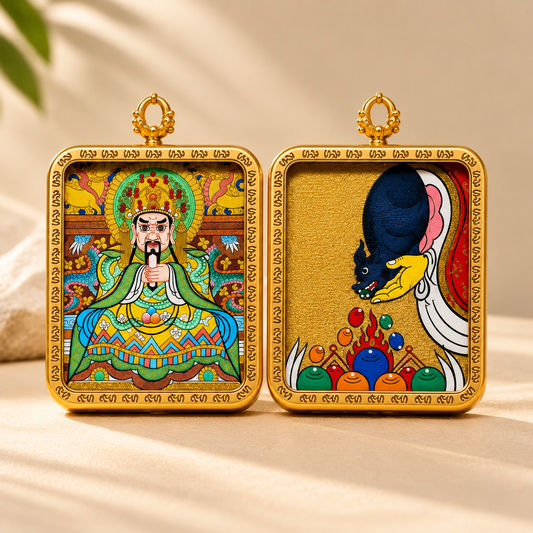
Our hand-painted Mahamayuri Tibetan Thangka pendant depicts the graceful Buddhist figure alongside a magnificent peacock, with the bird's colorful tail creating one of the most visually striking backgrounds in the collection.
Each miniature Thangka is individually painted by hand, so subtle variations in color, linework and feather details naturally occur.
Once you know the poison story, the peacock no longer looks like an extravagant decoration.
It becomes the heart of the image.
→ Explore the Hand-Painted Mahamayuri (Great Peacock) Thangka Pendant

And if you're wondering why the peacock became so central to Mahamayuri in the first place:
→ Why Is the Peacock Sacred to Mahamayuri? From Poison to Protection
❓Quick Questions About Mahamayuri
Who is Mahamayuri?
Mahamayuri (Mahāmāyūrī), commonly known as the Great Peacock, is a Buddhist protective figure traditionally associated with protection from poison, venom, dangerous creatures and harmful conditions.
Why is Mahamayuri associated with poison?
Her tradition is closely connected with the peacock and ancient beliefs about the bird's ability to encounter poisonous substances without being overcome by them.
Does Mahamayuri literally protect someone from poisoning?
A Mahamayuri image may have religious or devotional significance, but it should not be treated as medical protection or a substitute for emergency care.
What does the peacock symbolize in Mahamayuri imagery?
Within Mahamayuri's context, the peacock is especially connected with protection from poison and the transformation of harmful conditions.