Was Guru Rinpoche Really Born From a Lotus?
chenHenry🪷 His Name Gives Away the Mystery
The name Padmasambhava is commonly understood as:
“Lotus-Born.”
And according to Tibetan Buddhist tradition, that isn't merely a poetic nickname.
Guru Rinpoche is famously said to have appeared miraculously within a lotus flower on a lake, rather than being born in the ordinary way.
A child appearing from a lotus sounds like legend.
It is.
More precisely, it belongs to the sacred biographical traditions surrounding one of Tibetan Buddhism's most important masters. Traditional accounts describe Padmasambhava's miraculous appearance on a lotus in Lake Dhanakosha in Uddiyana.
But focusing only on whether the story happened literally misses a more interesting question:
Why a lotus?
Because in Buddhist art, a lotus is rarely just a flower.
 🌸 What Does “Padmasambhava” Mean?
The Sanskrit name combines padma, meaning lotus, with a term referring to being born or arisen.
Hence:
Padmasambhava → Lotus-Born
He is also known by related names such as Padmakara and, in Tibetan, Pema Jungné, again carrying the Lotus-Born meaning.
And then there is the name most commonly encountered in Tibetan contexts:
Guru Rinpoche — “Precious Master.”
These aren't separate people.
They are different names and titles connected with the same extraordinary figure.
🌊 What Is the Traditional Story of His Birth?
One widely known Tibetan Buddhist account places the event at Lake Dhanakosha in the land of Uddiyana.
According to the sacred narrative, a multicolored lotus appeared on the lake, and Padmasambhava manifested miraculously upon it as an extraordinary child.
The king of Uddiyana, Indrabhuti, encountered the child and eventually brought him into the kingdom. Traditional biographies then follow Padmasambhava through an extraordinary life of Buddhist study, tantric practice, travel and miraculous activity.
This is not a modern historical birth certificate.
It belongs to religious biography, where miraculous events communicate sacred identity and meaning.
And the lotus is central to that meaning.
🪷 Why Is the Lotus So Important in Buddhism?
A lotus begins somewhere that doesn't look particularly sacred.
Mud.
Dark water.
Sediment.
Yet its stem rises through the water and the flower opens above the surface.
This natural process made the lotus one of Buddhism's most enduring visual symbols.
It is commonly associated with ideas such as:
🌸 Purity
🪷 Awakening
🌿 Spiritual Development
✨ Emergence beyond defilement
This is why Buddhas and bodhisattvas so often appear seated or standing on lotus thrones.
The flower carries a visual message:
something awakened can emerge from conditions that appear anything but pure.
Seen this way, Padmasambhava's “Lotus-Born” identity is much richer than a supernatural birth story.
The flower helps tell us what kind of figure the tradition understands him to be.
 🔥 From a Lotus to a Master Who Subdues Obstacles
There is an interesting contrast in Guru Rinpoche's traditional biography.
His story begins with a lotus—one of Buddhism's most elegant symbols.
Yet much of his later life is remembered through powerful tantric imagery and stories of confronting hostile forces.
When Padmasambhava eventually traveled to Tibet in the 8th century, traditional accounts describe him overcoming forces that obstructed the establishment of Buddhism and binding local spirits by oath to protect the Dharma.
The peaceful lotus and the powerful obstacle-subduer might seem like opposites.
Within his story, however, they fit together.
Padmasambhava isn't remembered simply for escaping difficult conditions.
He is repeatedly portrayed as transforming them.
That is one reason themes of transformation and overcoming obstacles remain so closely connected with Guru Rinpoche imagery today.
Want the larger story of his role in Tibet?
→ Why Is Guru Rinpoche Called the “Second Buddha” of Tibet?
🎨 How Do You Know You're Looking at Guru Rinpoche?
A Guru Rinpoche Thangka isn't simply a painting of “a Buddhist master.”
His traditional iconography makes him recognizable.
Look closely and several features often appear.
👑 The Lotus Hat
Perhaps the easiest detail to notice.
Guru Rinpoche's distinctive hat immediately separates him visually from many other Buddhist figures.
The precise iconographic details can vary according to the particular manifestation being represented, but the lotus hat remains strongly associated with his image.
⚡ The Vajra
In common representations, Guru Rinpoche holds a vajra in his right hand.
The vajra is one of the central ritual symbols of Vajrayana Buddhism and carries a rich range of meanings, including indestructibility.
🏺 The Skull Cup
His left hand commonly holds a skull cup, another distinctive feature of tantric Buddhist iconography.
🪄 The Khatvanga
A ritual staff known as a khatvanga often rests against his shoulder.
Once you learn these features, looking at a Guru Rinpoche Thangka becomes almost like reading a visual language.
Instead of seeing:
“a man sitting in elaborate clothing”
you begin noticing:
hat → vajra → skull cup → staff → posture → robes
And suddenly the details have context.
🏔️ Why Does the “Lotus-Born” Story Still Matter?
For Buddhist practitioners, Guru Rinpoche's birth narrative belongs within a living religious tradition.
For someone approaching him through art or cultural history, the story also explains why lotus imagery is inseparable from his identity.
But there is another reason it remains memorable:
the story is almost impossible to forget.
There are countless Buddhist masters whose biographies are unfamiliar outside specialist circles.
“A tantric master miraculously born from a lotus” is different.
The image stays with you.
And once someone learns that Padmasambhava means “Lotus-Born,” his name itself becomes easier to remember.
That is especially valuable when encountering Tibetan Thangka art, where understanding the figure can completely change how the painting is viewed.
📿 From Sacred Biography to Wearable Thangka
Traditional Guru Rinpoche Thangkas can contain layers of iconographic detail.
A miniature pendant compresses that visual language into only a few centimeters.
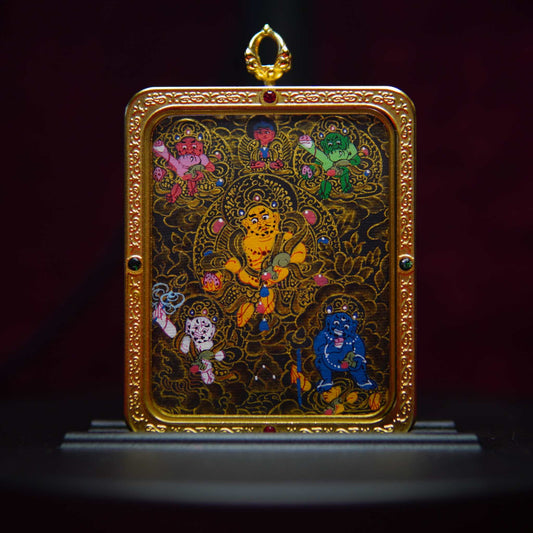
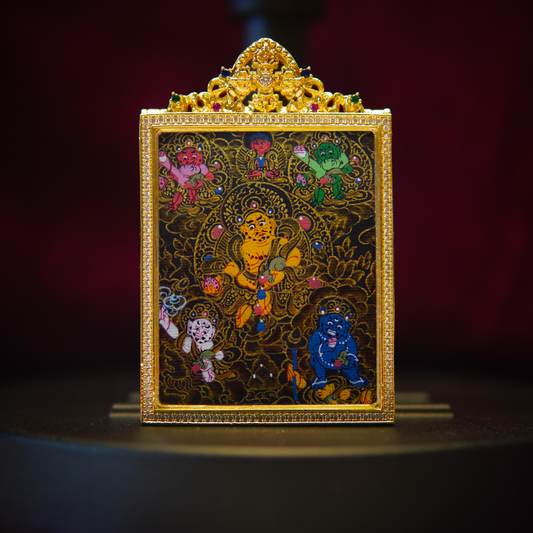
Our hand-painted Padmasambhava (Guru Rinpoche) Thangka pendant preserves the central figure in miniature, with his distinctive robes, ritual attributes and surrounding details individually painted by hand.
For Buddhist practitioners, the image may have devotional significance.
For others drawn to Tibetan Buddhist art, it can carry the symbolism commonly associated with Guru Rinpoche:
wisdom, protection, spiritual strength and transformation.
More importantly, once you know the story behind the image, it no longer looks like an anonymous Buddhist portrait.
You know who you're looking at.
You know why he is called Lotus-Born.
And you know why his image has remained so important for more than a thousand years.
→ Discover the Hand-Painted Padmasambhava (Guru Rinpoche) Thangka Pendant

❓Quick Questions
What does Padmasambhava mean?
Padmasambhava is commonly translated as “Lotus-Born.” The name refers to traditional Buddhist accounts of his miraculous appearance on a lotus at Lake Dhanakosha in Uddiyana.
Is Padmasambhava the same as Guru Rinpoche?
Yes. Padmasambhava is his Sanskrit name, while Guru Rinpoche is the Tibetan honorific meaning “Precious Master.”
Was Guru Rinpoche literally born from a lotus?
Traditional Tibetan Buddhist biographies describe his birth as a miraculous appearance on a lotus. This should be understood as part of his sacred religious biography; modern historical study does not treat miraculous narratives in the same way as ordinary biographical documentation.
What does the lotus symbolize in Buddhism?
The lotus is widely associated with purity, awakening and spiritual development, reflecting the way the flower rises from muddy water and blooms above the surface.
How can I recognize Padmasambhava in a Thangka?
Common representations often show his distinctive lotus hat, vajra, skull cup and khatvanga staff, although iconographic details can vary among his different manifestations.