Why Does Palden Lhamo Ride a Mule? The Strange Symbols Hidden in Her Thangka
chenHenryShare
🐴 Why Is One of Tibet's Fiercest Protectors Riding a Mule?
Look beneath Palden Lhamo and you'll find one of the strangest mounts in Buddhist art.
Not a lion.
Not a dragon.
Not even a horse.
A mule.
And the mule is only the beginning.
Look more closely at traditional Palden Lhamo imagery and the painting becomes increasingly unusual.
Fierce expressions.
Flames.
Wrathful ornaments.
Ritual objects.
Symbols that can seem shocking to someone seeing them for the first time.
None of this is random decoration.
Palden Lhamo's Thangka is a dense piece of protector iconography.
So why a mule?
And what are all these strange details trying to tell us?
 🛡️ Who Is Palden Lhamo?
Palden Lhamo (Śrī Devī) is one of the major female wrathful protectors in Tibetan Buddhism.
Her imagery belongs to Vajrayana Buddhist protector traditions and is intentionally powerful.
This is important before interpreting any individual symbol.
If you start with:
“What magical benefit does this object give me?”
you will probably misunderstand the painting.
A better question is:
“What does this detail tell me about the identity and activity of Palden Lhamo?”
That shift makes her Thangka much easier to read.
🐴 What Animal Does Palden Lhamo Ride?
Palden Lhamo is traditionally depicted riding a mule in her wrathful protector iconography.
The mount is one of the visual features that helps distinguish her from other wrathful Buddhist figures.
This matters because Tibetan Buddhist art contains many fierce deities.
At first glance, someone unfamiliar with the tradition may see:
fangs,
flames,
wild hair,
ritual implements,
and assume all wrathful figures are basically interchangeable.
They aren't.
Iconographic details identify the deity.
For Palden Lhamo, the mule is one of those details.
🐴 Why a Mule Instead of a Horse?
This is where we need to be careful.
Modern symbolism encourages easy explanations.
A writer might say:
“The mule represents stubborn determination.”
It sounds convincing.
But sounding convincing does not make it traditional Buddhist iconography.
Palden Lhamo's mule belongs to her specific sacred narrative and protector tradition.
The important starting point is therefore not generic animal symbolism.
It is that the mule is her characteristic mount within the traditional iconography of this wrathful protector form.
Understanding the complete narrative requires understanding Palden Lhamo herself rather than assigning modern personality traits to the animal.
That is a much safer way to read sacred art.
👹 Why Is the Mule Surrounded by Such Fierce Imagery?
Because the mount is part of an entire wrathful composition.
The animal does not appear in a peaceful meadow.
It carries a protector whose visual identity communicates force, urgency and power.
The surrounding elements reinforce that activity.
This is why Thangka iconography should be read as a system.
A single symbol rarely exists completely on its own.
Deity + mount + posture + ornaments + surrounding imagery
work together.
That complete visual language tells you much more than:
“mule = one specific benefit.”
💀 Why Are There So Many Disturbing Symbols?
For someone used to peaceful Buddha statues, Palden Lhamo can be shocking.
Why would Buddhist art contain:
skulls,death imagery,fierce ornaments,or other frightening details?
Because Vajrayana Buddhist art includes both peaceful and wrathful visual languages.
Wrathful imagery can confront:
obstacles,harmful conditions,mortality,attachment,and other difficult realities.
It does not mean Buddhism suddenly becomes a religion of horror.
The imagery is intentionally intense because the activity being represented is intense.
If you want the deeper explanation of why Palden Lhamo looks this way:
→ Why Does Palden Lhamo Look So Terrifying?
🔥 Why Is Palden Lhamo Surrounded by Flames?
Flames immediately communicate intensity.
They move.
They transform.
They consume.
In wrathful Buddhist imagery, fire can contribute to the visual language of powerful activity.
But we should resist reducing it to:
“Fire burns away bad luck.”
That may sound attractive on a product page, but it oversimplifies the religious imagery.
In a Palden Lhamo Thangka, flames belong to the larger wrathful composition.
They help create the sense that this is an active protector, not a peaceful meditative figure.
👁️ Why Does the Whole Painting Feel Like It's Moving?
This is one of the biggest differences between wrathful and peaceful compositions.
Compare a peaceful Buddha:
seated,balanced,symmetrical,still.
Now look at Palden Lhamo.
The mount moves.
Garments and ornaments move.
Flames move.
The entire composition feels active.
This isn't an accident.
Movement reinforces the idea of active protective activity.
For a miniature Thangka, preserving that sense of movement is especially difficult because the artist has only a few centimeters of space.
🤍 Why Does Palden Lhamo Look So Different From White Tara?
This comparison is useful because both are important female figures in Tibetan Buddhist art.
Yet visually they seem almost opposite.
White Tara
🤍 Peaceful appearance
🪷 Lotus imagery
👁️ Seven eyes
🌿 Longevity
🤍 Compassion
Palden Lhamo
👹 Wrathful appearance
🐴 Mule mount
🔥 Fierce protector imagery
🛡️ Protection
⚡ Powerful activity
The difference does not mean:
White Tara is compassionate and Palden Lhamo isn't.
It means Buddhist art can express beneficial activity through radically different visual forms.
💚 What About Green Tara?
Green Tara adds another contrast.
She is frequently associated with swift compassionate activity and protection, but her appearance remains peaceful compared with Palden Lhamo.
This is useful because it shows something important:
Protection itself does not have only one visual language.
Green Tara can represent protection through compassionate, graceful imagery.
Palden Lhamo expresses protection through a fierce wrathful protector form.
Understanding this difference helps prevent all “protection deities” from being treated as interchangeable products.
🎨 How to Read a Palden Lhamo Thangka
Instead of asking what magical benefit each object provides, try reading the image through identity.
| Detail | What to Notice |
|---|---|
| Mule | Important identifying mount of Palden Lhamo |
| Wrathful Face | Signals her fierce protector identity |
| Dynamic Posture | Emphasizes active rather than contemplative imagery |
| Flames | Reinforce the atmosphere of wrathful activity |
| Tantric Ornaments | Belong to her complex protector iconography |
| Ritual Attributes | Help identify the specific form and tradition |
This approach changes how you look at Thangka art.
You stop asking:
“What does this symbol give me?”
and begin asking:
**“Why did the artist need to paint this detail
?”
That is the moment a product image begins turning into something you can actually read.
🔍 Why Iconography Matters When Buying a Hand-Painted Thangka
This is especially important for a miniature hand-painted pendant.
If the only reason to buy Palden Lhamo were:
Protection & Strength
then the details of the painting would barely matter.
Any generic image could carry the same marketing words.
But traditional iconography changes that.
The mule matters.
The wrathful face matters.
The posture matters.
The ornaments matter.
The surrounding imagery matters.
These details tell you who is being depicted.
And when an artist has to preserve those identifying details within a painting only a few centimeters wide, craftsmanship becomes much easier to appreciate.
The value is not simply:
“This pendant means protection.”
It is also:
“Someone painted a recognizable Palden Lhamo composition by hand at miniature scale.”
📿 Palden Lhamo in Miniature Thangka Art
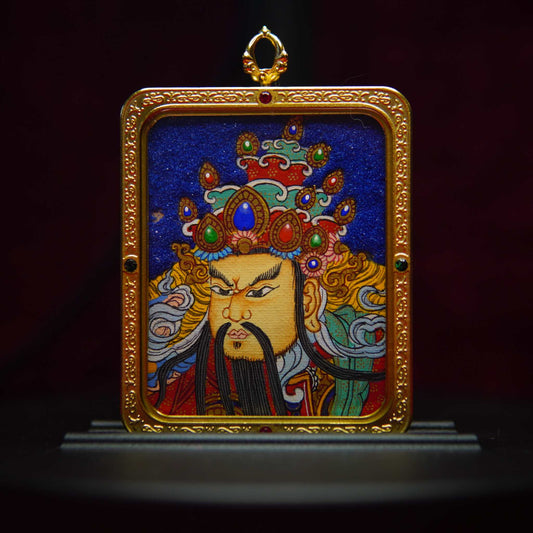
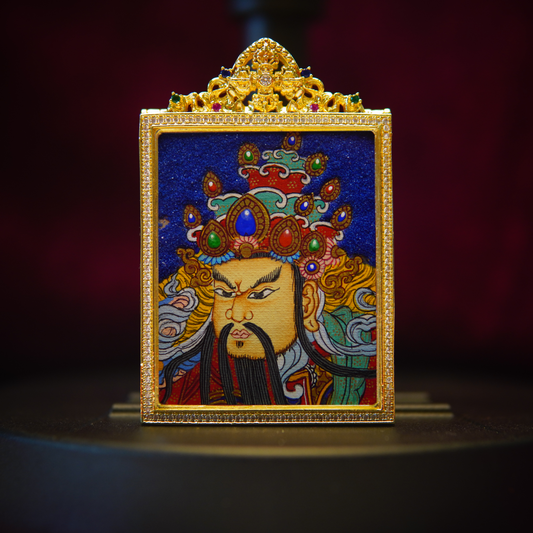
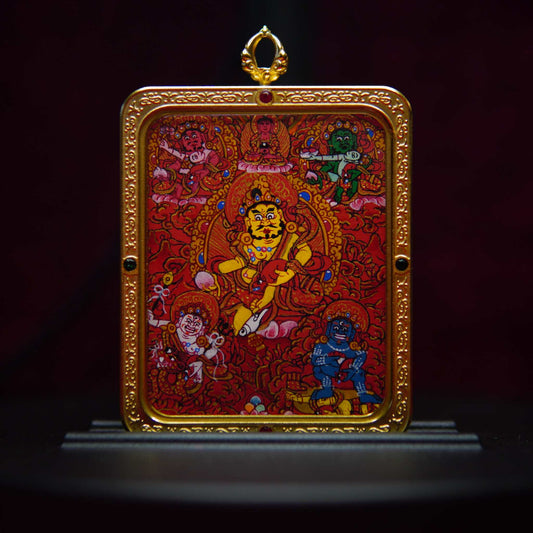
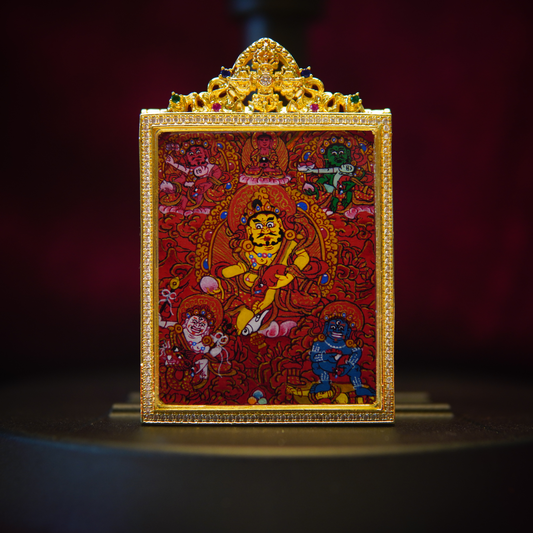
Our hand-painted Palden Lhamo Tibetan Thangka pendant brings this complex protector imagery into a wearable miniature artwork.
At first glance, you may notice only the fierce central figure.
Look longer and the composition begins to open up.
The mount.The expression.The movement.The ornaments.
The surrounding wrathful imagery.
Each piece is individually painted by hand, so subtle differences in linework, expression, color and fine details naturally occur.
For Vajrayana practitioners, Palden Lhamo belongs to specific protector traditions.
For collectors and others interested in Tibetan Buddhist art, her image offers a fascinating example of how much religious meaning can be compressed into a tiny visual space.
→ Explore the Hand-Painted Palden Lhamo Tibetan Thangka Pendant

❓Quick Questions About Palden Lhamo's Symbols
What animal does Palden Lhamo ride?
Palden Lhamo is traditionally depicted riding a mule, one of the important identifying features of her wrathful protector iconography.
Why does Palden Lhamo ride a mule?
The mule belongs to Palden Lhamo's specific traditional iconography and sacred narrative. It should not simply be reduced to a modern idea such as “stubbornness” or “strength.”
Why does Palden Lhamo have such frightening imagery?
Her frightening appearance belongs to the Vajrayana Buddhist visual language of wrathful protective activity. It does not mean she is an evil figure.
What do the flames around Palden Lhamo mean?
The flames contribute to the larger visual language of intense wrathful activity. Their meaning should be understood within the complete protector composition rather than as a standalone “good luck” symbol.
Is Palden Lhamo the same as Tara?
No. Palden Lhamo and Tara are distinct Buddhist figures with different identities, traditions and iconography. Palden Lhamo is especially known as a wrathful female protector, while Tara is widely associated with compassionate activity in peaceful forms.
How can I recognize Palden Lhamo in a Thangka?
Look at the complete composition, especially her wrathful appearance, characteristic mule mount, dynamic posture, tantric ornaments and surrounding protector imagery.