Red Jambhala vs Yellow Jambhala: What’s the Difference?
chenHenry🔴🟡 If Both Are Wealth Deities, Why Are They Different?
This is where shopping for a Jambhala Thangka can become confusing.
One figure is golden yellow.
Another is vivid red.
Both are described as Jambhala.
Both are associated with prosperity.
And many product pages describe both using exactly the same words:
wealth, money, abundance, success, fortune.
So what's the difference?
Are Red Jambhala and Yellow Jambhala simply the same wealth deity painted in two colors?
Not exactly.
Their prosperity symbolism overlaps, but their colors and traditional activities give the two forms different emphasis.
Understanding that difference makes choosing a Thangka much more meaningful than simply asking:
“Which one brings more money?”
 💰 First, Who Is Jambhala?
Jambhala is a Buddhist wealth deity associated with prosperity, material support, generosity and the relief of material hardship.
Rather than appearing in only one form, Jambhala is represented through several color forms within Tibetan Buddhist traditions.
This is where confusion begins.
Yellow.
Red.
Black.
White.
Green.
These shouldn't simply be understood as five decorative color options for the same product.
Different forms belong to specific iconographic and practice traditions and can emphasize different activities.
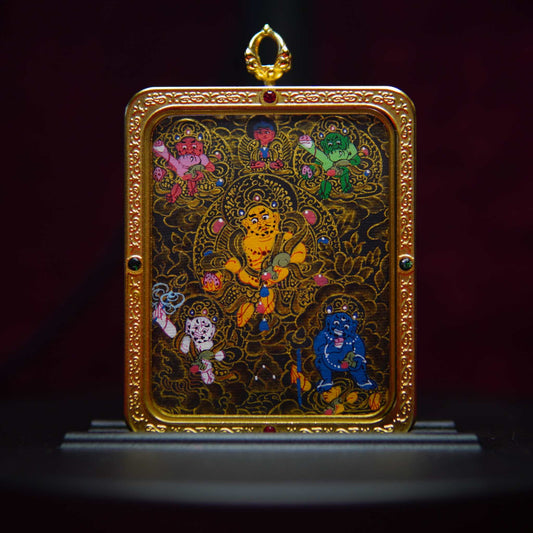
Yellow Jambhala is probably the form many people encounter first.
Red Jambhala introduces a different visual and symbolic emphasis.
 🟡 What Is Yellow Jambhala?
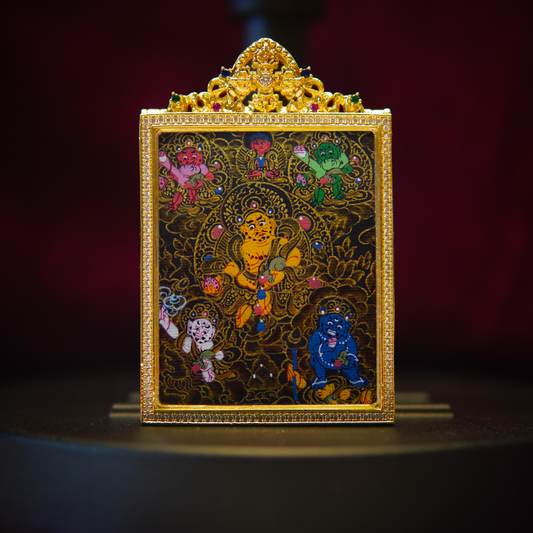
Yellow Jambhala is one of the most widely recognized Jambhala forms and is strongly associated with wealth, prosperity, abundance and material support.
His golden-yellow appearance visually reinforces the prosperity association for modern viewers, although his religious meaning should not be reduced to the modern equation:
gold color = money.
Yellow Jambhala's broader symbolism concerns resources and conditions that help alleviate material hardship.
This makes him one of the most immediately understandable Buddhist wealth figures for someone encountering Jambhala for the first time.
His symbolism is direct:
prosperity and material support are central.
🔴 What Makes Red Jambhala Different?
Red Jambhala shares Jambhala's broader connection with prosperity.
What distinguishes the red form is the additional association with magnetizing activity.
In Vajrayana Buddhist imagery, red is closely connected with attraction and magnetization.
So Red Jambhala can be understood through a combination of:
prosperity + magnetizing activity
rather than prosperity alone.
That creates a symbolic emphasis on drawing together favorable:
resources,
connections,
circumstances,
and opportunities.
This doesn't mean Yellow Jambhala has nothing to do with favorable circumstances.
Nor does it mean Red Jambhala is “better for business.”
The difference is one of traditional emphasis, not a power ranking.
 📊 Red Jambhala vs Yellow Jambhala at a Glance
| Red Jambhala | Yellow Jambhala | |
|---|---|---|
| Deity Family | Jambhala | Jambhala |
| Color | Red | Yellow / Golden |
| Shared Theme | Prosperity | Prosperity |
| Distinctive Emphasis | Magnetizing activity and favorable conditions | Wealth, abundance and material support |
| Modern Symbolic Connection | Opportunity, connection, growth | Prosperity, resources, abundance |
| Buddhist Context | Wealth + magnetizing activity | Wealth + material support |
| Should It Be Seen as Guaranteed Money? | No | No |
This is a useful starting point.
The actual iconography and religious traditions remain more detailed than any comparison table can capture.
🎨 Do Jambhala Colors Really Matter?
Yes—but not because Buddhist art uses a simple universal color code.
It would be convenient to say:
Yellow = money
Red = attraction
Black = protection
White = peace
Green = success
But Buddhist iconography is more complex than that.
Color interacts with:
the specific deity,
the activity,
the lineage,
the ritual tradition,
and the other attributes shown in the image.
This is why identifying the figure correctly matters before interpreting the color.
Red Jambhala is not Kurukulla simply because both are red.
Yellow Jambhala is not every golden Buddhist wealth figure.
Color is meaningful within context.
💰 Which Jambhala Is Associated With Wealth?
Both Red Jambhala and Yellow Jambhala are associated with prosperity.
Yellow Jambhala is particularly well known for wealth, abundance and material support.
Red Jambhala shares the prosperity association while bringing a stronger emphasis on magnetizing activity.
So if someone asks:
“Which Jambhala is the wealth deity?”
the answer is not limited to one color.
Several Jambhala forms belong to wealth and prosperity traditions.
The better question is:
How does the symbolism of each form differ?
🤔 Which Should You Choose: Red or Yellow Jambhala?
This is where many websites make the comparison too simplistic.
You may see claims such as:
Choose Yellow Jambhala if you want money.
Choose Red Jambhala if you want business opportunities.
That sounds convenient.
But it turns Buddhist iconography into a menu of guaranteed outcomes.
A more meaningful approach is to choose according to the symbolism and tradition that resonates with you.
Red Jambhala
May especially appeal to someone drawn to:
🧲 Magnetizing activity
🚪 Favorable opportunities
🤝 Connections
💰 Prosperity
Yellow Jambhala
May especially appeal to someone drawn to:
💰 Wealth
🌿 Abundance
🏠 Material support
🪷 Prosperity
Neither is automatically “stronger.”
And neither should be treated as a guarantee of financial results.
🪷 Is Wealth Considered Bad in Buddhism?
Not automatically.
The Buddhist problem is not simply the existence of resources.
The relationship with those resources matters.
Wealth can become an object of greed and attachment.
But resources can also:
feed a family,
support a community,
fund charitable work,
sustain Buddhist institutions,
and create conditions for study and practice.
This is why generosity is important when discussing Jambhala.
A Buddhist wealth deity makes much less sense if wealth is separated completely from how resources are used.
That gives Jambhala symbolism more depth than:
“a deity for getting rich.”
🌈 Are There More Than Red and Yellow Jambhala?
Yes.
This is where the Jambhala tradition becomes even more interesting.
In addition to Red and Yellow Jambhala, you may encounter forms described as:
⚫ Black Jambhala
⚪ White Jambhala
🟢 Green Jambhala
Together with Red and Yellow, these are commonly discussed as the Five Jambhalas.
Each has distinctive iconography and traditional associations.
That means Red vs Yellow is only the beginning.
For someone collecting Buddhist art or trying to understand which Jambhala appears in a Thangka, learning the five forms creates a much clearer picture.
📿 Choosing a Jambhala Thangka by Meaning
A Jambhala pendant becomes more interesting once you stop treating color as a cosmetic choice.
A red Thangka and a yellow Thangka may both belong to the prosperity tradition.
But they don't necessarily tell exactly the same story.
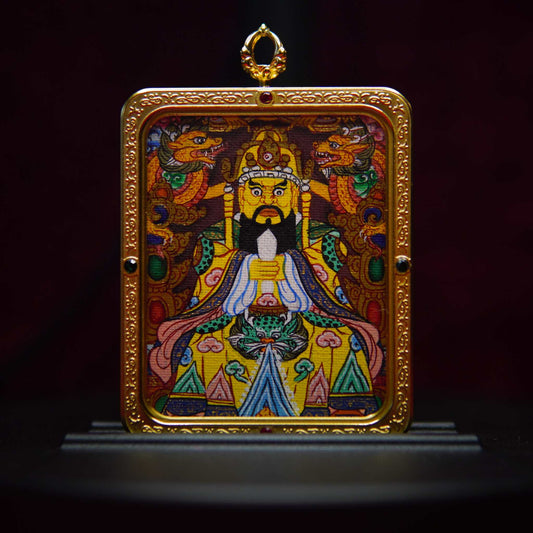
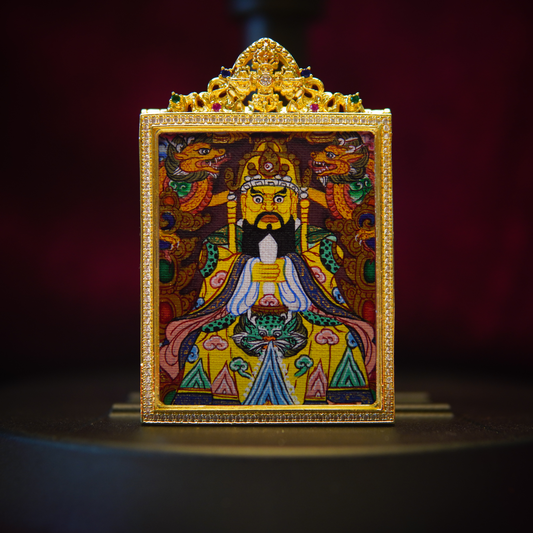
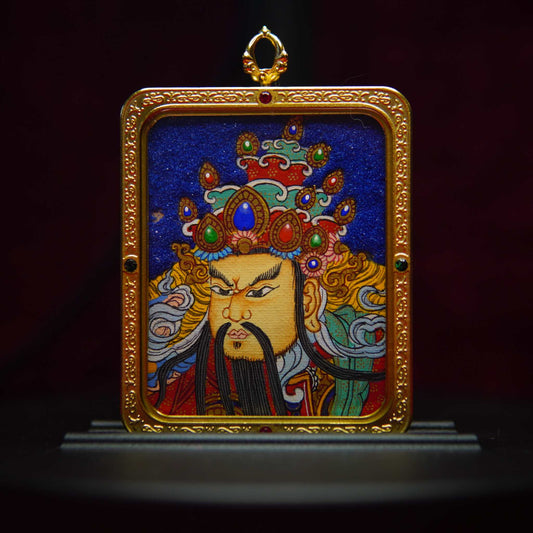
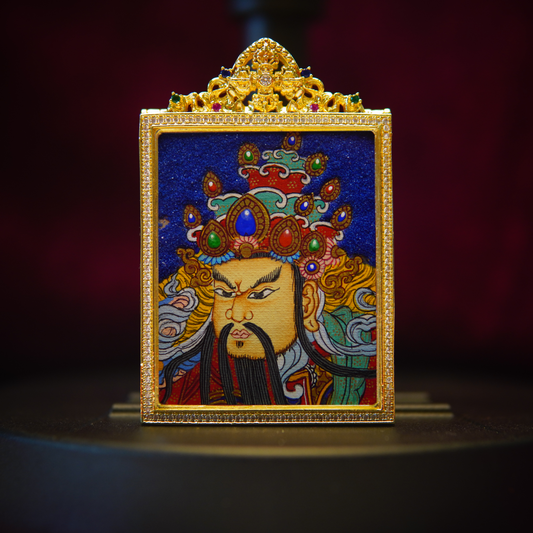
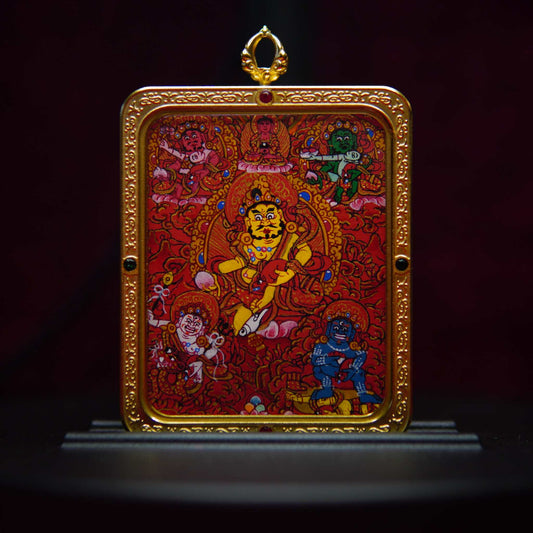
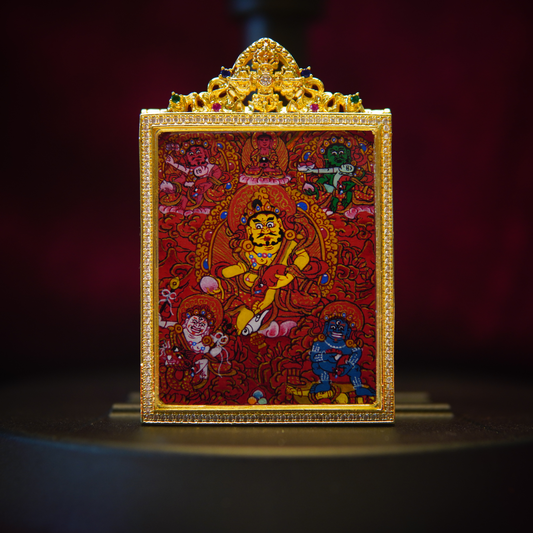
Our hand-painted Red Jambhala Tibetan Thangka pendant emphasizes the vivid red form within richly detailed miniature Buddhist artwork.
For someone drawn specifically to the relationship between prosperity, magnetizing activity and favorable conditions, Red Jambhala offers a distinctive visual and symbolic choice.
For someone more directly drawn to the traditional imagery of wealth, abundance and material support, Yellow Jambhala may resonate differently.
The goal isn't to find the “most powerful” one.
It's to understand what you're choosing.
→ Explore the Hand-Painted Red Jambhala Thangka Pendant
→ Explore the Hand-Painted Yellow Jambhala Thangka Pendant
❓Quick Questions: Red vs Yellow Jambhala
What is the main difference between Red and Yellow Jambhala?
Both are associated with prosperity. Red Jambhala has a particular association with magnetizing activity, while Yellow Jambhala is especially well known for wealth, abundance and material support.
Which Jambhala is better for wealth?
Rather than ranking one as better, it is more accurate to understand their different traditional emphases. Both belong to Jambhala prosperity traditions.
Why are Jambhalas different colors?
Different Jambhala forms have distinct iconography and activities within Tibetan Buddhist traditions. Color is part of that visual and ritual differentiation.