Why Does Vaishravana Carry a Jewel-Spitting Mongoose? The Strange Symbol Behind the Lord of Wealth
chenHenry🐾 Look Closely at Vaishravana's Hand
There is something strange hiding in many images of Vaishravana.
At first glance, you may barely notice it.
A small animal.
Not a lion.
Not a cat.
And not simply a decorative creature placed beside a Buddhist deity.
It's a mongoose.
And in Buddhist wealth iconography, this is no ordinary mongoose.
It is famously associated with jewels and treasure pouring from its mouth.
For a figure known as a deity of wealth, the meaning might seem obvious:
mongoose + jewels = money.
But the story is more interesting than that.
Why a mongoose?
Why jewels?
And why is treasure shown flowing outward rather than being locked away?
Those questions reveal something important about how wealth is represented in Buddhist art.
 💰 Who Is Vaishravana?
Vaishravana (Vaiśravaṇa) is a major Buddhist guardian and wealth-associated deity, especially prominent in Tibetan Buddhist art as a figure connected with prosperity, protection and valuable resources.
In Chinese Buddhist contexts, names and identities associated with Vaiśravaṇa include 毗沙门天 and 多闻天王. In the context of Tibetan Buddhist wealth imagery, Chinese-speaking devotees and sellers may also refer to the wealth-focused form as 财宝天王.
Vaishravana is also connected with the Four Heavenly Kings and the northern direction.
But if you're looking at him specifically as 财宝天王, one thing immediately stands out:
his imagery brings together two ideas that modern people often separate.
Wealth and guardianship.
He doesn't simply represent the existence of treasure.
His commanding appearance also communicates authority and protection.
🐾 What Animal Does Vaishravana Hold?
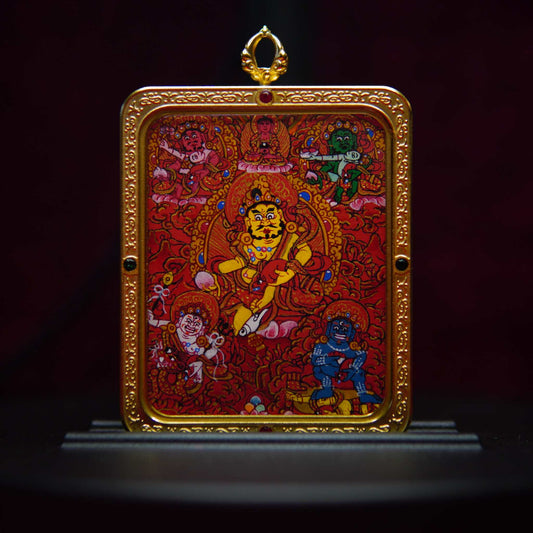
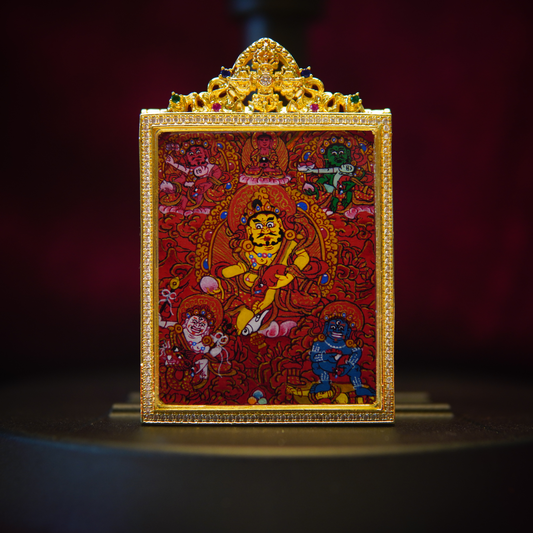
In many Tibetan Buddhist depictions, Vaishravana holds a mongoose associated with treasure and the pouring forth of jewels.
The animal is an important clue.
This matters because Buddhist art is full of attributes that identify particular figures.
A crown alone doesn't tell you enough.
Neither does a golden body.
Nor does simply seeing jewels.
But once you begin recognizing:
the posture,the ritual objects,the mount,the mongoose,and the surrounding composition,
the figure becomes easier to identify.
You stop seeing:
“a Buddhist wealth god.”
You begin seeing:
Vaishravana.
💎 Why Does the Mongoose Spit Out Jewels?
Jewels provide an immediate visual language for treasure and abundance.
A painter doesn't need to write:
“This figure is associated with prosperity.”
Treasure pouring from an animal communicates the idea instantly.
But there is something particularly interesting about the direction of the movement.
The treasure isn't locked in a chest.
It isn't hidden.
It isn't being clutched tightly against the body.
It flows outward.
For a modern viewer, this provides a useful way to think about the difference between simply possessing resources and allowing resources to become beneficial.
Wealth can support:
families,communities,religious practice,charitable activity,education,and people experiencing hardship.
That is where generosity becomes an important part of the conversation.
 🐍 Why a Mongoose?
This is one of the strangest parts of the image.
Why not a dragon?
Why not a lion?
Why not simply a bag of gold?
Mongooses have a long cultural association in South Asia with overcoming snakes, while serpent and nāga imagery can itself intersect with older traditions involving water, treasure and hidden riches.
Over time, the mongoose became an important attribute in South Asian and Buddhist wealth iconography.
But we should be careful here.
It is tempting to invent a perfectly neat explanation such as:
“The mongoose defeated the serpent of poverty and released its treasure.”
That sounds memorable.
It also oversimplifies a much more complex symbolic history.
A safer way to understand the image is this:
The treasure-producing mongoose became an established attribute of wealth-associated figures, including Vaishravana and forms connected with Jambhala.
And that leads to another interesting question.
Why do both appear with it?
🤔 Wait—Doesn't Yellow Jambhala Have a Mongoose Too?
Yes.
And this is where Buddhist wealth iconography becomes especially interesting.
If you've seen Yellow Jambhala, you may already recognize the same strange animal.
That isn't simply coincidence.
Vaishravana and Jambhala are closely related within the broader history and iconography of Buddhist wealth deities.
Their relationship is more complicated than saying:
“They are exactly the same.”
But it is also more complicated than saying:
“They are completely unrelated.”
This is why the mongoose can become a clue not only to wealth symbolism, but also to the historical and iconographic relationship between different Buddhist wealth figures.
We've explored that question separately:
→ Vaishravana vs Jambhala: Are They the Same Buddhist Wealth Deity?
🤲 What Does Generosity Have to Do With a Wealth Deity?
This question matters because otherwise the mongoose becomes little more than a supernatural ATM.
Treasure comes out.
You receive treasure.
End of story.
But Buddhist teachings repeatedly take our relationship with possessions seriously.
Having resources is not automatically the same as greed.
Likewise, having little does not automatically mean someone is free from attachment.
What matters includes how resources are understood and used.
For a modern viewer, the outward-flowing jewels provide a useful visual reminder:
Abundance can move.
Resources can support more than the person holding them.
That makes generosity a natural companion to prosperity.
 🛡️ Why Is Vaishravana Also Associated With Protection?
This is one of the features that makes Vaishravana especially interesting.
He is not represented only through wealth.
His broader Buddhist identity includes guardianship and protection.
That is why his appearance can feel more commanding and warrior-like than someone might expect from a “wealth deity.”
For a modern viewer, the combination can be understood symbolically as:
💰 Having Resources
🛡️ Protecting Beneficial Conditions
This does not mean a pendant guarantees that money will never be lost.
The symbolism is religious, not financial insurance.
But it helps explain why Vaishravana's wealth imagery feels different from a generic symbol of good luck.
🎨 How Can You Recognize Vaishravana in a Thangka?
Look at the whole composition.
Depending on the specific form, you may notice:
👑 Royal Crown & Ornaments — emphasizing authority and status
💰 Treasure Imagery — reflecting prosperity and resources
🐾 Mongoose — an important wealth-related attribute in many depictions
🛡️ Powerful Guardian Appearance — distinguishing him from purely peaceful wealth imagery
🌈 Rich Colors — gold, orange, blue, green and red frequently create a highly detailed composition
🪷 Sacred Surroundings — clouds, animals, lotuses and other imagery vary by painting
The exact attributes can vary between forms.
That is why learning the deity's iconography matters.
🔍 Why This Matters in a Miniature Thangka
In a large monastery painting, a mongoose is easy to paint.
In a pendant only a few centimeters across, it may be tiny.
The same is true for:
facial expression,crown,jewelry,ritual objects,animals,and treasure details.
Understanding iconography changes how you look at miniature art.
Without that knowledge, you may see:
“a colorful wealth deity.”
Once you understand the symbols, you begin checking whether the artist preserved the details that make the figure recognizable.
That makes craftsmanship easier to appreciate.
📿 Vaishravana in Hand-Painted Thangka Art
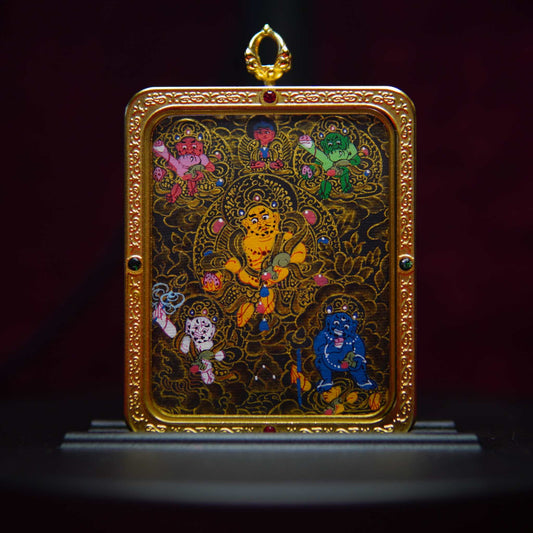
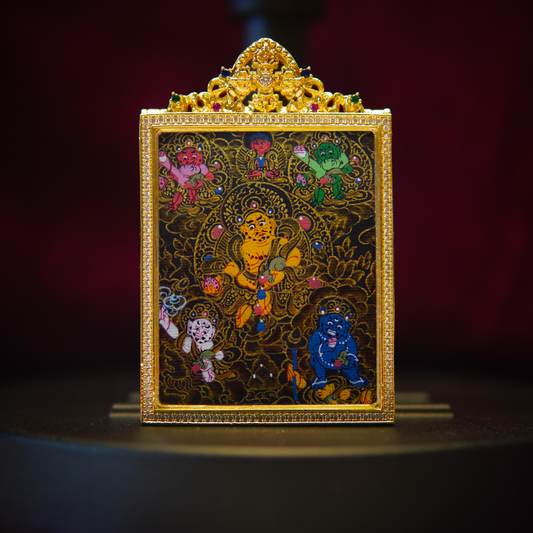
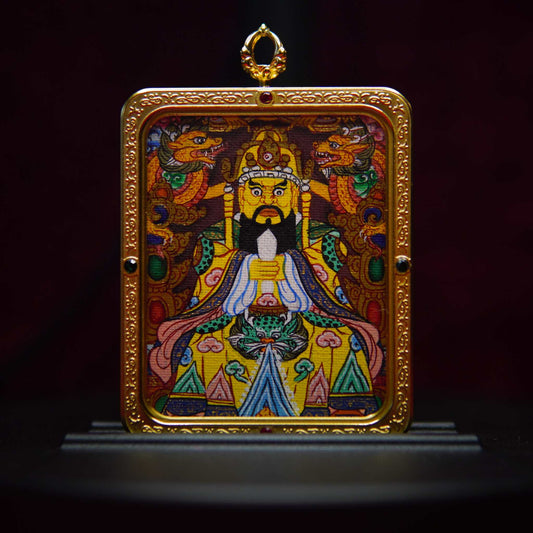
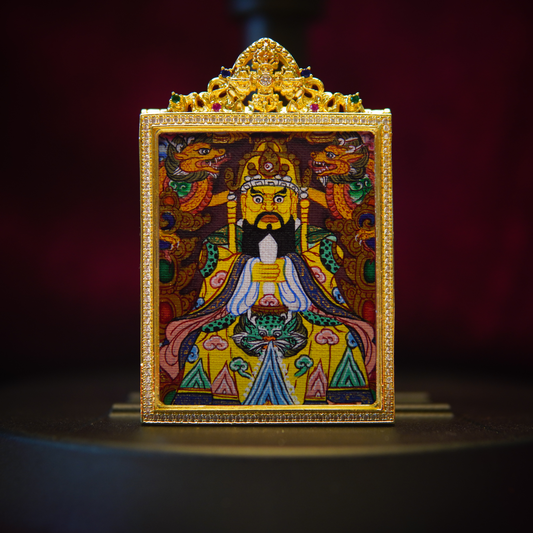
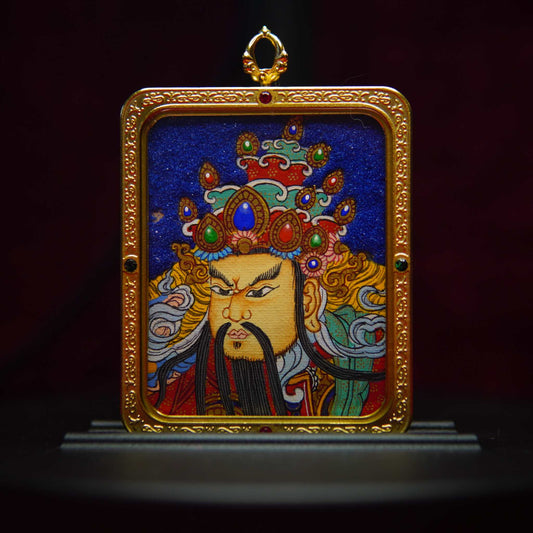
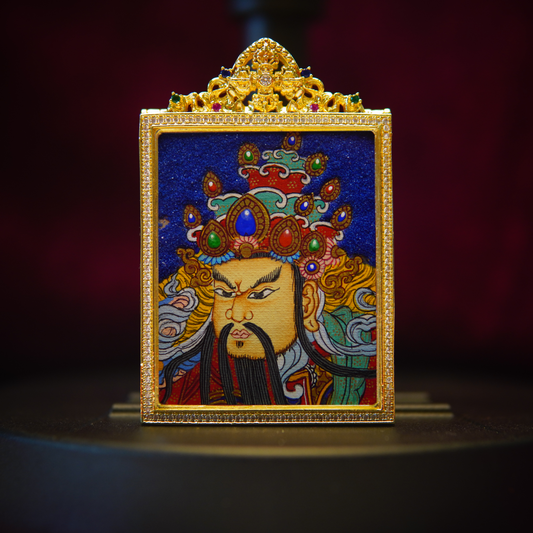
Our hand-painted Vaishravana Tibetan Thangka pendant presents the wealth-associated Buddhist guardian within richly detailed miniature artwork.
Across the available designs, posture, surrounding figures, colors and fine details may vary.
Each piece is individually painted by hand, so subtle differences in expression and linework are part of its handmade character.
For Buddhist practitioners, Vaishravana may carry specific devotional significance.
For others drawn to Buddhist symbolism, his imagery can represent:
💰 Wealth
💎 Abundance
🛡️ Protection
👑 Guardianship
🤲 Generosity
And once you notice the mongoose, it becomes difficult to overlook it again.
→ Explore the Hand-Painted Vaishravana Tibetan Thangka Pendant

❓Quick Questions About Vaishravana's Mongoose
Why does Vaishravana hold a mongoose?
The mongoose is an established attribute in Buddhist wealth iconography and is associated with treasure, abundance and jewels.
Why does the mongoose spit jewels?
The jewel-producing mongoose visually communicates wealth and abundance. It should be understood as Buddhist iconography rather than as a literal animal claim.
Is the mongoose unique to Vaishravana?
No. Mongoose imagery also appears prominently with Jambhala forms, reflecting broader relationships within Buddhist wealth-deity iconography.
Is Vaishravana only a wealth deity?
No. Vaishravana also has an important guardian and protector identity, which is one of the features that makes his symbolism distinctive.
Does carrying a Vaishravana pendant guarantee wealth?
No. A Thangka may carry devotional or symbolic meaning, but it should not be presented as guaranteeing financial outcomes.