Why Is White Tara a Meaningful Longevity Gift for Parents and Loved Ones?
chenHenryShare
🎁 Sometimes What You Want to Give Isn't Really an Object
Some gifts are easy to buy but difficult to make meaningful.
Flowers disappear.
Food is enjoyed and forgotten.
Another household object may eventually become just another household object.
But when you're choosing something for a parent, grandparent or someone you deeply care about, sometimes what you really want to give isn't an object at all.
It's a wish:
May you be well.
May you be peaceful.
May you have many good years ahead.
That is one reason White Tara can carry such powerful meaning as a gift.
In Tibetan Buddhism, White Tara is especially associated with compassion, longevity and long-life practices.
So a White Tara image doesn't need to promise anything supernatural to communicate something deeply personal.
Sometimes the meaning is simply:
I wish you a long and peaceful life.
 🤍 Who Is White Tara?
White Tara is a peaceful form of Tara in Tibetan Buddhism particularly associated with compassion and long-life practices.
She is usually depicted with a serene white body, seated upon a lotus and adorned with sacred jewelry and ornaments.
One detail makes her especially recognizable:
seven eyes.
In addition to the two eyes on her face, White Tara traditionally has an eye on her forehead, one in each palm and one on each sole.
These eyes are associated with extraordinary compassionate awareness.
Combined with her long-life traditions, the image creates an unusually strong visual language of:
seeing, caring and wishing for well-being.
🌿 Why Is White Tara Associated With Longevity?
White Tara has an important place in Tibetan Buddhist long-life practices.
This is why the English word longevity appears so frequently alongside her name.
But longevity should not be understood as a commercial promise that an object will extend someone's lifespan.
Within the religious tradition, White Tara belongs to practices and aspirations concerning long life, well-being and the conditions that support spiritual practice.
That distinction matters.
A White Tara pendant can symbolize a wish for longevity.
It should not be sold as a device that guarantees it.
And for a gift, symbolism is often enough.
👩 Why Give White Tara to a Mother?
A gift for a mother often carries more emotional weight than the object itself.
You may want to express:
gratitude,care,concern for her health,
or simply the wish that she remains part of your life for many years.
White Tara's imagery fits those feelings naturally.
Her association with compassion and longevity allows the gift to say something that ordinary jewelry may not.
For a birthday or Mother's Day, the meaning can be:
Thank you for caring for me. Now this carries my wish for your well-being.
For someone who already has an interest in Buddhism, meditation or Asian sacred art, the connection may feel even more personal.
👨 Is White Tara Also a Meaningful Gift for a Father?
Yes.
White Tara should not be treated as a women-only symbol simply because Tara appears in female form.
Compassion and longevity are not gender-specific.
For a father, grandfather or male elder, the pendant can carry the same intention:
long life, well-being, peace and care.
This is why I would not put Gift for Mom directly into the product title.
The symbolism is broader.
White Tara can be meaningful for anyone you want to wish a long and peaceful life.
👵 What About Grandparents and Elderly Parents?
This is perhaps one of the most natural gifting contexts.
As parents and grandparents grow older, gifts often become harder to choose.
They may already own most things they need.
What becomes more important is meaning.
A White Tara Thangka can acknowledge age without making the gift feel clinical.
It does not say:
“You are getting old.”
It says:
“Your well-being matters to me.”
That makes it suitable for:
birthdays,family celebrations,retirement,Mother's Day,Father's Day,or simply a gift given without an occasion.
 🩺 Is White Tara an Appropriate Gift for Someone Who Is Ill?
It can be, as a symbolic expression of care and a wish for well-being.
But the distinction between symbolism and medical treatment matters.
A White Tara pendant should not be given with a claim such as:
“This will heal your illness.”
That creates an expectation the object cannot responsibly promise.
A much more meaningful message is:
“I chose this because White Tara symbolizes compassion and long life, and I wanted you to know I'm thinking of you.”
That allows the religious symbolism to remain intact without turning sacred art into a medical claim.
💙 White Tara or Medicine Buddha: Which Meaning Fits the Gift?
These two Buddhist figures can both appear in conversations about well-being, so the difference is worth understanding.
White Tara
Especially associated with:
🌿 Longevity
🤍 Compassion
👁️ Compassionate Awareness
🕊️ Peace
Medicine Buddha
Especially associated with:
🌿 Healing Traditions
🪷 Relief from Suffering
💙 Well-Being
🧘 Meditation & Compassion
Neither is “better.”
The symbolism is simply different.
If your gift is primarily meant to express:
“May you have a long and peaceful life,”
White Tara is especially meaningful.
If the intention is more directly centered on Buddhist healing symbolism, Medicine Buddha may resonate differently.
Understanding the distinction makes the gift more personal.
👁️ Why Do White Tara's Seven Eyes Make the Gift More Meaningful?
At first, the eyes may seem unrelated to longevity.
But they add another layer to White Tara's imagery.
Her seven eyes are traditionally located on:
the face,forehead,palms,and soles.
They represent extraordinary awareness and compassionate perception.
For a gift, that creates a beautiful relationship between:
long life and being cared for.
If you haven't noticed all seven before, we've explored them separately:
→ Why Does White Tara Have Seven Eyes? The Meaning Behind Her Most Mysterious Feature
Once you find them, the image becomes much more interesting.
🎁 When Is a White Tara Pendant a Meaningful Gift?
White Tara works particularly well when the occasion is about care rather than celebration alone.
Birthday
A symbolic wish for another year—and many more ahead.
Mother's Day or Father's Day
A way to express gratitude alongside a wish for well-being.
Retirement
A meaningful symbol for entering a new and hopefully peaceful stage of life.
Recovery or a Difficult Period
An expression of support without making medical promises.
Family Milestone
A gift that carries more personal symbolism than ordinary jewelry.
No Occasion at All
Sometimes:
“I saw this and thought of you.”
is enough.
✍️ What Can You Write With a White Tara Gift?
The message doesn't need to sound religious if the recipient isn't Buddhist.
Something simple works better:
I chose White Tara because she symbolizes compassion, longevity and well-being. I hope this carries a simple wish from me to you: a long, peaceful life surrounded by people who love you.
For a Buddhist recipient, the message can be adapted according to their own tradition and practice.
The important part is that the symbolism explains why this particular image was chosen.
That makes the gift feel intentional.
🎨 Why Choose a Hand-Painted White Tara?
The meaning of White Tara is one part of the gift.
The craftsmanship is another.
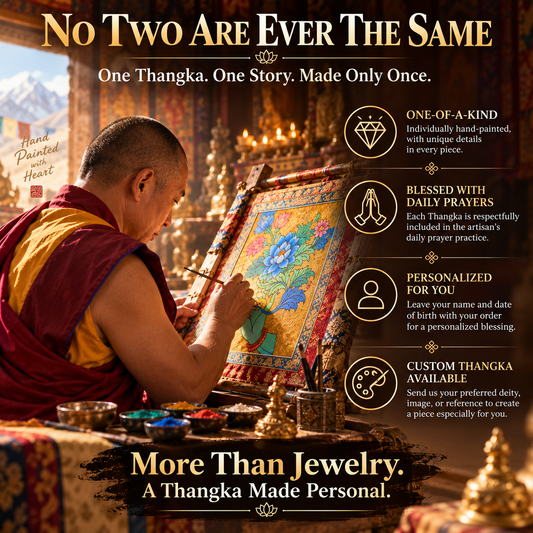
Our hand-painted White Tara Tibetan Thangka pendant places her traditional imagery inside a miniature painting only a few centimeters across.
The white form. Lotus. Halo. Ornaments.
And even the tiny seven-eye details.
Each piece is individually painted by hand, so subtle differences in expression, linework and color make every pendant slightly different.
For a gift centered on someone specific, that individuality matters.
It isn't simply:
another White Tara print.
It is a miniature hand-painted image chosen for a particular person and a particular intention.
📿 A Gift That Says More Than “Good Luck”
“Good luck” is easy to say.
White Tara carries a more specific message.
Not:
May you become rich.
Not:
May nothing difficult ever happen.
But something quieter:
May you have time.
May you have peace.
May you be cared for.
May you enjoy a long life.
For parents, grandparents and loved ones, sometimes that is exactly what we want a gift to say.
→ Explore the Hand-Painted White Tara Tibetan Thangka Pendan

❓Quick Questions About White Tara as a Gift
Why is White Tara associated with longevity?
White Tara holds an important place in Tibetan Buddhist long-life practices and is
Why is White Tara a meaningful gift for parents?
White Tara is traditionally associated with longevity, compassion and long-life practices, making her imagery a natural symbol for expressing wishes for a parent's long and peaceful life.
Is White Tara only suitable as a gift for mothers?
No. White Tara's symbolism of longevity and compassion is not gender-specific. She can be a meaningful gift for mothers, fathers, grandparents, partners, elders or other loved ones.
Can White Tara jewelry extend someone's life?
A White Tara pendant should not be presented as guaranteeing longevity or medical outcomes. Its value is devotional and symbolic—a way to express wishes for long life, well-being and peace.
What do White Tara's seven eyes symbolize?
Her seven eyes are associated with extraordinary compassionate awareness and wisdom. They are one of the most distinctive features of White Tara iconography.