Why Is the Goddess of Wisdom Holding a Musical Instrument?
chenHenry🎵 If Saraswati Is the Goddess of Wisdom, Why Isn't She Holding a Book?
Look at a Saraswati Thangka and you may notice something unexpected.
She is a goddess of knowledge and learning.
Yet one of her most recognizable attributes isn't a book.
It's a musical instrument.
Saraswati is commonly shown holding or playing a veena, a family of traditional Indian stringed instruments closely associated with her iconography.
At first, this seems like an unusual choice.
Books belong to learning.
Instruments belong to music.
But Saraswati comes from a tradition in which knowledge isn't complete when it simply sits inside the mind.
It can become speech.Poetry.Music.Art.
Once you see Saraswati as a goddess of knowledge expressed, the instrument begins to make much more sense.

🪷 Who Is Saraswati?
Saraswati (Sarasvatī) is a goddess associated with knowledge, learning, eloquence, music and the arts.
Her traditions are ancient and extend across several South Asian religions.
She is especially prominent in Hinduism, but also appears within Buddhist traditions. In Tibetan Buddhism she is known as Yangchenma.
Saraswati's imagery can vary depending on the artistic and religious tradition, but the musical instrument is one of her most recognizable attributes.
In Tibetan Thangka art, that instrument may be rendered according to the visual conventions of the painting rather than looking identical to a modern concert instrument.
The important clue is the relationship between Saraswati and music.
🎶 What Instrument Does Saraswati Hold?
Saraswati is traditionally associated with the veena, a family of plucked string instruments with a long history in India.
There isn't just one type of veena, and artistic depictions have changed across regions and periods.
That is why it is better not to judge every historical painting by asking whether the instrument matches a modern model exactly.
In religious art, the instrument serves an iconographic purpose.
It helps identify Saraswati.
And more importantly, it tells us something about what she represents.
🧠 What Does Saraswati's Veena Symbolize?
The veena is naturally connected with music, artistic expression and cultivated skill.
But its meaning becomes more interesting when placed beside Saraswati's association with knowledge.
Playing an instrument requires more than inspiration.
A musician has to learn.
Technique has to be practiced.
Rhythm has to be understood.
The ear has to be trained.
The hands repeat movements until they become natural.
Only then can technical knowledge become expressive freedom.
That relationship makes the veena an unusually appropriate attribute for Saraswati.
It brings together two things that modern culture sometimes separates:
discipline and creativity.
Saraswati represents both the learning required to master something and the ability to transform that knowledge into expression.

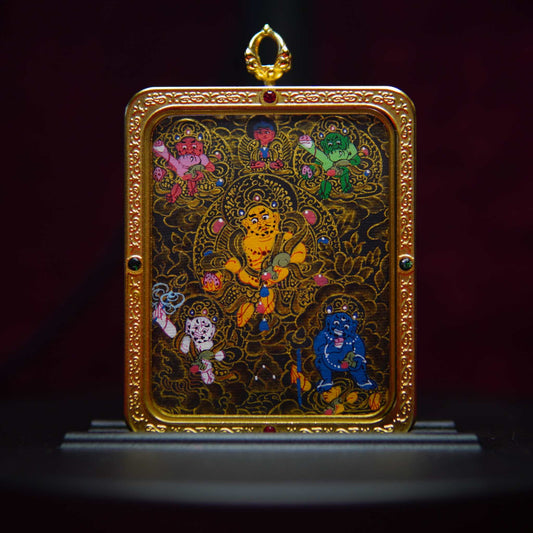
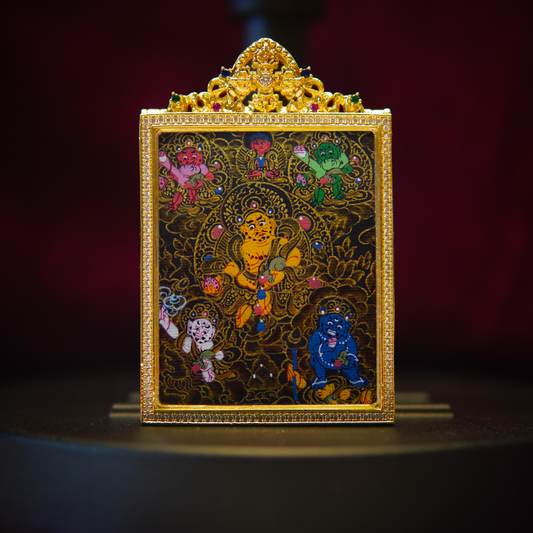
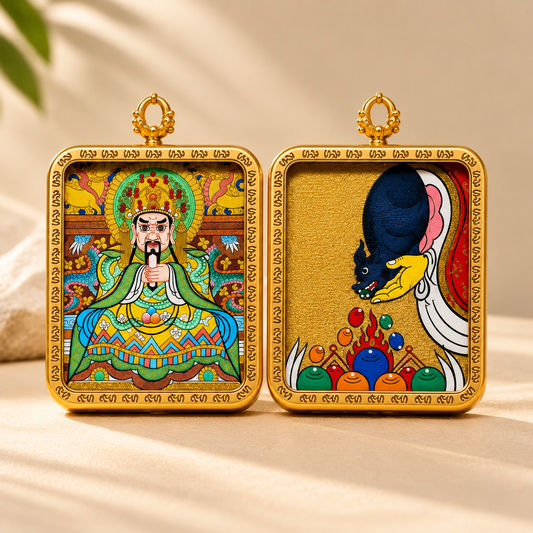
Hand-Painted Tibetan Saraswati Thangka Pendant Necklace
🗣️ What Does Music Have to Do With Speech?
Saraswati isn't only associated with instrumental music.
She is also connected with speech, language, eloquence and poetry.
Music and language may seem different, but both depend on structured sound.
Rhythm matters.
Tone matters.
Timing matters.
A sentence can be technically correct and still fail to move anyone.
A piece of music can contain the right notes and still feel empty.
Expression requires more than correctness.
This helps explain why the same goddess can be meaningful to a musician, poet, writer, teacher or speaker.
All of them are working with the same basic challenge:
How do I give form to what is inside my mind?
Saraswati's domain begins with knowledge but doesn't end there.
🎨 How Can You Recognize Saraswati in a Thangka?
The instrument is the easiest clue.
In Tibetan Buddhist art, Saraswati or Yangchenma is often depicted as a graceful female figure associated with music and learning.
Depending on the particular iconographic form, you may notice:
🎵 A stringed instrument — her strongest connection with music and artistic expression
🪷 Lotus imagery — common throughout Buddhist sacred art
👑 Ornamental crown and jewelry — emphasizing her divine form
✨ Peaceful expression — contrasting with the fierce imagery of wrathful Buddhist deities
🌈 Richly colored robes and halo — especially striking in miniature Thangka painting
Not every Saraswati image will look identical.
Buddhist iconography changes across regions, lineages and artistic traditions.
But if you see a peaceful goddess prominently holding a stringed instrument, Saraswati is one of the figures worth considering.
📚 Why Does Saraswati Matter to Students if She Is Holding an Instrument?
Because her symbolism isn't limited to musicians.
The instrument represents expression, but expression depends on learning.
A student isn't simply collecting facts.
The goal is eventually to understand those facts well enough to:
write about them,
explain them,
apply them,
teach them,
or create something new from them.
This is where Saraswati's seemingly different associations begin to fit together.
Learning feeds expression.
Expression gives learning a life beyond the learner.
That makes her symbolism particularly relevant to students, teachers, writers, researchers and creators—not just musicians.
🎁 When Does a Saraswati Gift Make Sense?
Saraswati's symbolism makes her especially suitable for moments connected with learning or creative growth.
🎓 Graduation
A Saraswati image can mark the transition from one stage of learning to another.
🎵 Music Study
For someone learning an instrument, the veena becomes a natural symbol of disciplined artistic development.
✍️ Writing or Art
Writers and artists may connect with Saraswati's associations with expression and creativity.
📚 Teaching
For a teacher, Saraswati represents something especially appropriate: knowledge that does not remain with one person, but is passed forward.
The point isn't that the image guarantees inspiration or success.
It is that the symbolism fits the occasion.
📿 Saraswati in a Hand-Painted Thangka Pendant
In our hand-painted Saraswati Tibetan Thangka pendant, the musical instrument remains one of the central visual details.
At only a few centimeters in size, the miniature painting brings together Saraswati's peaceful figure, ornate clothing, lotus imagery, halo and musical symbolism within a wearable piece of Buddhist-inspired art.
Because each Thangka is individually painted by hand, subtle variations between pieces are natural.
For someone choosing the pendant for themselves, Saraswati may represent a commitment to learning or creative work.
As a gift, it can carry a more specific message than ordinary jewelry:
knowledge, expression, creativity and the discipline to keep developing them.
→ Explore the Hand-Painted Saraswati Thangka Pendant

❓Quick Questions About Saraswati's Veena
Why does Saraswati hold a veena?
The veena reflects Saraswati's traditional association with music and the arts and complements her broader connection with learning, speech and creative expression.
What does Saraswati's veena symbolize?
It can be understood as a symbol of music, cultivated skill, harmony and artistic expression, particularly when considered alongside Saraswati's role as a goddess of knowledge.
Is Saraswati only associated with musicians?
No. Saraswati is also associated with students, scholars, writers, teachers, poets and others whose work involves knowledge, language or creative expression.
What is Saraswati called in Tibetan Buddhism?
She is known as Yangchenma in Tibetan Buddhism and is associated with learning, music, refined speech and intellectual accomplishment.