Why Does King Pehar Look Completely Different in Different Thangkas?
chenHenry🔍 Search for King Pehar — and Things Get Confusing Fast
Search Google Images for Pehar Gyalpo and something strange happens.
One Thangka may show a white figure.
Another appears red.
Another blue.
The number of arms changes.
The mount changes.
The objects in his hands change.
Even the overall mood of the painting can look different.
So which one is actually King Pehar?
Potentially, all of them.
The reason is that Pehar is not represented through only one fixed appearance.
Tibetan Buddhist iconography traditionally organizes Pehar into five principal forms, often described through the categories of:
Body,Speech,Mind,Qualities,Activities
These are sometimes collectively referred to as the Five Pehar Kings or Five Gyalpos.
Once you know this, the confusing search results begin to make much more sense.

👑 There Isn't Just One Visual Form of Pehar
Western viewers often expect a religious figure to have one recognizable appearance.
Jesus looks like Jesus.
Green Tara has recognizable attributes.
Manjushri has his sword.
But Tibetan Buddhist iconography can be much more complex.
A single deity or protector may have multiple forms depending on:
the ritual tradition,the activity represented,the textual source,the lineage,
or the aspect being emphasized.Pehar is a particularly good example.
His five principal aspects correspond broadly to:
| Pehar Aspect | Association |
|---|---|
| Body | Embodied/form aspect |
| Speech | Speech and expression |
| Mind | Mental or consciousness aspect |
| Qualities | Virtues and qualities |
| Activities | Protective and active functions |
This is why identifying a Pehar Thangka requires more than simply looking at the name.
⚪ The Body Aspect of Pehar
The Body Pehar represents the body or form aspect within the fivefold system.
Traditional iconographic descriptions distinguish this form through specific appearance, attributes, and mount.
As with the other Pehar forms, these details matter because Tibetan Buddhist art works almost like a visual language.
Color is one clue.
The number of faces and arms is another.
The objects held in the hands may provide additional evidence.
The mount can be especially important.
But one clue alone is rarely enough.
A white figure, for example, should not automatically be identified as Body Pehar simply because of color.
The entire iconographic combination needs to be considered.
🔴 The Speech Aspect of Pehar
The Speech Pehar corresponds to the speech aspect.
In Buddhist symbolism, speech is more than ordinary conversation.
Speech can include teaching, mantra, communication, command, and the expression of intention.
This form of Pehar has its own iconographic characteristics, helping distinguish it from the other members of the fivefold group.
Again, the exact identification should be based on a combination of traditional attributes rather than a single visual feature.
For collectors, this is one reason a properly identified Thangka is more valuable than simply labeling every fierce protector image “King Pehar.”
🔵 The Mind Aspect of Pehar
The Mind Pehar represents the mind aspect of the fivefold system.
This is another reminder that the Five Pehar Kings should not simply be understood as five unrelated gods.
They are organized around different aspects within a larger protector framework.
In Tibetan Buddhist iconography, the mind form can have its own color, attributes, posture, and associated imagery.
These distinctions may be obvious to a specialist familiar with protector iconography but almost invisible to a first-time viewer.
That is why two paintings labeled “Pehar” can appear surprisingly different without either necessarily being incorrectly identified.
💎 The Qualities Aspect of Pehar
The Qualities Pehar corresponds to the aspect of qualities or virtues.
Within the fivefold structure, this provides another way of organizing Pehar's functions and iconography.
For someone buying Tibetan Buddhist art, the most important lesson isn't memorizing every attribute immediately.
It is understanding that the differences are intentional.
The artist is not simply improvising a new costume for Pehar.
Traditional Buddhist art often relies on established iconographic systems.
Different colors, objects, mounts, postures, and surrounding figures can indicate which form is being represented.
⚡ The Activities Aspect of Pehar
The Activities Pehar is particularly associated with active or protective function.
This is also one of the Pehar forms frequently encountered in Tibetan art.
Some well-known depictions show a highly wrathful figure with multiple faces and arms and a dynamic mount, reinforcing the sense of powerful protective activity.
This is where many people first encounter Pehar's striking visual language.
But even here, identification should be careful.
Different paintings, artistic traditions, and compositions may emphasize different details.
A product listing should not claim:
“This is definitely Activities Pehar”
simply because the image looks fierce.
Traditional iconography deserves more precision than that.

👁️ How Can You Tell Which Pehar You're Looking At?
When examining a Pehar Thangka, look at the whole composition.
Useful clues include:
Color — What is the dominant body color?
Faces — How many faces are shown?
Arms — How many arms does the figure have?
Implements — What objects are being held?
Mount — Is Pehar riding an animal, and which one?
Posture — Seated, standing, or dynamically riding?
Retinue — Which surrounding figures appear?
These details work together.
This is why identification from a cropped image can be difficult.
It is also why we prefer not to assign a specific Pehar form to a product unless the iconography and source information support that identification.
🎨 What Does This Mean for a Pehar Thangka Collector?
It means that “Pehar Gyalpo” is only the beginning of the question.
Two Pehar paintings can differ dramatically while belonging to the same broader protector tradition.
For someone collecting Tibetan Buddhist art, this makes Pehar especially interesting.
You aren't simply looking at different artistic interpretations of one portrait.
You may be looking at different aspects of the protector himself.
That gives collectors a reason to pay attention to details that might otherwise seem decorative.
A mount isn't necessarily just an animal.
A color isn't necessarily just an aesthetic choice.
An extra face or arm may change the identification of the entire image.
🛡️ Why Does Pehar Need Five Forms?
The fivefold structure reflects a broader Buddhist way of organizing different dimensions of enlightened or sacred activity through categories such as body, speech, mind, qualities, and activities.
In Pehar's protector tradition, these categories become expressed through distinct forms.
That allows one protector complex to communicate different aspects and functions visually.
For a beginner, the important takeaway is simple:
King Pehar is not supposed to look identical in every Thangka.
The variation is part of the tradition.
📿 Pehar Gyalpo in Miniature Thangka Art
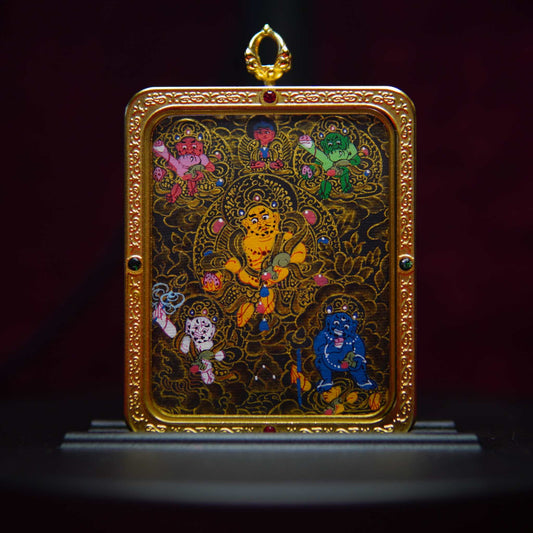
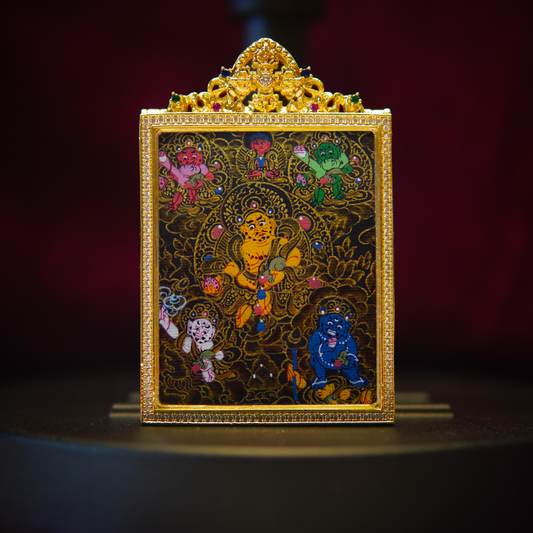
Our hand-painted Pehar Gyalpo Thangka pendant presents King Pehar in a dynamic wrathful scene surrounded by guardian figures, animals, clouds, and richly layered detail.
Because the specific iconographic form should be identified carefully, we describe the piece simply as Pehar Gyalpo / King Pehar unless stronger source information confirms a particular one of the Five Pehar forms.
That may sound less dramatic than making a confident claim.
But with traditional Buddhist art, accuracy matters.
Each pendant is individually painted by hand, allowing the complex protector imagery to be carried in a miniature format.
→ Explore the Hand-Painted Pehar Gyalpo (King Pehar) Thangka Pendant

New to King Pehar entirely?
Start with the stranger part of his story:
→ He Was Subdued by Guru Rinpoche — So How Did King Pehar Become a Buddhist Protector?
❓Quick Questions About the Five Pehar Kings
Why does Pehar Gyalpo look different in different Thangkas?
Because Pehar is traditionally represented through multiple forms, including a fivefold system associated with body, speech, mind, qualities, and activities. Different forms have different iconographic characteristics.
Are the Five Pehar Kings five completely separate deities?
They are better understood as a fivefold protector complex or different aspects associated with Pehar rather than simply five unrelated figures sharing the same name.
Can you identify a Pehar form by color alone?
Usually not reliably. Color can be an important clue, but faces, arms, implements, mount, posture, and surrounding figures should also be considered.
Is every fierce Tibetan protector King Pehar?
No. Tibetan Buddhist art contains many wrathful protectors and deities. Identification should be based on iconography rather than fierce appearance alone.