He Was Subdued by Guru Rinpoche — So How Did King Pehar Become a Buddhist Protector?
chenHenry👑 Not Every Buddhist Protector Began as a Buddhist Protector
Pehar Gyalpo has one of the stranger stories in Tibetan Buddhist tradition.
Today, King Pehar is known as an important worldly protector.
But according to Tibetan religious tradition, his relationship with Buddhism did not begin that way.
The story instead leads back to Guru Rinpoche — Padmasambhava, the great tantric master remembered for helping establish Vajrayana Buddhism in Tibet.
Traditional accounts describe Pehar as a powerful worldly deity who was subdued and bound by oath.
But instead of simply disappearing from the story, something much more interesting happened:
Pehar became a protector of the Buddhist teachings.
An obstructive force became a guardian.
So who exactly is King Pehar, and why would Tibetan Buddhism transform a powerful worldly deity into one of its protectors?

🛡️ Who Is Pehar Gyalpo?
Pehar Gyalpo, commonly known as King Pehar, is an important worldly protector in Tibetan Buddhist tradition.
The Tibetan word gyalpo means “king,” which is why the English name King Pehar is commonly used.
Pehar became especially important within the Tibetan Buddhist protector tradition and is historically associated with Samye Monastery, Tibet's first Buddhist monastery.
He later became connected with the Nechung Oracle, one of the best-known institutional oracle traditions in Tibet.
Pehar is therefore not simply a decorative wrathful figure from Tibetan art.
He occupies a specific place within Tibetan Buddhist religious history and protector traditions.
But there is an important distinction:
Pehar is not a Buddha.
And he is not simply another bodhisattva.
He belongs to the category usually described in English as a worldly protector.
🪷 What Is a “Worldly Protector”?
This phrase can be confusing if you're new to Tibetan Buddhism.
Tibetan Buddhist art includes many kinds of figures:
Buddhas.
Bodhisattvas.
Tantric deities.
Enlightened protectors.
Worldly protectors.
They should not all be treated as interchangeable.
A worldly protector is a powerful being understood within Buddhist tradition as having been bound to protect the Dharma, Buddhist institutions, practitioners, or particular places.
Pehar is one of the most famous examples.
This is why simply describing every figure on a Thangka as a “Buddha” creates problems.
The differences are part of what makes Tibetan Buddhist iconography so interesting.
And in Pehar's case, his identity as a worldly protector is central to his story.

⚡ What Does Guru Rinpoche Have to Do With Pehar?
According to Tibetan Buddhist tradition, Padmasambhava subdued Pehar and bound him by oath to protect Buddhism.
This belongs to a broader group of religious narratives surrounding Guru Rinpoche's activities in Tibet.
Traditional biographies frequently describe Padmasambhava confronting local gods, spirits, and other powerful beings that resisted or obstructed the establishment of Buddhism.
But the stories often do not end with destruction.
Instead, some of these beings are oath-bound.
Their power remains—but their role changes.
They become protectors.
Pehar is one of the best-known examples of this pattern.
It is important to understand these accounts as Buddhist religious tradition and sacred narrative, rather than treating every detail as modern historical biography.
But within that tradition, the meaning is powerful:
the force that once obstructed the Dharma becomes responsible for guarding it.
🔥 Why Turn an Obstacle Into a Protector?
This may be the most interesting part of the story.
The obvious solution to an obstacle seems to be:
Destroy it.
But Pehar's story follows another pattern:
Transform its role.
The power itself does not necessarily disappear.
Its direction changes.
This idea appears repeatedly in Tibetan Buddhist narratives surrounding oath-bound protectors.
A potentially dangerous force becomes a guardian once brought into a Buddhist framework and bound by commitment.
That helps explain why protector imagery can look so fierce.
The figure has not become gentle simply because the role has changed.
The same intensity is now directed toward guardianship and protection.
👹 Why Does King Pehar Look So Fierce?
Look at a Pehar Thangka and there is very little about the image that feels passive.
The central figure may appear with:
multiple arms,
wrathful expressions,
ritual implements,
dynamic movement,
animals or mounts,
surrounding guardian figures,
and richly layered clouds or flames.
The exact iconography varies because Pehar has several principal forms.
That means not every Pehar painting looks the same.
But the fierce visual language is appropriate to his role as a protector.
Wrathful imagery in Tibetan Buddhist art does not automatically mean:
evil.
Nor does it simply mean:
angry.
It communicates powerful activity.
For Pehar, that activity is connected with his role as a guardian.
🏔️ Why Is Pehar Connected With Samye and Nechung?
Pehar's history in Tibet became closely associated with important Buddhist institutions.
Traditional accounts connect him with Samye Monastery, the first Buddhist monastery established in Tibet.
Later, Pehar became associated with Nechung, and the Nechung Oracle developed into one of Tibet's most important state oracle institutions.
The relationship between Pehar and the oracle tradition is complex, particularly because Dorje Drakden, associated with Pehar's retinue, is often discussed in connection with the deity communicating through the Nechung Oracle.
For a general audience, the important point is simpler:
Pehar's role moved far beyond a local legend.
He became connected with major Tibetan Buddhist institutions and protector practices.
📿 Why Carry a Pehar Gyalpo Thangka?
For Buddhist practitioners, Pehar belongs to specific protector traditions and should be approached with respect for that religious context.
For someone encountering Pehar through Tibetan Buddhist art, his story also makes the imagery unusually meaningful.
The themes are clear:
🛡️ Guardianship
⚡ Protective Strength
🔥 Confronting Obstacles
🏔️ Vigilance and Duty
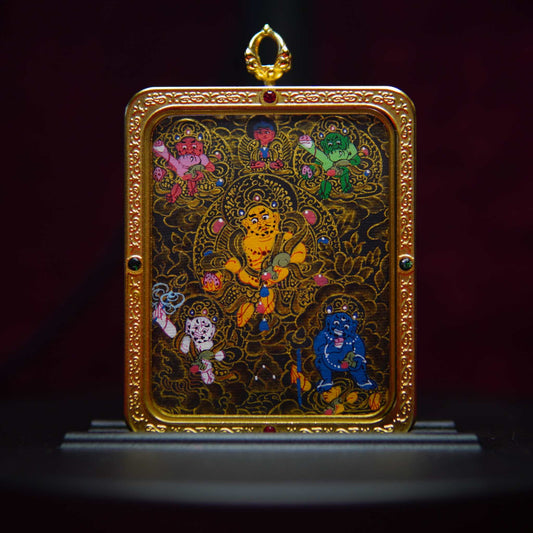
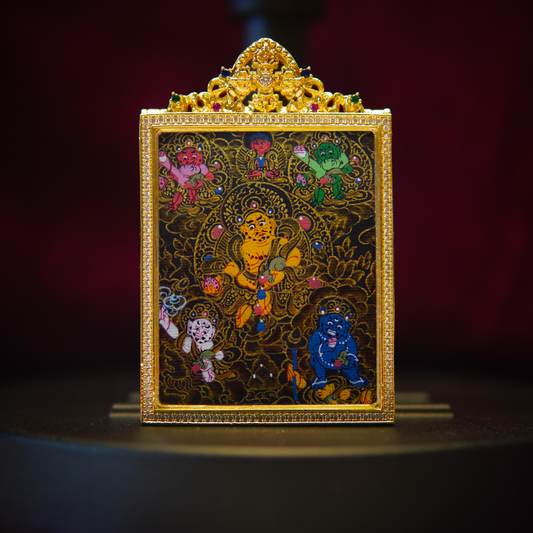
Our hand-painted Pehar Gyalpo Thangka pendant presents King Pehar within a dense miniature composition filled with wrathful movement, guardian figures, animals, and vivid Tibetan Buddhist imagery.
Each piece is painted individually by hand, so subtle differences in linework and color are natural.
→ Explore the Hand-Painted Pehar Gyalpo (King Pehar) Thangka Pendant

And if you've searched for Pehar online and wondered why every painting seems to show a different figure, there is a reason:
→ Why Does King Pehar Look Completely Different in Different Thangkas?
❓Quick Questions About Pehar Gyalpo
Who is Pehar Gyalpo?
Pehar Gyalpo, or King Pehar, is an important worldly protector in Tibetan Buddhist tradition, historically associated with protector traditions surrounding Samye and later Nechung.
Is Pehar a Buddha?
No. Pehar is generally classified as a worldly protector rather than a Buddha or bodhisattva.
What is the connection between Pehar and Guru Rinpoche?
According to Tibetan Buddhist tradition, Guru Rinpoche (Padmasambhava) subdued Pehar and bound him by oath to protect the Buddhist teachings.
Why does Pehar look wrathful?
His fierce imagery reflects the visual language of Tibetan Buddhist protector art and communicates powerful protective activity rather than simply ordinary anger.