Is Guru Dragpo Angry? What “Wrath” Really Means in Tibetan Buddhism
chenHenry👹 He Looks Angry. So Is He?
There is no point pretending Guru Dragpo looks peaceful.
He doesn't.
His eyes are fierce. Flames fill the composition. His posture is powerful, and the entire image is designed to feel intimidating.
For someone seeing Tibetan Buddhist wrathful art for the first time, the conclusion seems obvious:
This deity must be angry.
And from there, another assumption often follows:
If he looks frightening, is he dangerous—or even evil?
This is where Western viewers can easily misread Tibetan Buddhist art.
In this context, wrathful appearance does not necessarily mean ordinary emotional anger.
It belongs to a religious visual language in which fierce forms can represent forceful enlightened activity, particularly in relation to obstacles and harmful conditions.
Guru Dragpo is a particularly striking example.

🔥 What Does “Wrathful” Mean in Tibetan Buddhism?
Buddhist art doesn't communicate every kind of enlightened activity through the same peaceful face.
Some figures smile.
Some meditate.
Some appear compassionate and serene.
Others are surrounded by fire.
The English word “wrathful” can be misleading because it immediately makes us think of rage—someone losing control.
That isn't the most useful way to understand wrathful Buddhist imagery.
A wrathful form can instead communicate intensity, immediacy and uncompromising activity.
Something needs to be confronted.
An obstacle needs to be subdued.
A harmful condition cannot simply be ignored.
The image becomes fierce because the activity being represented is fierce.
❤️ Can Something Fierce Still Be Compassionate?
This is one of the most interesting ideas behind wrathful Buddhist imagery.
We often assume compassion must look gentle.
Usually, it does.
But not always.
Imagine pulling someone suddenly away from danger.
The movement may be forceful.
Your voice may become loud.
The moment may not look peaceful at all.
Yet the motivation can still be protection.
This is only an analogy, not a definition of Buddhist doctrine, but it helps explain why fierce appearance and compassionate intention are not automatically opposites.
In Vajrayana Buddhist imagery, wrathful activity can be understood as directed against ignorance, obstacles and harmful forces—not as uncontrolled rage for its own sake.
This is why looking frightening does not make Guru Dragpo an “evil version” of Guru Rinpoche.
👁️ Why Do Wrathful Deities Have Flames, Fangs and Weapons?
Because visual art has to communicate without paragraphs of explanation.
A peaceful seated figure immediately suggests stillness.
A wrathful figure has to communicate something different.
So the visual vocabulary changes.
🔥 Flames create a sense of transformative and intense activity.
👁️ Fierce eyes and expressions communicate alertness and uncompromising force.
⚔️ Weapons and ritual implements can symbolize activities directed toward cutting through, subduing or overcoming obstacles.
⚡ Dynamic posture tells us the figure is not passive.
This doesn't mean every weapon in every Thangka has one simple universal definition.
Wrathful iconography is highly specific, and forms vary between traditions.
But taken together, these visual elements tell the viewer:
something is being actively confronted.
🛡️ Is Guru Dragpo About Protection or Aggression?
Guru Dragpo is traditionally associated with protective and obstacle-subduing activity; his imagery should not simply be understood as celebrating aggression.
This distinction matters.
Modern marketing sometimes takes wrathful Buddhist figures and turns them into something like:
“Wear this powerful deity and destroy your enemies.”
That may sound dramatic, but it strips away much of the religious context.
Protection in Buddhist traditions can involve confronting obstacles to practice or harmful conditions.
The wrathful appearance communicates the force of that activity.
It isn't an excuse to turn Buddhist imagery into a symbol of personal hostility.
For someone wearing Guru Dragpo imagery today, that distinction can make the symbolism much more meaningful.
🪷 Why Does Guru Rinpoche Need Both Peaceful and Wrathful Forms?
Different forms allow Buddhist art to communicate different kinds of activity.
The familiar image of Guru Rinpoche / Padmasambhava emphasizes the great tantric master.
Guru Dragpo emphasizes a wrathful dimension.
One image may naturally draw attention toward:
wisdom,
teaching,
spiritual mastery.
The other toward:
protection,
determination,
forceful activity,
overcoming obstacles.
This doesn't require imagining two different personalities.
They belong to the broader religious understanding of Padmasambhava and the many ways his enlightened activity is represented.
If you're unfamiliar with that relationship:
→ Read: Why Does the Peaceful Guru Rinpoche Have a Terrifying Wrathful Form?

⚡ Why Would Someone Choose a Wrathful Figure?
Not everyone is drawn to wrathful Buddhist art.
Some people naturally connect more with the compassion of Green Tara.
Others with Saraswati's learning and creativity.
Others with Shakyamuni Buddha's meditative presence.
Guru Dragpo offers a very different visual experience.
His imagery may resonate particularly during periods when the central issue is not calmness, but resolve.
A difficult project.
A major life transition.
A demanding discipline.
An obstacle that has been avoided for too long.
Again, this does not mean Guru Dragpo is a magical device for removing every difficulty.
But Buddhist imagery can function as a reminder of particular qualities.
In Guru Dragpo's case, those qualities are difficult to miss.
🔥 Is Wrath Always Something Negative?
In everyday life, uncontrolled anger often causes harm.
Nothing about wrathful Buddhist imagery changes that.
The interesting distinction is between anger as an uncontrolled emotion and wrath as a symbolic mode of enlightened activity within Vajrayana iconography.
They aren't interchangeable.
This is also why the phrase:
“Guru Dragpo is the angry Guru Rinpoche”
is technically convenient but conceptually weak.
“Wrathful Guru Rinpoche” is better.
It points toward a religious category rather than simply describing someone's mood.
That small language choice makes a big difference in understanding the artwork.
🎨 Reading a Guru Dragpo Thangka Differently
Once you understand wrathful imagery, the painting changes.
The flames no longer simply mean:
“scary.”
The fierce expression no longer automatically means:
“evil.”
The dynamic body and ritual imagery no longer look like random visual chaos.
They become part of a deliberate iconographic language designed to communicate force, protection and obstacle-subduing activity.
That is especially interesting in miniature Thangka painting.
A large amount of religious imagery has to be compressed into only a few centimeters.
The viewer is invited to look closely.
And the closer you look, the less simple the first impression becomes.
📿 Guru Dragpo in a Hand-Painted Thangka Pendant
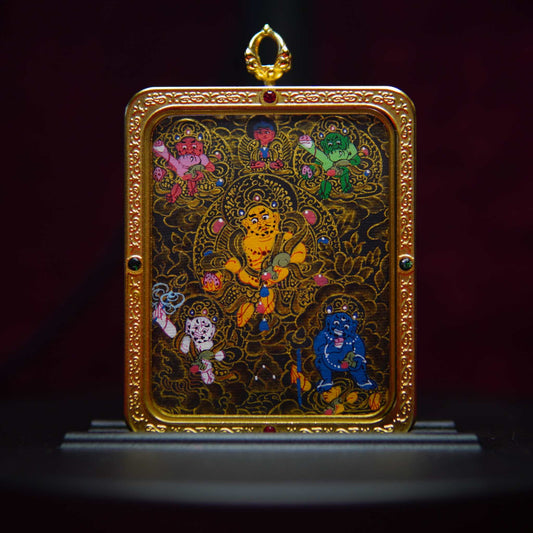
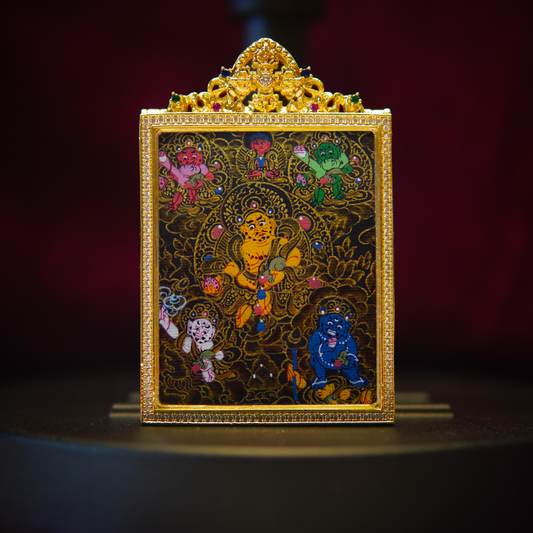
Our hand-painted Guru Dragpo Thangka pendant depicts this wrathful form in miniature, surrounded by the vivid colors and dynamic imagery characteristic of the composition.
Each piece is individually painted by hand and enclosed in a gold-plated copper case.
For practitioners, Guru Dragpo may carry specific religious significance connected with tradition and practice.
For others approaching the image through Tibetan Buddhist art, it can represent a more accessible set of themes:
protection, strength, determination and the courage to confront obstacles.
Not anger for anger's sake.
Not aggression.
But a visual language built around the idea that some obstacles require more than passive attention.
→ Explore the Hand-Painted Guru Dragpo (Wrathful Guru Rinpoche) Thangka Pendant

❓Quick Questions About Wrathful Buddhist Deities
Is Guru Dragpo angry?
Not in the ordinary sense of uncontrolled emotional anger. Guru Dragpo is a wrathful manifestation associated with Guru Rinpoche, and the fierce appearance represents a particular mode of enlightened activity in Tibetan Buddhist tradition.
Are wrathful Buddhist deities evil?
No. Fierce appearance should not automatically be interpreted as evil. Wrathful Buddhist imagery can represent protective, transformative and obstacle-subduing activity.
Why do Tibetan Buddhist deities look scary?
Fierce expressions, flames, weapons and dynamic postures form part of a visual language used to communicate powerful activity rather than peaceful contemplation.
What does Guru Dragpo symbolize?
Guru Dragpo is particularly associated with protection, strength, determination and overcoming or subduing obstacles.