Why Does the Peaceful Guru Rinpoche Have a Terrifying Wrathful Form?
chenHenry🔥 Wait — Is This Really Guru Rinpoche?
Look at two Thangkas of Guru Rinpoche side by side.
In one, Padmasambhava sits calmly, richly dressed and composed. His expression carries the authority of a great tantric master.
Then look at Guru Dragpo.
The atmosphere changes completely.
Flames surround the figure. His expression is fierce. His body appears charged with movement and power. Everything about the image feels more intense.
They can look like two completely different beings.
But the relationship between them is exactly what makes Guru Dragpo so fascinating.
Guru Dragpo (also spelled Guru Drakpo) is a wrathful manifestation associated with Guru Rinpoche — Padmasambhava.
So why would one of Tibetan Buddhism's most revered masters need such a terrifying form?

🪷 Who Is Guru Dragpo?
Guru Dragpo is a wrathful manifestation of Guru Rinpoche found within Tibetan Buddhist traditions.
The name may also appear as Guru Drakpo, depending on the transliteration.
To understand him, it helps to first understand Guru Rinpoche.
Padmasambhava, known throughout the Himalayan Buddhist world as Guru Rinpoche (“Precious Master”), occupies an extraordinary place in Tibetan Buddhism, particularly within the Nyingma tradition.
He is remembered not only as a tantric teacher, but also through traditions describing his ability to confront and subdue forces obstructing the Dharma.
Guru Dragpo presents this aspect in an explicitly wrathful form.
This doesn't mean that the peaceful Guru Rinpoche somehow “turns evil.”
The change in appearance communicates a different kind of activity.
👹 Why Does Guru Rinpoche Have a Wrathful Form?
Buddhist sacred art contains both peaceful and wrathful forms.
Peaceful imagery may communicate compassion, meditation, wisdom or serenity.
Wrathful imagery uses a very different visual vocabulary.
Fire.
Fierce expressions.
Dynamic movement.
Weapons and ritual implements.
Powerful postures.
These forms can represent forceful enlightened activity directed toward obstacles and harmful conditions.
Guru Dragpo belongs to this world.
His appearance isn't simply saying:
“Guru Rinpoche is angry.”
Instead, the wrathful form emphasizes the forceful aspect of overcoming what stands in the way.
That is why understanding Guru Dragpo requires looking beyond the face.
🔥 Why All the Flames and Fierce Imagery?
Imagine removing the flames from a Guru Dragpo Thangka.
Softening the expression.
Removing the dynamic movement.
The entire meaning of the image would change.
Wrathful Buddhist iconography is intentionally dramatic.
The flames create a visual atmosphere of transformation and intense activity. Fierce facial features make it immediately clear that this is not a passive form.
Ritual implements and powerful bodily gestures add to the sense that something is actively being confronted.
The exact iconography can vary between forms and traditions, so it is risky to assign a universal meaning to every tiny object in every Guru Dragpo painting.
But the larger visual message is clear:
This is Buddhist imagery in action.
🛡️ What Is Guru Dragpo Associated With?
Guru Dragpo traditions are particularly associated with protective and obstacle-subduing activity.
That is why modern descriptions of Guru Dragpo often use words such as:
🛡️ Protection
🔥 Overcoming Obstacles
⚡ Strength & Determination
💎 Transformation
These ideas need a little context.
“Protection” doesn't mean that a Guru Dragpo image should be sold as a guarantee that nothing bad can happen.
And “overcoming obstacles” doesn't mean wearing a pendant automatically removes every difficulty from life.
For Buddhist practitioners, Guru Dragpo belongs to specific religious traditions and practices.
For someone approaching the figure through Buddhist art, however, the imagery can also serve as a powerful symbol of facing rather than avoiding difficulty.

⚡ Why Not Just Choose Peaceful Guru Rinpoche?
This is where the choice becomes interesting.
A peaceful image of Guru Rinpoche and a wrathful image of Guru Dragpo don't necessarily compete with each other.
They emphasize different dimensions.
Someone may feel drawn to the traditional Guru Rinpoche image because of its associations with:
wisdom,
Vajrayana teaching,
spiritual mastery,
and the establishment of Buddhism in Tibet.
Guru Dragpo, by contrast, may resonate more strongly with themes of:
determination,
protection,
confronting obstacles,
and forceful transformation.
The question isn't:
“Which one is more powerful?”
A better question is:
“Which symbolism speaks more clearly to what I am facing?”
🏔️ Is Guru Dragpo the Same as Padmasambhava?
The relationship is better understood as manifestation rather than a separate historical person.
Padmasambhava is the great tantric master known as Guru Rinpoche.
Guru Dragpo is a wrathful form associated with him in Tibetan Buddhist tradition.
Padmasambhava = Guru Rinpoche
Guru Dragpo / Guru Drakpo = Wrathful Guru Rinpoche
Once you know that relationship, a Guru Dragpo Thangka becomes much easier to read.
The terrifying figure isn't disconnected from Guru Rinpoche.
The wrathful appearance is part of the story.
📿 Why Carry a Guru Dragpo Thangka?
Guru Dragpo's imagery is unusually intense for something as small as a pendant.
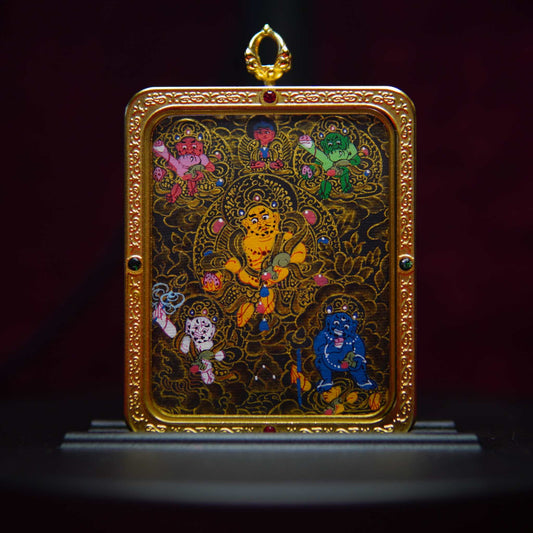
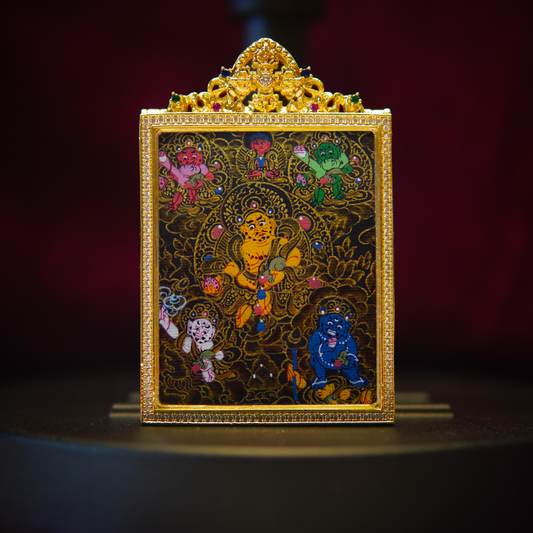
Our hand-painted Guru Dragpo Tibetan Thangka pendant compresses the flames, fierce expression, ritual imagery and dynamic composition into a miniature artwork only a few centimeters across.
Each piece is individually painted by hand, so subtle variations in color, linework and detail naturally occur.
For Buddhist practitioners, Guru Dragpo may carry specific devotional significance.
For others drawn to Tibetan Buddhist art, the pendant can represent the themes most immediately associated with his wrathful imagery:
protection, determination, strength and overcoming obstacles.
It may be particularly meaningful during a difficult transition, a demanding period of life, or a moment when avoiding the problem is no longer an option.
→ Explore the Hand-Painted Guru Dragpo Thangka Pendant

But one question remains:
If Guru Dragpo looks angry, does Buddhist “wrath” actually mean anger?
→ Read: Is Guru Dragpo Angry? What Wrath Really Means in Tibetan Buddhism
❓Quick Questions About Guru Dragpo
Who is Guru Dragpo?
Guru Dragpo (Guru Drakpo) is a wrathful manifestation associated with Guru Rinpoche, or Padmasambhava, in Tibetan Buddhist tradition.
Is Guru Dragpo the same as Guru Rinpoche?
Guru Dragpo is understood as a wrathful manifestation of Guru Rinpoche rather than an unrelated historical teacher.
What does Guru Dragpo represent?
Guru Dragpo is particularly associated with protective activity, strength, determination and the subjugation or overcoming of obstacles.
Why does Guru Dragpo look terrifying?
His fierce appearance belongs to the visual language of wrathful Tibetan Buddhist imagery, which can represent powerful enlightened activity rather than ordinary anger or evil.