Why Is Ragaraja, a Wrathful Buddhist Deity, Associated With Love?
chenHenry❤️ He Doesn't Look Like a Deity of Love
If someone showed you an image of Ragaraja without telling you who he was, “love” probably wouldn't be your first guess.
His body is red.
His expression is fierce.
Flames surround him.
Multiple arms hold ritual implements, and the entire composition has the intensity of a wrathful Buddhist protector.
Yet Ragaraja—known especially in Japanese Esoteric Buddhism as Aizen Myōō—became closely associated with desire, attraction, affection and relationships.
That sounds almost contradictory.
Why would a figure connected with love look so fierce?
The answer begins with something deeper than romance.
Ragaraja is not simply about finding love.
His imagery is connected with the transformation of desire and passion.
And that changes the way the entire image should be understood.

🔥 Who Is Ragaraja?
Ragaraja (Rāgarāja), widely known as Aizen Myōō in Japanese Esoteric Buddhism, is a wrathful Buddhist deity associated with desire, passion and their transformation on the Buddhist path.
The Sanskrit word rāga can refer to passion, desire or attachment.
This is important because those emotions are not hidden in Ragaraja's imagery.
They are almost impossible to miss.
His intense red body and wrathful appearance make him visually different from peaceful figures such as White Tara or Saraswati.
Ragaraja doesn't look detached from powerful emotion.
He looks immersed in its energy.
But this does not mean his message is simply:
Follow every desire you have.
The religious idea is more sophisticated.
Powerful emotion itself becomes something to be worked with and transformed.
❤️ Why Is Ragaraja Associated With Love?
Over time, Ragaraja became associated in popular devotional culture with love, attraction, affection, harmonious relationships and interpersonal connection.
It isn't difficult to see why.
Romantic relationships are among the most emotionally intense parts of human life.
They involve:
desire,
attraction,
affection,
attachment,
longing,
jealousy,
and vulnerability.
Ragaraja's religious symbolism already deals with powerful emotional and desirous energy, making the later connection with relationships understandable.
But calling him simply:
“the Buddhist god of love”
loses an important part of the story.
Ragaraja isn't best understood as a Buddhist Cupid who shoots an arrow and makes someone fall in love with you.
His imagery asks a more interesting question:
What happens to desire when it is transformed rather than blindly followed?
🔴 Why Is Ragaraja Red?
Color matters in Buddhist art.
Ragaraja's intense red body immediately separates him visually from many peaceful Buddhist figures.
Red naturally evokes heat, passion and intensity, making it particularly suited to a deity associated with desire.
But it would be too simplistic to say:
Red = romance.
The color works within a larger wrathful composition.
Ragaraja is not painted as a gentle red Valentine's Day figure.
His red form appears with flames, fierce features and tantric attributes.
The overall effect communicates powerful emotional energy, not sentimental romance.
That distinction is important.
The red tells us something about intensity.
The Buddhist context tells us what happens to that intensity.
👹 Why Does a Deity Associated With Love Look So Angry?
Because wrathful Buddhist imagery doesn't necessarily represent ordinary anger.
This is one of the easiest things to misunderstand when encountering Esoteric Buddhist art for the first time.
A fierce expression can represent forceful transformative activity.
Flames, weapons, multiple arms and intense facial features create a visual language very different from peaceful meditation.
Ragaraja's appearance therefore shouldn't be read as:
“Love makes him angry.”
Nor is he a deity of jealousy or possessiveness.
The wrathful form reflects the intensity of transformation.
That makes the contrast between love and fierceness much less strange.
The image isn't trying to show gentle affection.
It is dealing with the raw power of desire itself.
💑 Is Ragaraja Really for Relationships?
Ragaraja has indeed become associated with relationships and attraction in devotional contexts, especially through traditions surrounding Aizen Myōō.
That makes his imagery meaningful to people interested in themes of:
❤️ affection
💑 relationships
🔥 passion
✨ attraction and affinity
🪷 emotional transformation
But there is an important line between symbolism and promise.
A Ragaraja image should not be sold with claims such as:
“Wear this and your crush will fall in love with you.”
or
“This pendant guarantees marriage.”
Those claims reduce a complex Buddhist deity to a supernatural dating tool.
A more meaningful interpretation is that Ragaraja represents the complicated territory where desire, attachment, passion and transformation meet.
That makes him relevant to relationships without turning him into a love spell.
🌿 Why Does Ragaraja Feel So Modern?
Because relationships haven't become less complicated.
We may use dating apps instead of traditional matchmakers, but the emotions remain recognizable.
Attraction can become attachment.
Affection can coexist with insecurity.
Passion can create both closeness and confusion.
Wanting someone can easily become wanting to control the outcome.
Ragaraja's symbolism doesn't offer a simple formula for fixing these problems.
But the figure is unusually suited to representing the idea that strong emotion does not have to remain in its original form.
That is very different from suppressing every feeling.
It is also different from indulging every impulse.
The interesting territory lies between those extremes.
🎁 When Can a Ragaraja Pendant Be a Meaningful Gift?
Because of the relationship symbolism surrounding Ragaraja, the image can make an unusually specific gift.
For a partner, it can represent passion and connection.
For an anniversary, it can symbolize a relationship that has changed and deepened over time.
For someone entering a new chapter emotionally, it can represent transformation rather than simply attraction.
And for someone already interested in Esoteric Buddhist art, the meaning may be religious or cultural rather than romantic.
The point isn't:
“This object will make love happen.”
The meaning comes from choosing an image whose traditional symbolism relates to the relationship or emotional journey you want to acknowledge.
📿 Ragaraja in Miniature Thangka Art
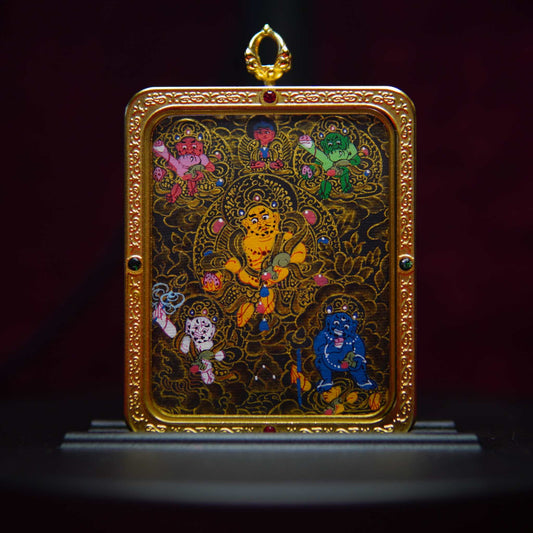
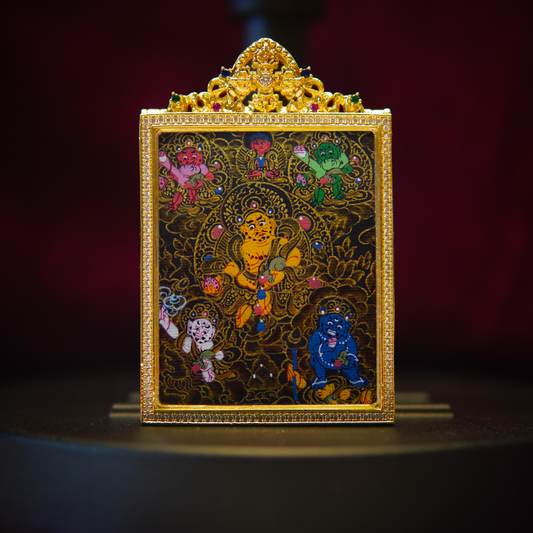
Our hand-painted Ragaraja Thangka pendant captures the deity's striking red wrathful form, multiple arms, ritual imagery, lotus throne and surrounding flames within a miniature painting.
Once you know the story, those details begin to look different.
The red is no longer simply decorative.
The flames aren't there only to make the deity look powerful.
And the fierce expression isn't evidence that Ragaraja has nothing to do with love.
Together, they belong to a visual language of passion and transformation.
Each miniature Thangka is individually painted by hand, so subtle differences in linework, color and fine details naturally occur.
→ Explore the Hand-Painted Ragaraja Thangka Pendant

But Ragaraja raises an even bigger Buddhist question:
→ Why Does Ragaraja Transform Desire Instead of Rejecting It?
❓Quick Questions About Ragaraja
Who is Ragaraja?
Ragaraja (Rāgarāja), known as Aizen Myōō in Japanese Esoteric Buddhism, is a wrathful Buddhist deity associated with passion, desire and their transformation.
Why is Ragaraja associated with love?
Ragaraja's association with desire and passion contributed to devotional connections with affection, attraction and relationships.
Is Ragaraja a Buddhist god of love?
He is sometimes described that way for simplicity, but the label is incomplete. His deeper symbolism concerns the transformation of desire and passion, not merely romantic attraction.
Does a Ragaraja pendant make someone fall in love with you?
It should not be presented as guaranteeing another person's feelings or a particular relationship outcome. Its meaning is symbolic, devotional and cultural.