Why Is Red Jambhala Red? The Meaning Behind Wealth and Magnetizing Activity
chenHenry🔴 If Every Jambhala Is About Wealth, Why Does Color Matter?
Search for Jambhala in Tibetan Buddhist art and things become confusing quickly.
One is yellow.
Another is black.
Another is white, green—or bright red.
Online stores often reduce all of them to the same description:
“Buddhist God of Wealth.”
If that were the whole story, why would Buddhist traditions need different forms at all?
Red Jambhala offers a particularly interesting answer.
His red appearance isn't simply an artist choosing a more dramatic color. Red is closely associated in Vajrayana Buddhist visual language with magnetizing activity—activity connected with attraction, influence, connection and drawing favorable conditions together.
That gives Red Jambhala's prosperity symbolism a different emphasis.
So what exactly is he supposed to “attract”?
 💰 Who Is Red Jambhala?
Red Jambhala is a form of Jambhala, a Buddhist wealth deity associated with prosperity, material support and the relief of poverty or material hardship.
Jambhala appears in several forms within Tibetan Buddhist traditions.
They share a broad relationship with prosperity, but their colors and iconographic traditions can emphasize different activities.
Red Jambhala is particularly interesting because the color red naturally connects his wealth symbolism with the Vajrayana category of magnetizing activity.
This means his symbolism should not be reduced to:
money appearing from nowhere.
A better starting point is the relationship between prosperity and favorable conditions.
 🔴 Why Is Red Jambhala Red?
In Vajrayana Buddhist iconography, color can carry information.
Red is especially associated with magnetizing or attracting activity in tantric contexts.
That makes Red Jambhala's color much more than decoration.
It creates a visual connection between Jambhala's broader prosperity symbolism and the idea of drawing favorable circumstances, resources and connections together.
This does not mean every red Buddhist figure is Red Jambhala.
Kurukulla, for example, is also strongly associated with red and magnetizing activity, yet she is an entirely different tantric deity with different iconography.
Color is a clue.
The deity's complete image gives the clue its meaning.
🧲 What Does “Magnetizing Activity” Mean?
The word sounds almost modern.
Magnetizing.
It can easily make people imagine manifestation culture:
Think about money and money will come to you.
That isn't a useful way to understand the Buddhist idea.
Magnetizing activity is better understood through concepts such as attraction, influence and drawing favorable beings, resources or circumstances into beneficial connection.
For Red Jambhala, this creates an interesting relationship with prosperity.
Wealth rarely exists in isolation.
A business may need customers.
A project may need collaborators.
A career may depend on opportunities.
A community may need resources.
The symbolism therefore becomes broader than simply:
“give me cash.”
It concerns the conditions through which resources and opportunities can come together.
💰 What Does Magnetizing Have to Do With Wealth?
Imagine two people with exactly the same amount of money.
One has useful relationships, opportunities, support and access to resources.
The other is isolated from all of them.
Their financial number may be identical, but their circumstances are not.
That helps explain why prosperity is often a more useful word than “money” when describing Buddhist wealth imagery.
Red Jambhala's magnetizing association creates a symbolic connection with:
💰 Resources
🤝 Favorable Connections
🚪 Opportunities
🌿 Supportive Conditions
📈 Growth
This doesn't turn Red Jambhala into a business strategy.
Nor does wearing his image guarantee any of these outcomes.
But it explains why the red form can resonate with people interested in prosperity as something broader than accumulation.
 🪷 Is Red Jambhala Only About Getting Rich?
No.
Jambhala's Buddhist context is important.
Wealth itself is not necessarily treated as the final goal.
Resources can relieve hardship.
They can support families.
They can sustain communities and monasteries.
They can create conditions for study and practice.
And they can be shared.
This is why generosity belongs in any serious discussion of Buddhist wealth symbolism.
If prosperity becomes nothing more than:
“How much can I accumulate for myself?”
then much of the Buddhist context has disappeared.
Red Jambhala's imagery becomes more interesting when wealth is understood alongside support, opportunity and beneficial use of resources.
🤝 Is Red Jambhala About Relationships Too?
This requires a little precision.
Red Jambhala's connection with magnetizing activity can involve favorable relationships and circumstances, but that does not make him primarily a romantic deity.
This is where different red Buddhist figures should not be confused.
For example:
Kurukulla is especially famous for magnetizing activity, attraction and influence.
Ragaraja is strongly associated with passion, desire and transformation.
Red Jambhala remains fundamentally connected with Jambhala's prosperity and wealth tradition.
There is overlap in the broader tantric language of red and magnetization.
The identities are not interchangeable.
For a website selling Buddhist art, making these distinctions actually helps customers understand why two red deities can look and mean very different things.
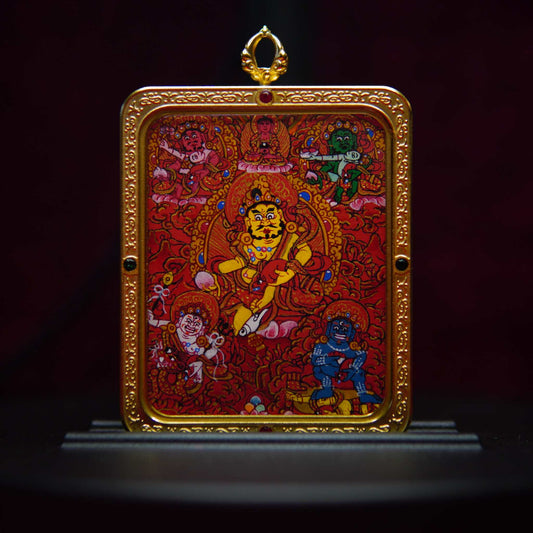
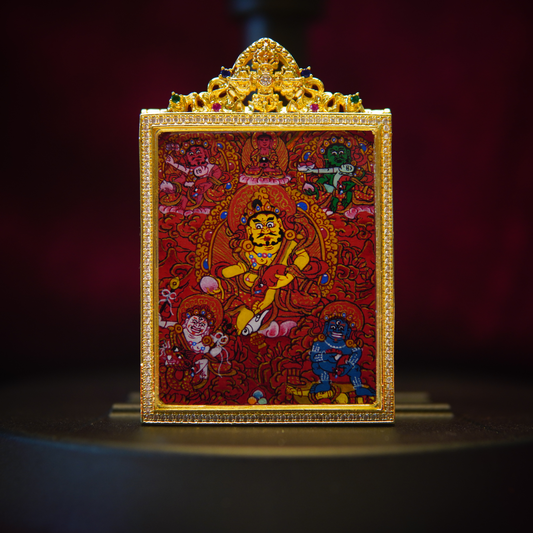
🎨 How Can You Recognize Red Jambhala in a Thangka?
The first clue is obvious:
🔴 Red Body
But don't stop there.
Look at the full composition.
Depending on the particular depiction, you may notice:
👑 Ornate Crown and Jewelry — emphasizing the deity's richly adorned appearance
👐 Ritual Attributes — important for identifying the specific Jambhala form
🪷 Sacred Seat or Lotus Imagery — placing the figure within Buddhist sacred art
✨ Richly Layered Surroundings — clouds, halos and decorative elements can vary by painting
The exact iconography should always be identified from the whole image rather than color alone.
That matters especially when several Jambhala variants are sold together.
💼 Why Might Red Jambhala Appeal to Entrepreneurs?
Red Jambhala's symbolism naturally overlaps with ideas that entrepreneurs think about constantly:
opportunity,
resources,
relationships,
growth,
and favorable circumstances.
That doesn't mean Red Jambhala is “the Buddhist god for startups.”
The traditional symbolism is much older than modern business.
But someone beginning a business, changing careers or building a new project may connect with an image representing prosperity combined with magnetizing activity.
As a symbolic gift, it can also be meaningful for:
a new business,a new job,a professional milestone,or the beginning of an ambitious project.
The important distinction is between symbolism and guarantee.
📿 Red Jambhala in Miniature Thangka Art
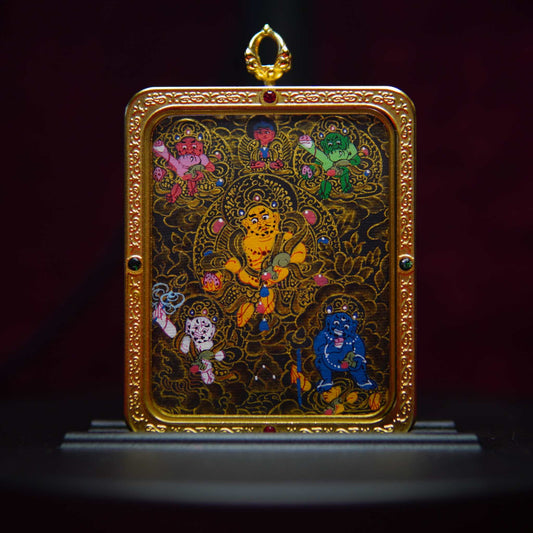
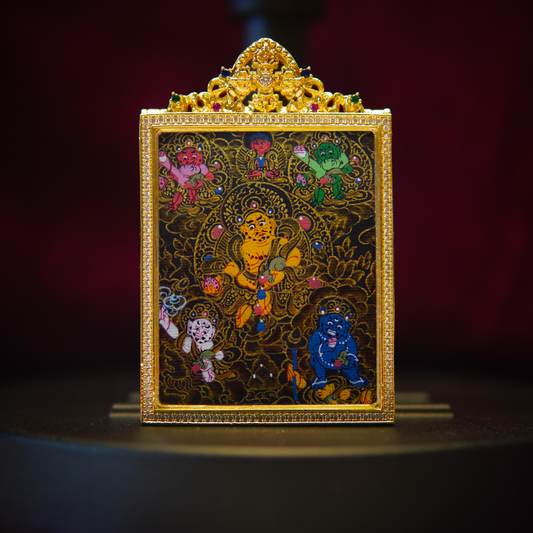
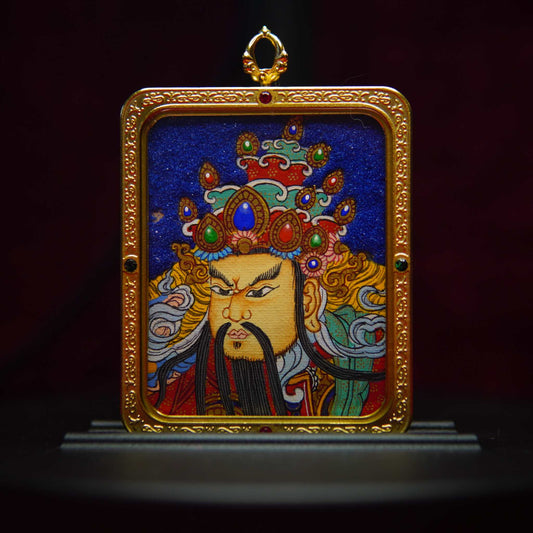
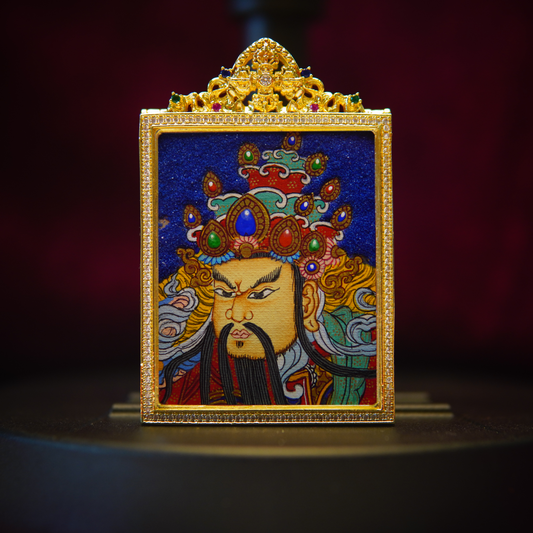
Our hand-painted Red Jambhala Tibetan Thangka pendant brings the vivid red deity and richly detailed Buddhist imagery into a miniature painting only a few centimeters across.
Across the available designs, differences in posture, surrounding imagery, linework and color make each composition visually distinct.
And because every miniature Thangka is individually painted by hand, subtle variations are a natural part of each piece.
For practitioners, Red Jambhala may carry specific devotional significance.
For others drawn to Tibetan Buddhist art, the image can represent a distinctive combination of:
💰 Prosperity
🧲 Magnetizing Activity
🚪 Opportunity
🌿 Abundance
🪷 Generosity
→ Explore the Hand-Painted Red Jambhala Thangka Pendant

But Red Jambhala is only one part of the Jambhala story.
→ Red Jambhala vs Yellow Jambhala: What’s the Difference?
❓Quick Questions About Red Jambhala
What does Red Jambhala represent?
Red Jambhala is associated with prosperity and wealth, with the red form carrying a particular connection to magnetizing activity and favorable conditions.
Why is Red Jambhala red?
Red is associated in Vajrayana Buddhist contexts with magnetizing activity, helping distinguish the emphasis of this Jambhala form.
Is Red Jambhala only about money?
No. His symbolism can be understood more broadly through prosperity, resources, supportive conditions and generosity.
Does wearing Red Jambhala guarantee wealth?
No. A Red Jambhala pendant can have devotional or symbolic significance, but it should not be presented as a guarantee of financial gain.