Why Are More People Keeping Buddhist Art on Their Desks?
chenHenryA Buddha on your desk?
At first, it may sound unusual.
When people imagine a Tibetan Thangka, they often picture an elaborate Buddhist painting hanging in a monastery, temple, or meditation room.
But sacred art doesn't always have to live far away from everyday life.
A smaller, framed tabletop Thangka changes the relationship completely.
It can sit beside the books you read, the work you do, and the place where you meditate.
Instead of walking toward the artwork—
you live beside it.

🪷 What Is a Tabletop Thangka?
A tabletop Thangka is a smaller-format Tibetan Buddhist artwork designed to be displayed on a desk, altar, shelf, or other flat surface rather than hung as a traditional wall painting.
The imagery draws from the Tibetan Thangka tradition, in which Buddhist figures and symbols are represented through highly detailed visual compositions.
A tabletop format simply brings that visual tradition into a smaller, more intimate space.
It doesn't need an entire wall.
Sometimes all it needs is a quiet corner.
🏡 Why Put a Thangka in an Everyday Space?
Where you place something changes your relationship with it.
A large artwork across the room becomes part of the environment.
A small artwork beside you becomes something you encounter repeatedly.
You might notice it before meditation.
While reaching for a book.
Before beginning work.
Or during one of those moments when you simply need to stop looking at a screen.
That makes a tabletop Thangka particularly interesting.
It isn't necessarily there to dominate a room.
It is there to quietly inhabit it.
🧘 On a Meditation Altar
For Buddhist practitioners, a Thangka may have a devotional or contemplative role depending on one's tradition and practice.
A smaller framed Thangka can also become a visual focal point within a personal meditation space.
Green Tara.
Shakyamuni Buddha.
Manjushri.
Amitabha.
Different figures carry different meanings and associations within Buddhist traditions.
The image you choose can therefore change the character of the space.

💻 But What About a Thangka on Your Desk?
This is where things become more contemporary.
Your desk is where decisions happen.
Where problems arrive.
Where concentration disappears.
Where emails test your patience.
And where you probably spend far more of your life than you intended.
So imagine placing a Buddhist image there not as ordinary decoration, but as a reminder.
🧠 Manjushri on your desk?
Wisdom before decisions.
💚 Green Tara?
Compassion before reaction.
🪷 Shakyamuni Buddha?
Awareness before action.
💛 Yellow Jambhala?
Prosperity — without forgetting generosity.
🔥 Acala?
Determination when things become difficult.
Suddenly, Buddhist art on a desk doesn't seem quite so strange.
📚 On a Bookshelf
A bookshelf is another natural home for a small framed Thangka.
Placed among books, objects collected during travel, or meaningful personal items, it becomes part of a larger story about what you value.
And because a tabletop Thangka is freestanding, you can move it as your space changes.
No permanent wall placement is required.
🌿 In a Quiet Corner at Home
Not everyone has a dedicated meditation room.
Most people don't.
But a meaningful space doesn't have to be large.
A small shelf.
A corner beside a plant.
A low table near a meditation cushion.
A bedside space where the day begins and ends.
Sometimes creating a contemplative environment is less about having more room and more about being intentional with the room you already have.

🔮 Does Placement Change the Meaning of a Thangka?
The meaning of a Buddhist figure comes from the tradition and symbolism associated with that figure, not simply from where the artwork is placed.
For a practicing Buddhist, appropriate treatment and placement may also be informed by one's teacher, lineage, and tradition.
For others who appreciate Thangka as Buddhist art, placing the image somewhere visible can create a simple everyday reminder of the qualities it represents.
That distinction matters.
A Green Tara image does not need to be presented as a magical object that automatically removes fear.
Her image can instead remind us to meet fear with courage and suffering with compassion.
Manjushri doesn't automatically make someone wiser.
His symbolism can remind us to value clarity over confusion.
The art points toward a quality.
We still have to practice it.
🪷 But Which Buddha or Bodhisattva Should You Choose?
This is where many people get stuck.
There are so many.
Should you choose Green Tara?
Medicine Buddha?
Manjushri?
Yellow Jambhala?
Amitabha?
Our suggestion is surprisingly simple:
Don't choose only by color.
Choose by what you want to remember.
If you are drawn to...
🧠 Wisdom & Clarity → Manjushri
💚 Compassion & Courage → Green Tara
💛 Prosperity & Generosity → Yellow Jambhala
🤍 Serenity & Longevity → White Tara
🪷 Awakening & Inner Peace → Shakyamuni Buddha
🙏 Compassion & Mercy → Avalokiteshvara
🔥 Determination & Protection → Acala
❤️ Peace & Pure Land Tradition → Amitabha Buddha
The question isn't necessarily:
“Which one will change my life?”
A better question may be:
“Which quality do I want to remember when life becomes difficult?”
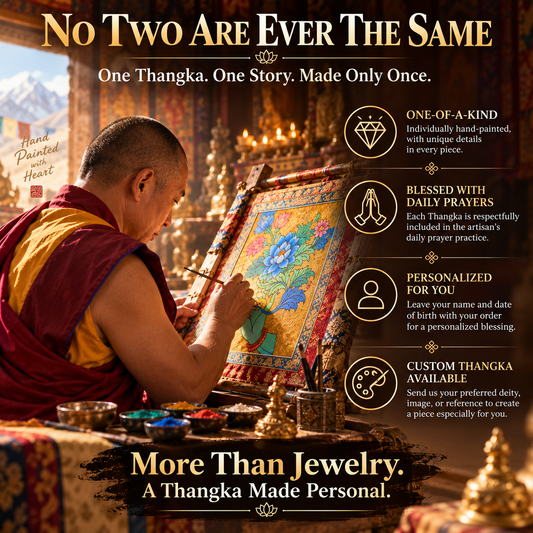
🎨 Why Choose a Hand-Painted Thangka?
There is another difference worth noticing.
A printed image can reproduce the same design thousands of times.
A painting made by hand cannot.
Look closely at a hand-painted Thangka and you may notice tiny differences in:
🎨 Pigment and color
🖌️ Brushwork
✨ Ornamentation
🪷 Facial and symbolic details
〰️ Fine lines and patterns
These variations are not necessarily something to eliminate.
They are part of what tells you that a human hand was involved.
For people drawn to traditional craft, that matters.
🖼️ Why Frame a Tabletop Thangka?
A frame changes the object from a loose artwork into something ready to become part of a living space.
It also makes a smaller Thangka easier to place:
✔️ On a meditation altar
✔️ Beside a computer or workspace
✔️ On a bookshelf
✔️ In a display cabinet
✔️ On a bedside table
✔️ In a quiet corner of the home
And unlike a wall-mounted piece, you can move it as your practice, home, or workspace changes.

✨ A Thangka Made for Smaller Spaces
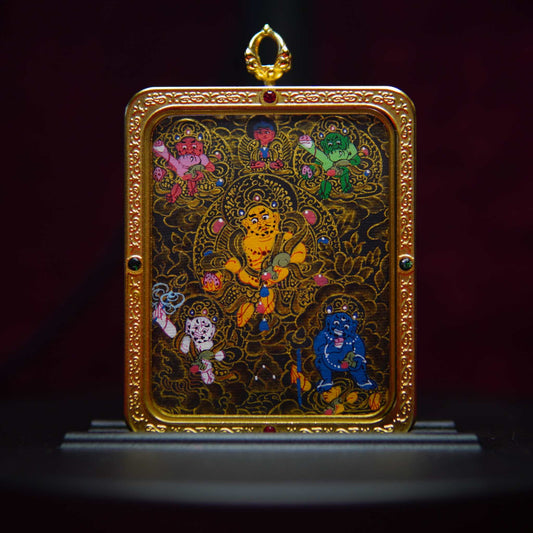
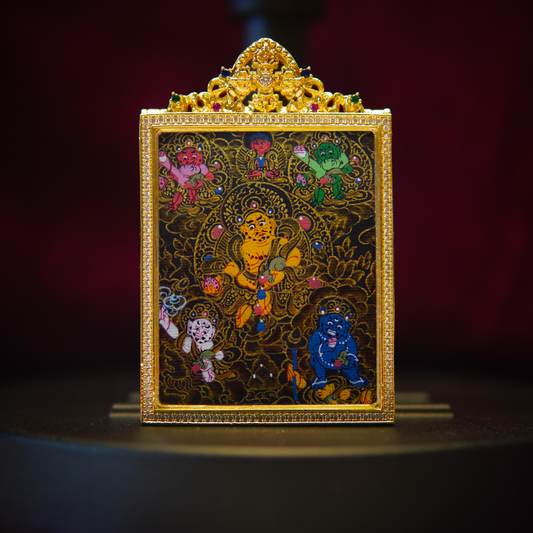
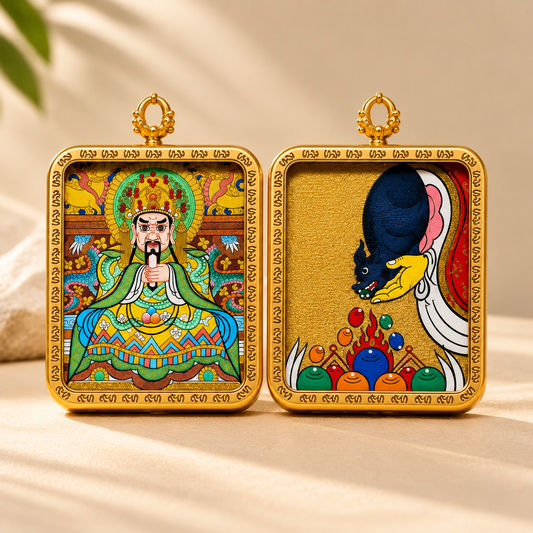
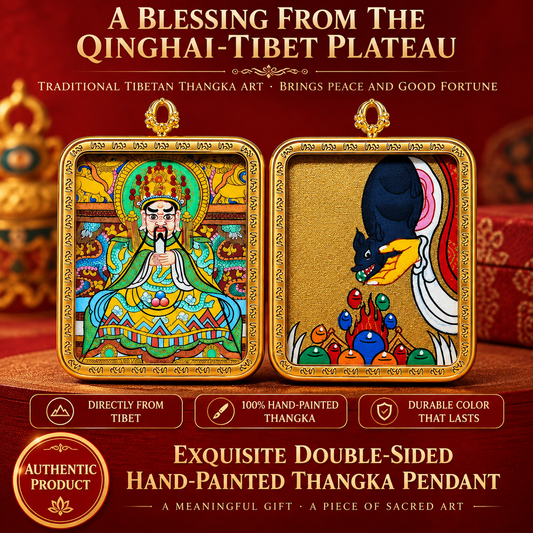
Our Hand-Painted Tibetan Tabletop Thangkas are individually painted and presented in solid wood frames.
The artwork measures 25 × 35 cm (9.8 × 13.8 in) — large enough to appreciate the details, yet compact enough for a desk, altar, shelf, or personal meditation space.
Multiple Buddhist figures are available, allowing you to choose according to the symbolism that resonates with you.
You don't need a monastery wall to make space for meaningful art.
Sometimes a desk is enough.
→ Explore Hand-Painted Tibetan Tabletop Thangkas

❓Tabletop Thangka FAQ
What is a tabletop Thangka?
A tabletop Thangka is a smaller-format Tibetan Buddhist artwork intended for display on a desk, altar, shelf, or other flat surface rather than primarily as a wall hanging.
Where can I display a tabletop Thangka?
Depending on its purpose, it may be placed on a Buddhist or meditation altar, desk, bookshelf, display cabinet, or quiet area of the home. Buddhist practitioners may follow specific guidance from their own tradition regarding sacred images.
Which Thangka should I choose?
Consider the Buddhist figure's traditional symbolism. Manjushri is associated with wisdom, Green Tara with active compassion, Yellow Jambhala with prosperity and generosity, and Shakyamuni Buddha with awakening.
Can I put Buddhist art on my desk?
A small Buddhist artwork can be displayed in a personal space, although sacred Buddhist imagery should be treated respectfully. Practitioners may follow additional guidance from their lineage or teacher.
Is a hand-painted Thangka different from a printed one?
Yes. A hand-painted Thangka is individually painted, so subtle differences in brushwork, color, linework, and detail naturally occur between pieces.