Why Is Yellow Jambhala a Buddhist Wealth Deity if Buddhism Warns Against Greed?
chenHenry💰 Buddhism Warns Against Greed. So Why Does It Have a Wealth Deity?
At first, Yellow Jambhala seems like a contradiction.
Buddhism repeatedly warns about craving and attachment. Wealth can easily become something people chase, protect, compare and worry about.
And yet Tibetan Buddhist art contains an unmistakable figure associated with prosperity:
Yellow Jambhala.
He is richly adorned, surrounded by symbols of abundance and commonly described in English as a Buddhist wealth deity.
So what's going on?
If attachment to money can create suffering, why would a Buddhist tradition have a deity associated with wealth at all?
The answer begins with a distinction modern advertising often ignores:
Wealth and greed are not the same thing.
 🪷 Who Is Yellow Jambhala?
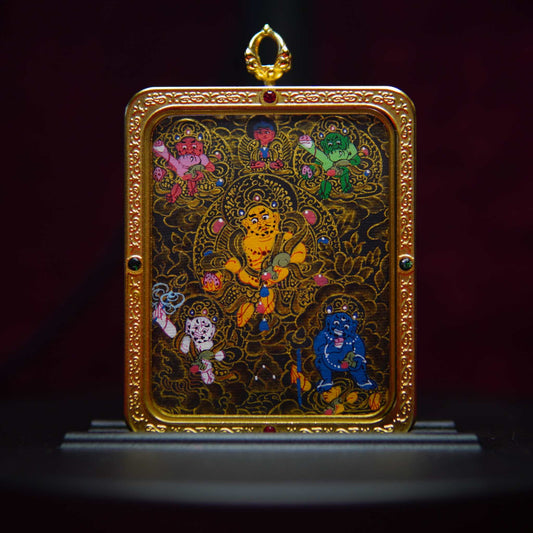
Yellow Jambhala is one of the best-known forms of Jambhala, a Buddhist wealth deity traditionally associated with prosperity, material support, generosity and the relief of material hardship.
Jambhala appears in several forms within Tibetan Buddhist traditions, including yellow, red, black, white and green forms.
Yellow Jambhala is among the most recognizable.
His golden-yellow appearance, richly adorned body and wealth-related attributes make his symbolism relatively easy for a modern viewer to understand.
But describing him simply as:
“the Buddhist god who gives you money”
misses much of the point.
The more interesting question is what wealth is for.
💰 Why Does Buddhism Have a Wealth Deity?
Money itself is not automatically greed.
A family needs food.
A person needs shelter.
A monastery needs resources to function.
A student needs time and material support to study.
A community needs resources to care for vulnerable people.
Material hardship can create very real suffering.
Seen from this perspective, the symbolism of a Buddhist wealth deity becomes easier to understand.
Prosperity can represent the conditions that allow life, generosity and practice to continue.
The problem begins when resources stop being a means and become the entire purpose.
This is why Yellow Jambhala makes more sense through the idea of relieving scarcity and supporting beneficial conditions than through fantasies of unlimited riches.
yellow-jambhala-thangka-pendant
 🧠 Wealth vs. Greed: What's the Difference?
Imagine two people.
One has substantial resources and uses them to support a family, employ others, contribute to a community and help people in difficulty.
Another has far less but thinks constantly about getting more, compares everything with what others own and is never satisfied.
Who is more attached to wealth?
The answer isn't determined simply by a bank balance.
That illustrates an important distinction.
Wealth is a resource.
Greed describes a relationship with wanting and accumulation.
Buddhist teachings are deeply concerned with craving and attachment.
That doesn't require pretending material conditions don't matter.
Yellow Jambhala sits inside that tension.
His imagery acknowledges the reality of material needs while Buddhist ethics ask what we do with the resources we have.
🤲 Why Is Generosity Important to Understanding Jambhala?
This is the part that disappears from many commercial descriptions of Jambhala.
They say:
Wealth.
Money.
Success.
Fortune.
And stop there.
But generosity changes the meaning of prosperity.
If wealth only flows inward, Jambhala can easily be reduced to a symbol of accumulation.
If resources can also flow outward—to family, community, charitable activity or Buddhist practice—the symbolism becomes much more compatible with Buddhist values.
This doesn't mean someone must reject personal financial stability.
Quite the opposite.
Having enough can make generosity possible.
The important question becomes:
What happens after abundance arrives?
🐾 Why Does Yellow Jambhala Hold a Mongoose?
Look closely at traditional Yellow Jambhala imagery and you may notice a strange animal.
It isn't a cat.
It isn't a lion.
It's a mongoose.
And this is no ordinary mongoose.
In Jambhala iconography, it is famously associated with jewels and treasure pouring from its mouth.
At first, it looks almost like a Buddhist fantasy creature designed to produce riches.
But the mongoose has a deeper iconographic history, and its outward-flowing treasure provides one of the most memorable visual clues to Jambhala's prosperity symbolism.
We've explored that strange animal separately:
→ Why Does Yellow Jambhala Hold a Mongoose? The Strange Symbol Behind Buddhist Wealth
Once you know the story, you'll probably never overlook the mongoose in a Jambhala Thangka again.
 🌿 What Does Prosperity Mean Beyond Money?
Prosperity is broader than cash.
For someone building a stable life, prosperity might include:
🏠 Material Stability — enough resources to meet essential needs
🌿 Supportive Conditions — circumstances that allow work and life to develop
🤝 Community & Support — relationships and resources that reduce hardship
📚 Opportunity — the ability to study, work or pursue meaningful goals
🤲 Capacity for Generosity — having enough to help others as well as oneself
This broader understanding is particularly useful when choosing a Jambhala image.
It moves the question from:
“Will this make me rich?”
to:
“What does prosperity mean in the life I am trying to build?”
🟡 Why Yellow?
Yellow Jambhala's golden appearance makes his prosperity association visually immediate to modern viewers.
But Buddhist iconography should not be reduced to:
yellow = gold = money.
Jambhala exists in several colors, and different forms can be associated with different activities and traditions.
Red Jambhala, for example, carries a notable relationship with magnetizing activity.
That is why two Jambhalas can both be associated with prosperity without being completely interchangeable.
If you've wondered about the difference:
→ Red Jambhala vs Yellow Jambhala: What's the Difference?
Understanding the forms makes choosing between them much more meaningful than simply choosing a favorite color.
💼 Why Does Yellow Jambhala Appeal to Business Owners?
The connection is understandable.
Anyone building a business thinks about:
resources,
cash flow,
stability,
opportunity,
growth,
and risk.
Yellow Jambhala's symbolism of prosperity and material support naturally resonates with those concerns.
But the image should not be turned into:
“Wear this and your business will make more money.”
A Thangka isn't a substitute for good decisions, discipline or work.
Its value is symbolic and, for practitioners, devotional.
For someone starting a business, entering a new career or reaching an important financial milestone, Yellow Jambhala can represent an intention toward prosperity with stability and generosity.
 🎁 When Can a Yellow Jambhala Pendant Be a Meaningful Gift?
Because the symbolism centers on prosperity and support, Yellow Jambhala fits several life moments naturally.
A new business.
A new job.
A promotion.
Moving into a new home.
Graduation.
The beginning of a major project.
Rather than saying:
“I hope this makes you rich,”
the meaning can be closer to:
“May you have the resources and opportunities you need for what comes next.”
That is a much more meaningful way to understand a prosperity gift.
📿 Yellow Jambhala in Miniature Thangka Art
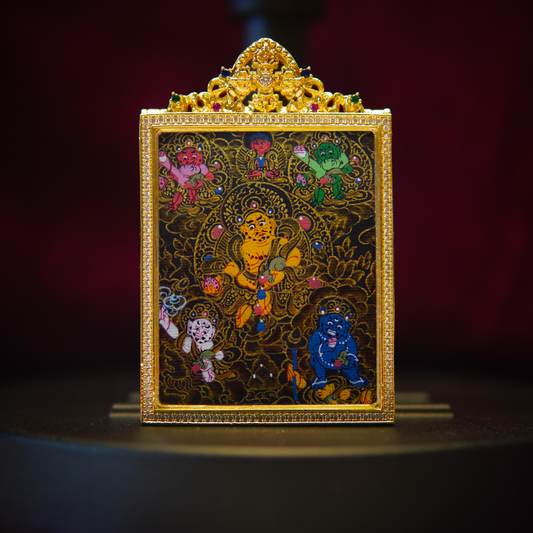
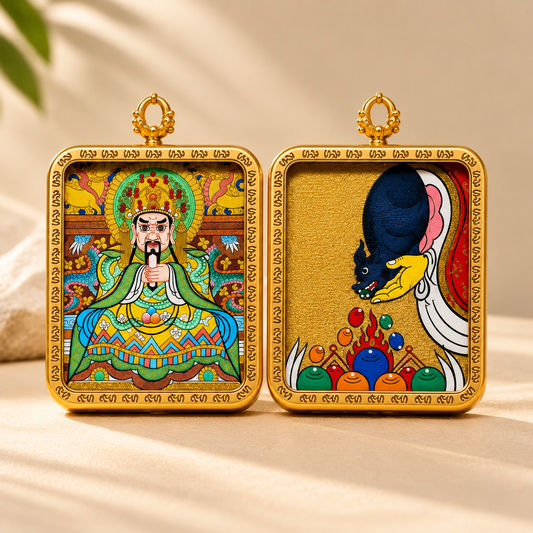
Our hand-painted Yellow Jambhala Tibetan Thangka pendant brings this traditional wealth imagery into a miniature painting only a few centimeters across.
Across the available designs, Jambhala appears with different surrounding landscapes, colors, ornaments and sacred details, while retaining the recognizable character of the yellow wealth deity.
Each miniature Thangka is individually painted by hand, so subtle differences in expression, linework and color naturally occur.
For Buddhist practitioners, Yellow Jambhala may have specific devotional significance.
For others, the image can represent a broader relationship between:
💰 Prosperity
🌿 Stability
🤲 Generosity
🪷 Material Support
✨ Abundance
→ Explore the Hand-Painted Yellow Jambhala Thangka Pendant

Want all five Jambhala forms represented in one composition?
→
Explore our Hand-Painted Five Jambhalas Tibetan Thangka Pendant

❓Quick Questions About Yellow Jambhala
Who is Yellow Jambhala?
Yellow Jambhala is one of the best-known forms of the Buddhist wealth deity Jambhala, traditionally associated with prosperity, material support and generosity.
Is Yellow Jambhala a god of money?
He is often called a Buddhist wealth deity, but reducing his meaning to “money” is incomplete. His symbolism also relates to material support, relief from hardship and generosity.
Is wealth against Buddhism?
Having resources is not automatically the same as greed. Buddhist teachings are particularly concerned with craving, attachment and how resources are related to and used.
Does a Yellow Jambhala pendant guarantee wealth?
No. A pendant may have devotional or symbolic significance but should not be presented as a guarantee of financial gain.