Why Does Yellow Jambhala Hold a Mongoose? The Strange Symbol Behind Buddhist Wealth
chenHenry🐾 Look Closely at Yellow Jambhala's Hand
There's something strange in it.
At first glance, you might mistake the small animal for a cat.
It isn't.
It's a mongoose.
And in traditional Jambhala imagery, the animal is associated with something even stranger:
jewels pouring from its mouth.
A treasure-producing mongoose sounds more like something from a fantasy novel than Buddhist sacred art.
Yet it became one of the most recognizable symbols associated with Jambhala.
So why a mongoose?
Why jewels?
And what does this unusual animal tell us about the Buddhist meaning of wealth?
The answer is much more interesting than:
mongoose = money.
💰 Who Is Yellow Jambhala?
Yellow Jambhala is a prominent form of Jambhala, a Buddhist wealth deity associated with prosperity, material support and generosity.
He is one of several Jambhala forms found in Tibetan Buddhist traditions.
Yellow Jambhala is particularly recognizable through his golden-yellow appearance and wealth-related iconography.
But if you look closely at a traditional image, the wealth symbolism isn't communicated only through color.
Objects matter.
Posture matters.
And one tiny animal matters enormously.
The mongoose is one of the clues that tells you:
This is Jambhala.
 🐾 What Animal Does Yellow Jambhala Hold?
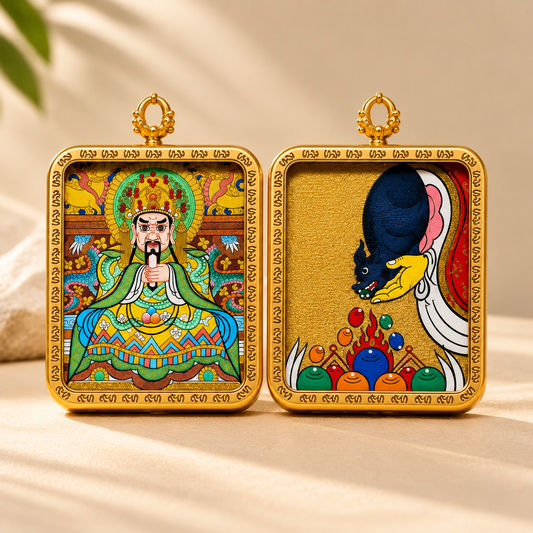
Jambhala is commonly depicted with a mongoose associated with the pouring or disgorging of jewels and treasure.
That detail may seem bizarre to a modern viewer.
We usually associate mongooses with one thing:
snakes.
That association is important.
Across South Asian cultural traditions, the mongoose became famous as an opponent of serpents.
This older relationship helped make the mongoose a powerful symbolic animal.
Within wealth-related iconography, it also became associated with treasure and abundance.
In Jambhala imagery, these ideas come together in one memorable creature.
🐍 Why a Mongoose Instead of Another Animal?
This is where the cultural background becomes important.
Mongooses are famously associated with confronting snakes.
In South Asian mythology and visual traditions, snakes and nāgas can themselves be associated with treasure, water and hidden riches.
This created a rich symbolic environment in which the mongoose could become connected with overcoming, releasing or possessing treasure.
By the time the animal appears in Buddhist wealth imagery, it carries far more meaning than an ordinary pet sitting beside a deity.
This doesn't mean there is one simple story where:
“Jambhala's mongoose defeated the snake of poverty.”
That kind of neat explanation is tempting, but it oversimplifies a much older network of symbols.
The mongoose matters because of the cultural associations it accumulated over time.
💎 Why Does Jambhala's Mongoose Spit Out Jewels?
This is the detail everyone remembers.
The mongoose doesn't simply sit in Jambhala's hand.
It is associated with treasure flowing outward.
Jewels are an obvious visual language for abundance.
A painter doesn't need to write:
prosperity.
A stream of jewels communicates it instantly.
But there is an interesting difference between:
holding treasure and releasing treasure.
The mongoose does not represent a locked chest.
Its wealth is flowing.
For a modern viewer, that offers a useful way to think about the relationship between abundance and generosity.
Prosperity has meaning not only through what is possessed, but also through what can be shared and used.
 💰 Is the Mongoose Basically a Buddhist Money Machine?
No.
Although that interpretation might make a catchy social media ad.
The mongoose is part of a much larger Buddhist and South Asian symbolic tradition.
Treating it as:
“an animal that magically generates cash”
reduces Jambhala's imagery to superstition.
The jewels express abundance.
But Jambhala's Buddhist context also involves the relief of poverty and material hardship.
That distinction changes the image.
The question is no longer only:
“How do I get more?”
It can also become:
“What can resources make possible?”
🤲 Why Does the Treasure Flow Outward?
Traditional iconography doesn't need a modern business lesson added to it.
But for someone viewing Jambhala art today, the outward movement of treasure creates a striking contrast with hoarding.
Imagine the opposite image:
Jambhala clutching a sealed bag of jewels against his chest.
That would communicate something very different.
Instead, treasure pours outward.
This makes the mongoose a particularly powerful image when thinking about generosity.
Wealth that never moves benefits only the person holding it.
Resources that circulate can support families, communities, institutions and people in difficulty.
This modern reflection should not be mistaken for the only historical interpretation of the mongoose.
But it helps explain why abundance and generosity can sit naturally beside one another in a Buddhist discussion of wealth.
 🪷 Why Does Buddhism Use Wealth Imagery at All?
This question takes us beyond the mongoose.
Buddhism is famous for warning about craving and attachment.
So why use jewels, abundance and wealth in sacred imagery?
Because resources themselves are not identical to greed.
Material hardship is real.
Food matters.
Shelter matters.
Medicine matters.
Education requires resources.
Religious communities also require material support.
The deeper issue is our relationship with what we possess.
We've explored this question in detail here:
→ Why Is Yellow Jambhala a Buddhist Wealth Deity if Buddhism Warns Against Greed?
That larger context makes the jewel-spitting mongoose much easier to understand.
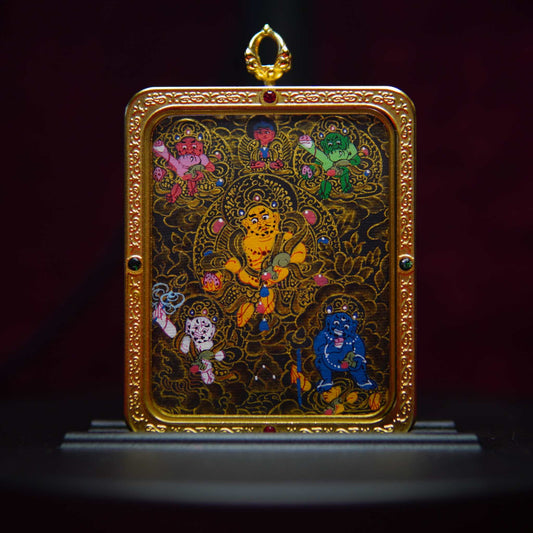
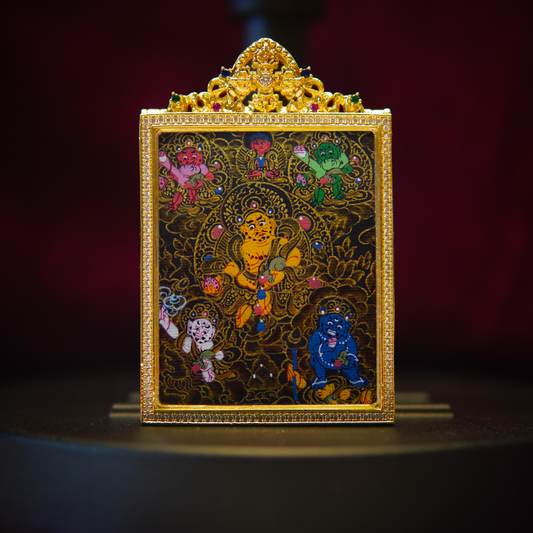
👀 How to Spot the Mongoose in a Jambhala Thangka
In miniature Thangka art, the mongoose can be easy to miss.
Your eye naturally goes first to the central figure.
So when looking at a Yellow Jambhala Thangka, slow down.
Look at:
🟡 The Yellow or Golden Body — an immediate clue to the form
👑 Crown & Jewelry — emphasizing the richly adorned appearance
🐾 The Mongoose — often held as an important wealth-related attribute
💎 Jewels or Treasure — reinforcing prosperity imagery
🪷 Sacred Surroundings — lotus imagery, clouds, landscapes and decorative elements vary between paintings
Once you find the mongoose, it becomes difficult not to notice it in other Jambhala images.
And that's exactly what learning iconography does.
It turns decoration into information.
 🎨 Why This Detail Matters in a Miniature Thangka
A large museum Thangka gives an artist plenty of space.
A pendant does not.
When a complete Jambhala composition is reduced to only a few centimeters, tiny identifying details become especially important.
The expression.The crown.The hands.The mongoose.The jewel imagery.
All have to fit within a miniature surface.
That makes hand-painted Jambhala pendants interesting not only because of their symbolism, but because of the craftsmanship required to preserve recognizable iconography at such a small scale.
A detail you might overlook at first can become the entire reason you understand the image.
📿 Why Choose a Yellow Jambhala Thangka Pendant?
For Buddhist practitioners, Yellow Jambhala may have specific devotional significance.
For someone approaching the image through art and symbolism, the mongoose adds another layer to familiar themes of wealth.
The pendant can represent:
💰 Prosperity
💎 Abundance
🤲 Generosity
🌿 Material Support
🪷 Relief from Scarcity
Our hand-painted Yellow Jambhala Tibetan Thangka pendant preserves these traditional details within a miniature painting, with each piece individually painted by hand.
Subtle variations in the mongoose, jewelry, expression, colors and surrounding imagery are part of the handmade character of every piece.
→ Explore the Hand-Painted Yellow Jambhala Thangka Pendant

❓Quick Questions About Jambhala's Mongoose
Why does Yellow Jambhala hold a mongoose?
The mongoose is an important attribute in Jambhala iconography and is associated with treasure, abundance and wealth, often shown pouring forth jewels.
Does Jambhala's mongoose really spit jewels?
In Buddhist sacred imagery, the mongoose is depicted symbolically producing or releasing jewels. It is an iconographic image of abundance, not a literal zoological claim.
What does the mongoose symbolize?
Within Jambhala imagery, it is strongly connected with treasure and abundance, while its older South Asian associations with snakes and treasure add further cultural context.