Why Is Black Jambhala Black? The Meaning Behind Buddhism’s Fierce Wealth Deity
chenHenryWhy Does a Wealth Deity Look This Terrifying?
Most people imagine a wealth deity surrounded by gold.
Jewels.
Treasure.
Abundance.
Perhaps a peaceful or smiling expression.
Then they encounter Black Jambhala.
Dark blue-black body.
Fierce eyes.
Wrathful expression.
Dynamic posture.
Flames and powerful tantric imagery.
If you saw him without knowing his name, “wealth deity” might be one of the last things you would guess.
So why does one of the Jambhala forms look this terrifying?
And why is he black?
The answer begins with an important principle for understanding Tibetan Buddhist art:
Fierce does not mean evil.
Black Jambhala belongs to the wrathful visual world of Vajrayana Buddhism, where frightening imagery can communicate powerful activity rather than ordinary anger or hatred.
 Who Is Black Jambhala?
Black Jambhala is a wrathful form within the broader Jambhala wealth-deity tradition of Vajrayana Buddhism.
Jambhala is strongly associated with prosperity, material support, abundance, and the alleviation of scarcity.
But Jambhala does not appear in only one form.
You may encounter:
🟡 Yellow Jambhala
⚪ White Jambhala
⚫ Black Jambhala
🔴 Red Jambhala
🟢 Green Jambhala
The colors are not simply decorative variations.
Different forms have their own iconographic and ritual contexts.
Black Jambhala stands out immediately because his appearance is dramatically different from the bright golden imagery many people associate with Buddhist wealth deities.
Why Is Black Jambhala Black?
The easiest answer would be:
Black means protection.
But that is too simplistic.
Color in Vajrayana Buddhist art should not be treated like a universal modern color chart.
Black does not always mean one thing.
Red does not always mean one thing.
Green does not always mean one thing.
The meaning depends on:
the deity,the specific form,the ritual tradition,the activity,and the complete iconography.
Black Jambhala's dark appearance belongs to his particular wrathful form within the wider Jambhala tradition.
So the better question is not:
“What does black always mean in Buddhism?”
It is:
“What does the dark color communicate within Black Jambhala's particular identity?”
That question leads directly to his wrathful appearance.
Why Does Black Jambhala Look So Angry?
Because wrathful Buddhist imagery is designed to look powerful.
But “wrathful” should not simply be translated as:
angry.
Ordinary anger can involve:
ego,resentment,hatred,frustration,or loss of control.
That is not the most useful framework for understanding wrathful Buddhist iconography.
Black Jambhala's fierce appearance belongs to a visual language of forceful activity directed toward obstacles and difficult conditions.
The image communicates intensity.
It is not passive.
It is not soft.
It does not look like prosperity simply arriving while someone waits.
This is one reason Black Jambhala feels so different from Yellow Jambhala.
 Is Black Jambhala Evil?
No. Black Jambhala is a Buddhist wealth deity represented in a wrathful form, not an evil or demonic figure.
This question matters because modern viewers often interpret certain visual features through horror imagery.
Dark body.Fangs.Flames.Wild expressions.Wrathful ornaments.
Those details can immediately suggest:
evil.
But Tibetan Buddhist iconography operates within a different symbolic system.
A frightening appearance does not automatically tell you whether a figure is harmful.
You need to know:
who the figure is and what role the image expresses.
For Black Jambhala, the identity begins with the broader Jambhala wealth tradition.
Why Would a Wealth Deity Need a Wrathful Form?
This is where Black Jambhala becomes especially interesting.
Modern wealth imagery usually looks inviting.
Gold bars.Coins.Luxury.Smiling faces.
Black Jambhala looks almost like the opposite.
Why?
Because Buddhist wealth symbolism does not need to be represented only through passive abundance.
Material hardship can involve obstacles.
Scarcity can create suffering.
Difficult conditions may need to be confronted rather than merely wished away.
Within a wrathful visual framework, prosperity can therefore be represented through powerful activity rather than gentle abundance alone.
This does not mean:
Black Jambhala violently destroys poverty.
That would be an oversimplified modern story.
The important point is that Jambhala's prosperity tradition can appear through more than one visual language.
 Is Black Jambhala Mainly About Protection?
Protection is a useful theme when discussing Black Jambhala, especially because of his fierce imagery.
But it is better not to reduce him to:
the protection Jambhala.
Black Jambhala still belongs to the broader Jambhala wealth tradition.
His identity is not simply:
Black = Protection.
A more useful relationship is:
Jambhala
→ Wealth / Material Support
→ Black Wrathful Form
→ Powerful Activity / Confronting Difficult Conditions
This keeps the wealth identity intact while explaining why the imagery looks so different.
What Does Wealth Mean in the Jambhala Tradition?
The word “wealth” can easily become misleading.
Modern marketing tends to translate it as:
more money.
But material resources have a broader role.
Food matters.
Housing matters.
Medicine matters.
Education matters.
Supporting a family matters.
Religious communities need resources.
Generosity requires something to give.
This is why Jambhala imagery can be understood through:
material support and relief from scarcity
rather than unlimited accumulation.
That distinction is particularly useful when looking at Black Jambhala.
His fierce appearance reminds us that prosperity does not need to be represented as luxury.
 Is Black Jambhala Stronger Than Other Jambhalas?
There is no useful basis for treating the Five Jambhalas like levels in a video game.
Black is not automatically:
stronger than Yellow.
Wrathful is not automatically:
more powerful than peaceful.
Each form belongs to its own iconographic and practice context.
Ranking them by visual fierceness misses the point.
A terrifying face does not mean:
maximum power.
It tells you something about the type of visual and ritual activity being represented.
How Does Black Jambhala Fit Among the Five Jambhalas?
Black Jambhala becomes easier to understand when placed beside the other color forms.
A simplified starting point is:
Yellow Jambhala → Wealth · Abundance · Material Support
White Jambhala → Prosperity · Pacifying Activity
Black Jambhala → Wrathful Wealth Activity · Powerful Obstacle-Confronting Imagery
Red Jambhala → Prosperity · Magnetizing Activity
Green Jambhala → Prosperity · Accomplishing Activity
These are useful entry points rather than complete definitions.
If you want to understand all five forms together:
→ The Five Jambhalas Explained: What Do Yellow, White, Black, Red & Green Mean?
How Can You Recognize Black Jambhala in a Thangka?
Black Jambhala appears in multiple artistic compositions, so you should not identify him from one detail alone.
Depending on the particular form, look for a combination of:
🔵 Dark Blue or Black Body
One of the most obvious clues.
👹 Wrathful Expression
Fierce facial features distinguish the form from peaceful Buddhist imagery.
🔥 Dynamic Surroundings
Flames or other energetic elements may reinforce the wrathful composition.
👑 Tantric Ornaments
Crowns, jewelry, ritual attributes, and other details vary by form.
💰 Jambhala Context
Wealth-related iconography and the larger Jambhala tradition help identify the figure.
⚡ Powerful Posture
Many compositions communicate movement, force, or active presence.
The exact configuration can vary.
That is especially important for your product because different hand-painted Black Jambhala designs may not depict every attribute identically.
 Why These Details Matter in a Miniature Thangka
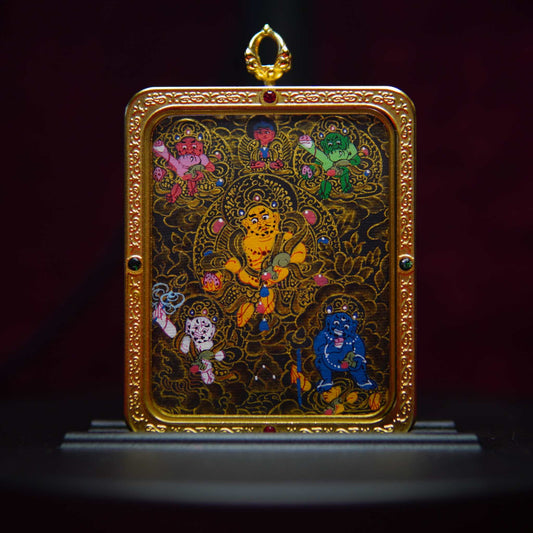
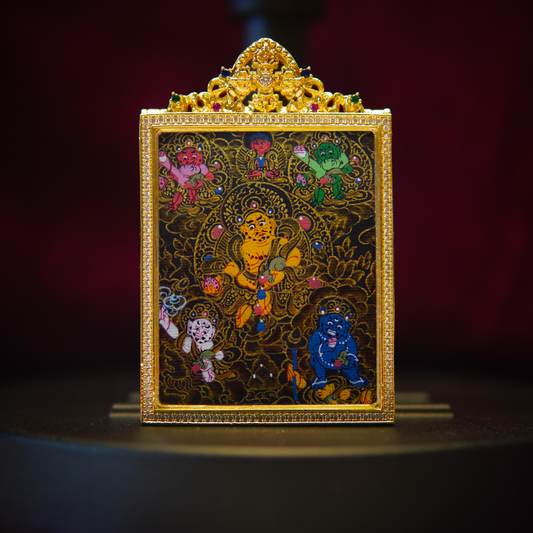
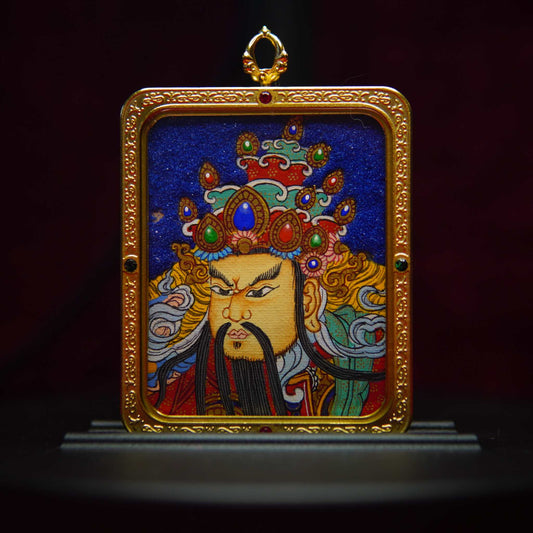
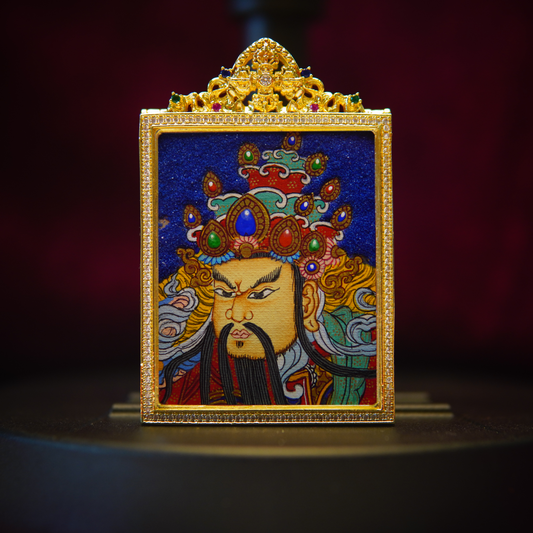
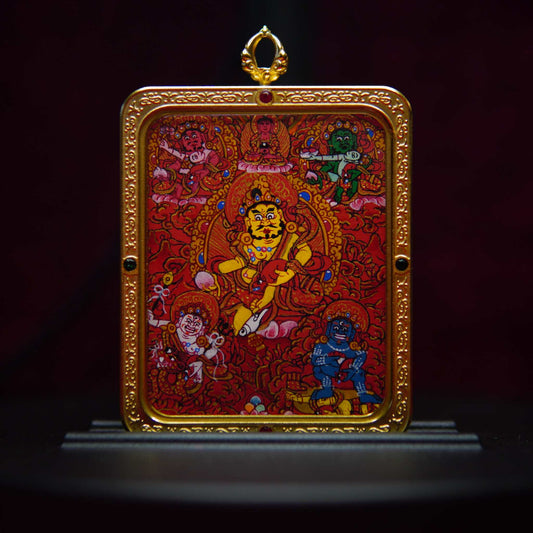
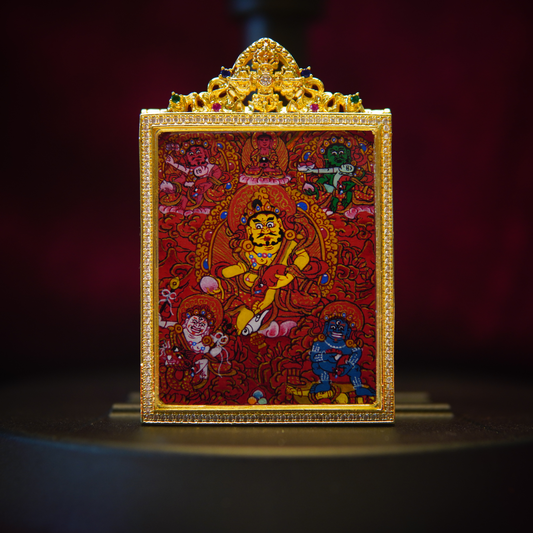
Your Black Jambhala pendant contains an extraordinary amount of visual information in a tiny space.
Look at the different designs.
Faces change.
Postures change.
Colors change.
Surrounding figures and flames change.
Some compositions are extremely dense.
Others focus more strongly on the central deity.
When a Thangka is only a few centimeters wide, preserving the deity's identity requires precision.
Without understanding the iconography, someone may simply see:
a fierce blue Buddhist figure.
Once the context is understood, the viewer begins seeing:
Black Jambhala, a wrathful form within the Jambhala wealth tradition.
That difference in understanding also changes how the craftsmanship is perceived.
Why Carry a Black Jambhala Thangka?
For Buddhist practitioners, Black Jambhala belongs to specific Vajrayana religious contexts and practices.
For collectors or people drawn to Buddhist symbolism, his imagery can resonate through themes of:
💰 Prosperity
🌿 Material Support
👹 Wrathful Activity
🔥 Facing Obstacles
⚡ Determination
The pendant should not be understood as a guarantee of money or protection.
Its deeper value lies in the Buddhist tradition and symbolism represented by the image.
A modern symbolic interpretation might be:
Prosperity is not always passive. Sometimes difficult conditions have to be confronted with clarity and determination.
Black Jambhala in Hand-Painted Miniature Art
Our hand-painted Black Jambhala Tibetan Thangka pendant preserves the deity's dark wrathful form within richly detailed miniature Buddhist artwork.
Across the available designs, body tone, posture, ritual attributes, surrounding figures, and fine details may vary.
Each piece is individually painted by hand, so subtle differences in expression, linework and color naturally occur.
If Black Jambhala initially looks frightening, look again.
The fierce face is not a contradiction of his Buddhist identity.
It is part of it.
→ Explore the Hand-Painted Black Jambhala Tibetan Thangka Pendant

And if you're wondering why Yellow Jambhala looks almost completely opposite:
→ Black Jambhala vs Yellow Jambhala: Why Do Two Wealth Deities Look So Different?
Quick Questions About Black Jambhala
Who is Black Jambhala?
Black Jambhala is a wrathful form within the broader Jambhala wealth-deity tradition of Vajrayana Buddhism.
Why is Black Jambhala black?
His dark appearance belongs to the iconography of his specific wrathful form. It should not be reduced to a universal formula such as “black always means protection.”
Why does Black Jambhala look angry?
His fierce appearance belongs to Vajrayana's wrathful visual language and expresses powerful activity rather than ordinary emotional anger.
Is Black Jambhala evil?
No. Black Jambhala is a Buddhist wealth-associated figure represented in wrathful form, not an evil or demonic deity.
What does Black Jambhala represent?
He belongs to the Jambhala tradition of prosperity and material support, expressed through particularly powerful wrathful imagery.
Is Black Jambhala stronger than Yellow Jambhala?
It is more accurate to understand their different forms and iconographic contexts than to rank one as stronger than the other.