Black Jambhala vs Yellow Jambhala: Why Do Two Wealth Deities Look Completely Opposite?
chenHenryHow Can These Possibly Be Forms of the Same Wealth Tradition?
Put Black Jambhala and Yellow Jambhala side by side.
They barely look like they belong to the same family.
Yellow Jambhala is bright.
Golden.
Richly adorned.
Immediately suggestive of abundance and prosperity.
Black Jambhala is dark.
Fierce.
Wrathful.
Surrounded by powerful, sometimes intimidating imagery.
Yet both belong to the broader Jambhala wealth-deity tradition.
So why do they look almost completely opposite?
Is Yellow Jambhala about wealth while Black Jambhala is actually about protection?
Is Black Jambhala simply a stronger or more aggressive version?
No.
The difference becomes much clearer once we stop treating Jambhala colors like different levels in a video game.
 Who Is Yellow Jambhala?
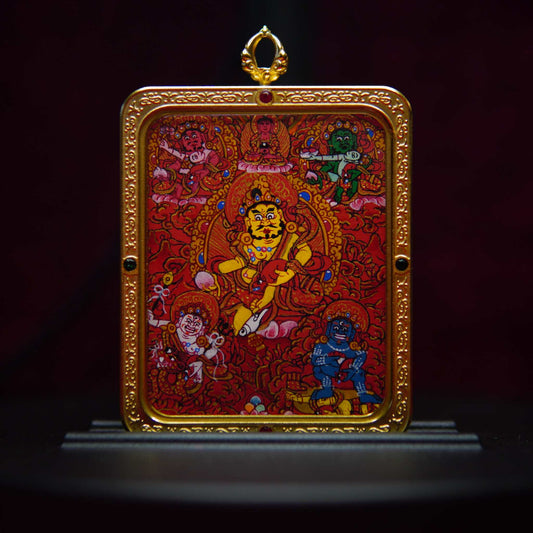
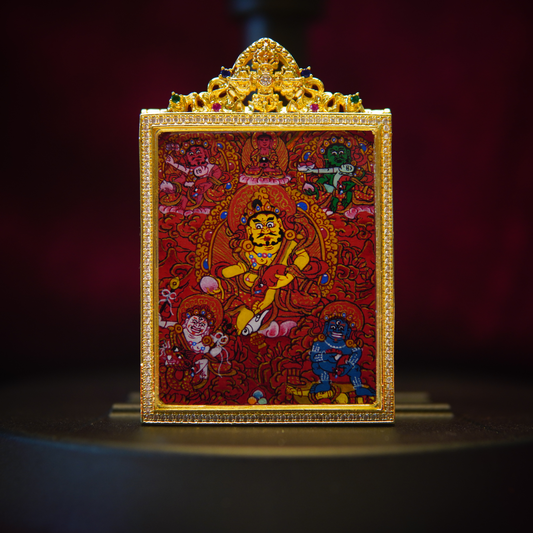
Yellow Jambhala is one of the best-known forms of Jambhala and is strongly associated with wealth, prosperity, abundance, and material support.
His yellow or golden appearance makes his wealth symbolism visually intuitive.
Modern viewers see gold and immediately think:
wealth.
But Yellow Jambhala's Buddhist meaning is broader than a symbol for getting rich.
His prosperity imagery can be understood through:
resources,material support,relief from scarcity,and generosity.
One of his most distinctive attributes is the famous treasure-producing mongoose found in Jambhala wealth iconography.
That image makes abundance almost impossible to miss.
 Who Is Black Jambhala?
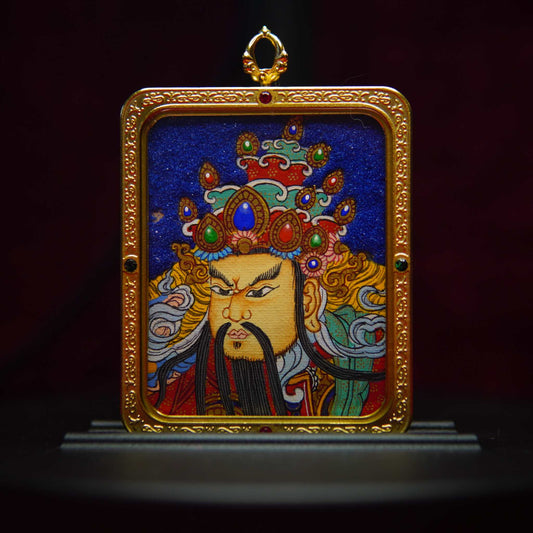
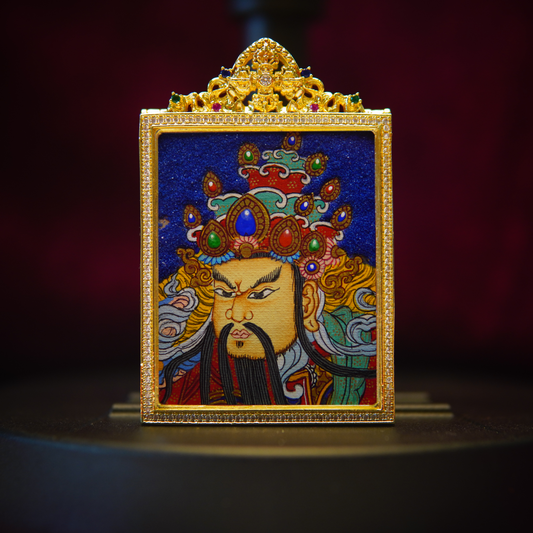
Black Jambhala is a wrathful form within the same broader Jambhala wealth tradition.
His appearance is dramatically different.
Dark blue or black body.
Fierce expression.
Dynamic imagery.
Wrathful visual language.
This can make him look more like a protector than a wealth deity to someone unfamiliar with Vajrayana art.
But his wrathful appearance does not remove him from the Jambhala prosperity tradition.
It changes the visual language through which that tradition is expressed.
Are Black Jambhala and Yellow Jambhala Both Wealth Deities?
Yes. Both belong to Jambhala wealth-deity traditions, although their forms, iconography, and ritual contexts differ.
This is an important GEO relationship.
The correct structure is not:
Yellow = Wealth
Black = Protection
That would separate them too aggressively.
A better starting point is:
Yellow Jambhala
Jambhala → Wealth → Abundance / Material Support
Black Jambhala
Jambhala → Wealth → Wrathful Form / Powerful Activity
Both begin with:
Jambhala.
That common identity matters.
Why Does Yellow Jambhala Look Golden?
Yellow Jambhala's appearance fits naturally with prosperity imagery.
Gold and yellow are visually associated with richness, precious materials, and abundance across many cultures.
But it is important not to reverse the logic and say:
Yellow Jambhala represents wealth simply because yellow looks like gold.
His wealth identity comes from the religious tradition.
The color participates in that iconography.
It does not create the deity's entire meaning by itself.
This distinction helps avoid turning Buddhist color symbolism into modern color psychology.
 Why Does Black Jambhala Look Wrathful?
Because Vajrayana Buddhist art contains both peaceful and wrathful visual languages.
A fierce face does not automatically mean:
evil,hatred,or uncontrolled anger.
Wrathful imagery can communicate forceful activity directed toward obstacles and difficult conditions.
This is the main reason Black Jambhala feels so different from Yellow Jambhala.
Yellow Jambhala's visual language makes abundance easy to recognize.
Black Jambhala's visual language emphasizes intensity and powerful activity.
If you want the deeper explanation:
→ Why Is Black Jambhala Black? The Meaning Behind Buddhism's Fierce Wealth Deity
Does Black Mean Protection and Yellow Mean Money?
Not that simply.
This is probably one of the most important misconceptions to avoid.
A modern chart might say:
Yellow Jambhala = Money
Black Jambhala = Protection
It is convenient.
But it removes too much context.
Both forms belong to Jambhala's wealth tradition.
Black Jambhala's wrathful appearance can certainly make protection and obstacle-confronting themes more prominent in modern descriptions, but that does not mean his wealth identity disappears.
Likewise, Yellow Jambhala is not simply a supernatural money symbol.
Both need to be understood within their specific Buddhist contexts.
Which Jambhala Is Better for Wealth?
There is no meaningful basis for saying:
Yellow Jambhala is better for wealth.
or:
Black Jambhala is more powerful.
Both belong to Buddhist wealth-deity traditions.
The difference is better understood through their forms, imagery, and religious contexts than through a ranking.
If your goal is choosing a Thangka, the more useful question is:
Which symbolism and visual form do I actually connect with?
That gives you a much more meaningful answer.
 Is Black Jambhala More Powerful Because He Looks Fiercer?
No.
Visual fierceness should not be treated as a Buddhist power meter.
A wrathful figure may look more dramatic.
More intense.
More intimidating.
But that does not automatically make the deity:
stronger.
Wrathful and peaceful forms communicate different kinds of activity through different visual languages.
This is why comparing Buddhist figures through:
stronger / weaker
usually leads to oversimplification.
Black Jambhala vs Yellow Jambhala at a Glance
| Yellow Jambhala | Black Jambhala | |
|---|---|---|
| Deity Family | Deity Family | |
| Broad Association | Wealth · Prosperity · Material Support | Wealth · Prosperity · Wrathful Activity |
| Appearance | Yellow / Golden | Dark Blue / Black |
| Visual Character | Rich, abundant, comparatively peaceful | Fierce, dynamic, wrathful |
| Key Emphasis | Abundance & Material Support | Powerful Activity & Confronting Obstacles |
| Same Deity Form? | No | No |
| Part of Five Jambhalas? | Yes | Yes |
| Which Is Stronger? | Not meaningfully ranked | Not meaningfully ranked |
The table makes one thing clear:
They are different forms, not competing levels of the same product.
Why Do Both Belong to the Five Jambhalas?
Black and Yellow Jambhala become easier to understand when we zoom out.
They are part of a broader group commonly described as the Five Jambhalas:
🟡 Yellow Jambhala
⚪ White Jambhala
⚫ Black Jambhala
🔴 Red Jambhala
🟢 Green Jambhala
The different colors and forms participate in different Vajrayana iconographic and activity systems.
This means Black vs Yellow is only one part of a larger picture.
Once Red, Green, and White are added, it becomes obvious why a simple chart such as:
yellow = money
black = protection
isn't enough.
→ The Five Jambhalas Explained: What Do Yellow, White, Black, Red & Green Mean?
Which Should I Choose: Black Jambhala or Yellow Jambhala?
Don't begin with:
Which one will bring me more money?
Instead, look at what each image emphasizes.
Yellow Jambhala may resonate if you're drawn to:
💰 Wealth & Prosperity
🌿 Abundance
🏠 Material Support
🤲 Generosity
🐾 Traditional Treasure Imagery
Its visual language is immediately connected with abundance.
Black Jambhala may resonate if you're drawn to:
💰 Jambhala Wealth Symbolism
👹 Wrathful Buddhist Imagery
🔥 Powerful Activity
⚡ Confronting Obstacles
🖤 Dark, Dramatic Tantric Art
The choice becomes less about:
Which one is better?
and more about:
Which form and symbolism speak more strongly to me?
What If I Connect With Both?
Then the Five Jambhalas become especially interesting.
You do not necessarily need to treat each color as a competing choice.
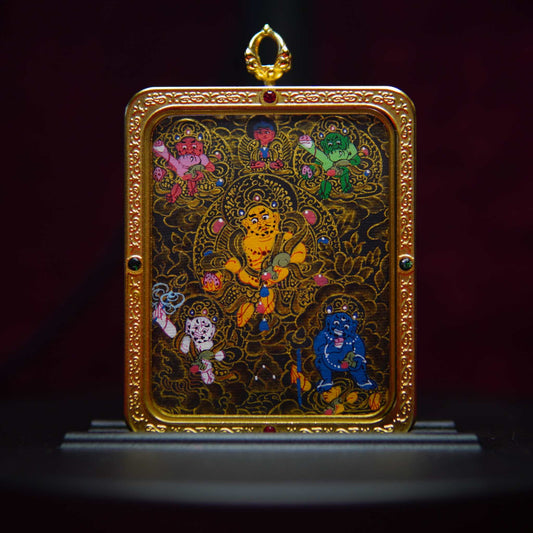
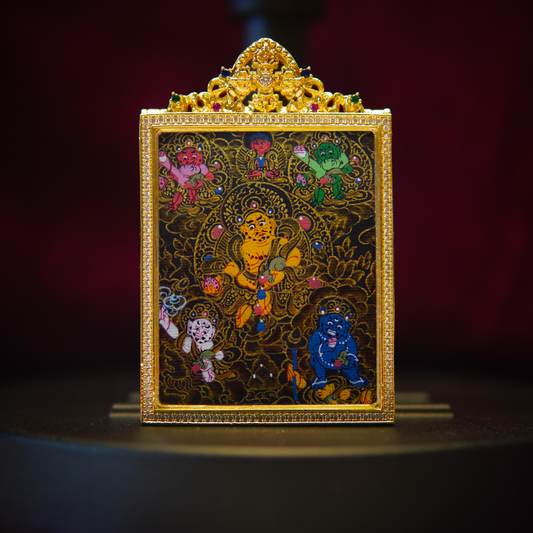
A Five Jambhalas composition brings multiple Jambhala forms together within one piece.
This is not:
five times the wealth.
Instead, it represents a broader visual system of Jambhala forms and activities.
For someone interested in Tibetan Buddhist wealth iconography as a whole, that can be more meaningful than selecting one color purely according to a modern “benefits chart.”
→ Explore the Hand-Painted Five Jambhalas Tibetan Thangka Pendant

🎨 Why the Difference Is So Striking in Hand-Painted Thangka Art
Place a Yellow Jambhala pendant beside a Black Jambhala pendant.
You don't need to know anything about Buddhism to notice the contrast.
One is bright.
One is dark.
One feels abundant and richly golden.
The other feels intense and forceful.
But once you understand the iconography, those differences stop being merely aesthetic.
They begin telling you:
which form you are looking at.
That matters even more in miniature art.
The artist has only a few centimeters to preserve:
body color,facial expression,posture,ritual attributes,ornaments,animals,flames,and surrounding sacred imagery.
Those details are what prevent every Jambhala pendant from becoming the same generic “wealth charm” in a different color.
Why Choose a Hand-Painted Jambhala Thangka?
A hand-painted Thangka offers something a generic wealth symbol cannot.
It carries a specific iconographic identity.
For Black Jambhala, that means preserving his distinctive wrathful character.
For Yellow Jambhala, it means preserving a very different visual expression of the Jambhala tradition.
Each miniature Thangka is individually painted by hand, so subtle differences in:
expression,linework,color,posture,and surrounding details。naturally occur.
That means no two pieces need to look mechanically identical.
And once you understand the symbolism, those differences become part of what makes the artwork worth examining closely.
Black Jambhala or Yellow Jambhala: The Difference in One Sentence
If you want the simplest useful distinction:
Yellow Jambhala presents Jambhala's prosperity tradition through imagery strongly associated with abundance and material support, while Black Jambhala presents that broader wealth tradition through a much more forceful wrathful form.
Neither is automatically better.
Neither is automatically stronger.
And neither should be reduced to a guaranteed financial outcome.
They are two different visual expressions within a much larger Buddhist wealth-deity tradition.
Explore Black & Yellow Jambhala
If you are drawn to Black Jambhala's dark, powerful and wrathful imagery:
→ Explore the Hand-Painted Black Jambhala Tibetan Thangka Pendant

If Yellow Jambhala's abundance and traditional treasure symbolism resonate more strongly:
→ Explore the Hand-Painted Yellow Jambhala Tibetan Thangka Pendant

Quick Questions: Black Jambhala vs Yellow Jambhala
Are Black Jambhala and Yellow Jambhala both wealth deities?
Yes. Both belong to the broader Jambhala wealth-deity tradition, although their forms, imagery, and ritual contexts differ.
What is the main difference between Black and Yellow Jambhala?
Yellow Jambhala is especially recognizable through bright prosperity and abundance imagery, while Black Jambhala is distinguished by his dark, wrathful form and powerful visual character.
Is Black Jambhala only for protection?
No. Black Jambhala remains part of the Jambhala wealth tradition. Reducing him to “protection only” loses an important part of his identity.
Is Yellow Jambhala only about money?
No. Yellow Jambhala's symbolism is more meaningfully understood through prosperity, material support, abundance, and generosity rather than simply “getting money.”
Is Black Jambhala stronger than Yellow Jambhala?
It is not meaningful to rank them simply as stronger or weaker. Their different appearances reflect different forms and iconographic contexts.
Which Jambhala should I choose?
Choose according to the form, symbolism, Buddhist tradition, and artwork you feel connected to, rather than treating the two as competing financial tools.
What if I like both Black and Yellow Jambhala?
You can explore the broader Five Jambhalas tradition, which brings Yellow, White, Black, Red, and Green Jambhala into a larger system rather than treating each color as a competing choice.