The Five Jambhalas Explained: What Do Yellow, White, Black, Red & Green Mean?
chenHenryWhy Are There Five Different Jambhalas?
If Jambhala is a Buddhist wealth deity, why are there five different colors?
Yellow Jambhala.
White Jambhala.
Black Jambhala.
Red Jambhala.
Green Jambhala.
At first glance, they can look like five versions of the same deity, almost as if an artist simply changed the colors.
But the colors are not merely decorative.
Within Vajrayana Buddhist traditions, colors can participate in larger systems of symbolism and different forms of activity.
That changes the question.
Instead of asking:
“Which Jambhala brings the most money?”
a more useful question is:
“What does each Jambhala form actually represent?”
Understanding that difference makes the Five Jambhalas much more interesting than five colorful versions of a Buddhist “money god.”
What Are the Five Jambhalas?
The Five Jambhalas are five color forms associated with Jambhala, a Buddhist wealth deity connected with prosperity, material support, abundance, and the alleviation of scarcity in Vajrayana traditions.
They are commonly described as:
🟡 Yellow Jambhala

Yellow Jambhala Thangka Pendant Necklace
🔴 Red Jambhala

Red Jambhala Thangka Pendant Necklace
🟢 Green Jambhala

Green Jambhala Thangka Pendant Necklace
⚪ White Jambhala

White Jambhala Thangka Pendant Necklace
⚫ Black Jambhala

Black Jambhala Thangka Pendant Necklace
Each has its own iconographic and ritual context.
The biggest mistake is to reduce them to a modern chart such as:
Yellow = money
Red = love
Green = business
White = health
Black = protection
It looks convenient.
But Buddhist iconography is more complex than a five-color benefits menu.
To understand the Five Jambhalas, we need to look at each form individually.
🟡 What Does Yellow Jambhala Represent?
Yellow Jambhala is probably the best-known of the Jambhala forms and is strongly associated with wealth, prosperity, abundance, and material support.
His yellow or golden appearance naturally makes modern viewers think of gold.
But his identity should not be reduced to:
yellow = gold = money.
Yellow Jambhala belongs to a much broader Buddhist wealth tradition concerned with the material conditions that can support life, practice, and generosity.
One of his most fascinating attributes is the mongoose associated with treasure and jewels.
Look closely at some Yellow Jambhala images and you may find this unusual animal accompanying the deity.
The treasure imagery makes his prosperity symbolism immediately recognizable.
But it also raises another question:
Why would a Buddhist wealth deity need a mongoose at all?
That strange detail deserves its own story.
→ Explore Why Does Yellow Jambhala Hold a Mongoose? The Strange Symbol Behind Buddhist Wealth
⚪ What Does White Jambhala Represent?
White Jambhala is another form within the broader Jambhala wealth tradition, represented through white iconography and associated with its own ritual context.
White in Vajrayana systems is often connected with pacifying activity.
That doesn't mean every white Buddhist deity has the same meaning.
White Tara, for example, belongs to an entirely different tradition.
White Mahakala is another distinct figure.
Context matters.
For White Jambhala, the white form can help us understand prosperity alongside themes of pacifying difficult conditions, material support, and the alleviation of hardship.
This gives White Jambhala a different emphasis from Yellow Jambhala, even though both remain connected with prosperity.
→ Explore Why Is White Jambhala White? The Meaning Behind Wealth, Compassion & Relief From Hardship
⚫ What Does Black Jambhala Represent?
Black Jambhala is immediately visually different.
His imagery can be more forceful and wrathful.
That does not mean:
black = evil.
Nor should Black Jambhala simply be translated as:
the protection Jambhala.
Wrathful Buddhist imagery belongs to a specific Vajrayana visual language.
It can express powerful activity directed toward obstacles and difficult conditions.
Within the broader Jambhala tradition, Black Jambhala therefore introduces a much more forceful visual expression of wealth-related activity.
His appearance reminds us that Buddhist prosperity imagery is not always peaceful, smiling, or golden.
Sometimes it is fierce.
🔴 What Does Red Jambhala Represent?
Red Jambhala is especially interesting through the Vajrayana association between red and magnetizing activity.
The word “magnetizing” can sound almost mystical in English.
It does not simply mean:
attracting whatever you want.
Within Vajrayana frameworks, magnetizing activity belongs to a larger system of enlightened activities.
For a general audience, it can help to think in terms of drawing together favorable conditions, resources, connections, or circumstances within a Buddhist religious context.
That is why Red Jambhala should not simply be marketed as:
“the Jambhala for love.”
His identity is broader than romantic attraction.
The red form adds a magnetizing dimension to Jambhala's wider prosperity symbolism.
→ Explore Why Is Red Jambhala Red? The Meaning Behind Wealth and Magnetizing Activity
🟢 What Does Green Jambhala Represent?
Green Jambhala is associated with green imagery and accomplishing activity.
This is another term that can easily be misunderstood.
Accomplishing activity does not simply mean:
business success.
Within Vajrayana Buddhism, it belongs to a much broader religious framework of effective activity and bringing beneficial aims toward completion.
For a modern viewer, that creates an understandable symbolic relationship:
Resources + Effective Action = Accomplishment
This is why Green Jambhala can resonate strongly with entrepreneurs, professionals, or people beginning major projects.
But the traditional meaning should not be replaced with:
“Green Jambhala guarantees business success.”
The symbolism is much richer than that.
→ Explore Why Is Green Jambhala Green? The Meaning Behind Wealth and Accomplishing Activity
🌈 So What Do the Five Colors Mean?
A simplified way to remember the five forms is:
| Jambhala Form | Useful Core Association |
|---|---|
| Yellow Jambhala | Wealth · Abundance · Material Support |
| White Jambhala | Prosperity · Pacifying Activity · Relief from Difficult Conditions |
| Black Jambhala | Wrathful Wealth Activity · Powerful Obstacle-Confronting Imagery |
| Red Jambhala | Prosperity · Magnetizing Activity |
| Green Jambhala | Prosperity · Accomplishing Activity |
This table is a starting point, not a replacement for the individual traditions.
The Five Jambhalas should not be treated like five buttons where each color automatically produces one specific result.
 💰 Are All Five Jambhalas Wealth Deities?
They belong to the broader Jambhala wealth-deity tradition, but the different forms bring different visual and ritual emphases.
That is why the common phrase:
Five Wealth Deities
can be useful for a beginner, but Five Jambhalas is more precise.
The word Jambhala tells you which Buddhist deity family the image belongs to.
That matters for both SEO and for correctly understanding the Thangka.
🤔 Which Jambhala Should I Choose?
There is no meaningful answer that says:
“Choose this one because it is the strongest.”
Instead, begin with the symbolism.
Yellow Jambhala may resonate if you are drawn to:
💰 Wealth
🌿 Abundance
🏠 Material Support
🤲 Generosity
White Jambhala may resonate if you are drawn to:
⚪ Pacifying Activity
🌿 Supportive Conditions
💰 Prosperity
🤲 Relief from Hardship
Black Jambhala may resonate if you are drawn to:
⚫ Wrathful Imagery
🔥 Powerful Activity
💰 Wealth Symbolism
⚡ Confronting Obstacles
Red Jambhala may resonate if you are drawn to:
🔴 Magnetizing Activity
💰 Prosperity
🧲 Favorable Conditions
🌿 Bringing Resources Together
Green Jambhala may resonate if you are drawn to:
🟢 Accomplishing Activity
⚡ Effective Action
🎯 Progress
💰 Prosperity
The goal isn't to find the “most powerful” Jambhala.
It is to understand which symbolism and form you actually connect with.
Why Choose All Five Jambhalas in One Thangka?
This is where the Five Jambhalas Thangka becomes different from buying a single Jambhala image.
The appeal is not:
“Five deities means five times more money.”
That would reduce the artwork to a superstition.
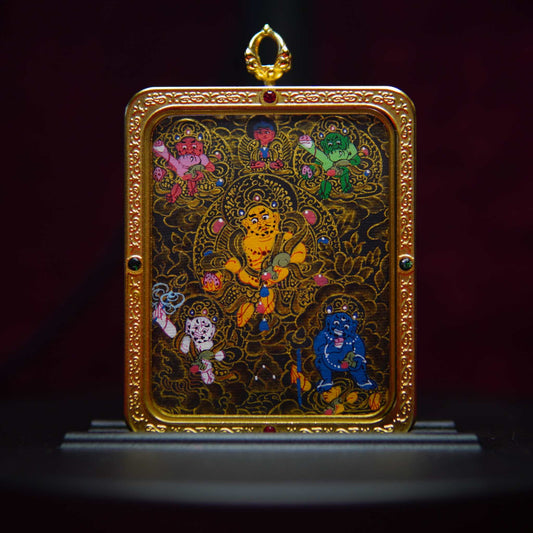
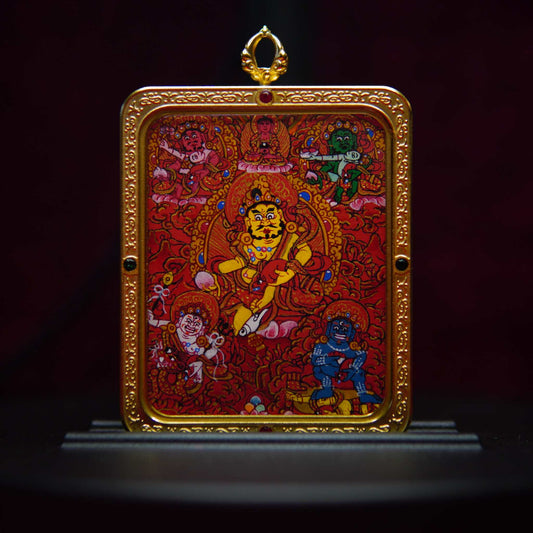
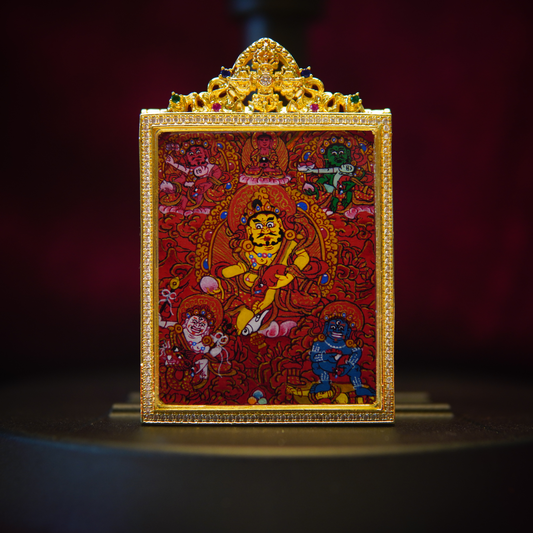
Instead, a Five Jambhalas composition brings multiple forms of the Jambhala tradition together within one visual system.
For someone interested in Tibetan Buddhist wealth iconography, that makes the piece particularly rich.
You are not looking at only one color.
You are looking at a miniature representation of a broader family of forms and activities.
 🎨 Why the Five Jambhalas Are Fascinating in Miniature Thangka Art
A single deity is already difficult to paint at miniature scale.
Now imagine five.
Different faces.
Different colors.
Different postures.
Different ritual attributes.
Different surrounding details.
All within a pendant only a few centimeters across.
This is where learning the iconography changes the value of the artwork.
Without knowing the Five Jambhalas, you may see:
“a colorful Buddhist wealth pendant.”
Once you understand the composition, you begin looking for:
Yellow.
White.
Black.
Red.
Green.
You start asking whether the artist preserved the differences between them.
The painting becomes something you can explore.
📿 Five Jambhalas in a Hand-Painted Thangka Pendant
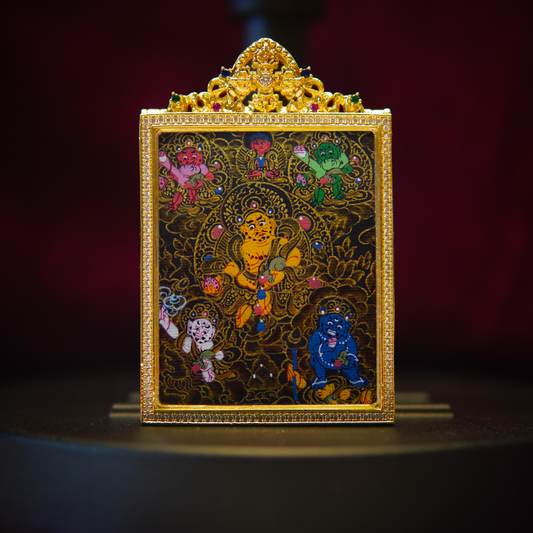
Our hand-painted Five Jambhalas Tibetan Thangka pendant brings these different wealth-deity forms together within one miniature composition.
Each piece is individually painted by hand, so subtle differences in expression, linework, color, placement, and surrounding details naturally occur.
For Buddhist practitioners, the Five Jambhalas belong to specific religious traditions and practices.
For collectors and others interested in Tibetan Buddhist art, the composition can represent:
💰 Prosperity
🌈 Different Jambhala Activities
🌿 Material Support
🤲 Generosity
🪷 Relief from Scarcity
→ Explore the Hand-Painted Tibetan Thangka Pendant
But this raises an even bigger question.
If Buddhism teaches non-attachment, why does it have wealth deities at all?
→ Why Does Buddhism Have Wealth Deities? Isn't Wanting Money Against Buddhist Teachings?
Quick Questions About the Five Jambhalas
What are the Five Jambhalas?
The Five Jambhalas are commonly described as Yellow, White, Black, Red, and Green Jambhala, representing different forms within the broader Jambhala wealth-deity tradition.
Are all Five Jambhalas associated with wealth?
They belong to the broader Jambhala prosperity tradition, but their colors and forms can carry different ritual and iconographic emphases.
Which Jambhala is best for wealth?
It is more useful to understand the different forms than to rank them. Yellow Jambhala is particularly well known for wealth and material support, while other forms emphasize different activities within the broader tradition.
Why are the Jambhalas different colors?
Color participates in Vajrayana Buddhist systems of symbolism and activity. The meaning depends on the specific form and tradition rather than a universal modern color chart.
Is wearing all Five Jambhalas more powerful?
A Five Jambhalas Thangka should not be presented as automatically “five times stronger.” Its significance comes from bringing the different Jambhala forms together in one composition.