Green Tara Meaning: Symbolism, Compassion, Protection & Thangka Art
chenHenryGreen Tara is one of the most recognizable figures in Tibetan Buddhist art. Often depicted in vivid green, seated gracefully on a lotus, she is traditionally associated with compassion, protection from fear, and swift compassionate action.
Yet the meaning of Green Tara is expressed through much more than color alone. Her posture, hand gestures, lotus flowers, ornaments, and surrounding imagery all form part of a visual language preserved for generations in Buddhist art — especially in Green Tara Thangka paintings.
Understanding these details can transform the way we see a Green Tara Thangka: not simply as a beautiful image, but as an artwork filled with symbolism.
 Who Is Green Tara?
Tara is an important female figure in Mahayana and Vajrayana Buddhist traditions. She appears in different forms, represented through different colors and iconographic details.
Among them, Green Tara is perhaps the best known.
She is particularly associated with active compassion — compassion that is not merely felt, but expressed through action.
This quality can be seen immediately in her posture.
Unlike figures shown in a fully meditative lotus position, Green Tara is commonly depicted with one leg extended outward, while the other remains folded.
She appears peaceful and centered, yet ready to rise.
It captures one of the most beautiful ideas associated with Green Tara:
Compassion is not only something we feel. It is something we act upon.
What Does Green Tara Symbolize?
Three themes are especially important when understanding Green Tara.
Compassion
Green Tara is strongly associated with compassion toward those experiencing fear, difficulty, or suffering.
Her symbolism goes beyond sympathy. She represents a compassionate response — the willingness to recognize suffering and act when help is needed.
For many people, her image therefore serves as a reminder to bring more kindness, patience, and awareness into everyday life.
Protection
Green Tara is also traditionally associated with protection from fears and obstacles.
Within Buddhist traditions, this symbolism has deeper religious interpretations. Rather than understanding a Green Tara image as a guarantee of supernatural protection, it can also be appreciated as a reminder of the courage and compassionate awareness with which fear can be faced.
Swift Action
One of Green Tara's most distinctive qualities is her readiness to respond.
Her extended leg is often interpreted as a visual sign that she is prepared to rise and act.
She is serene, but not distant.
Peaceful, but not passive.
Compassionate, yet ready for action.
 Symbols in a Green Tara Thangka
A Green Tara Thangka contains layers of visual symbolism. Individual paintings vary, but several elements appear frequently.
The Green Color
Green is Green Tara's defining visual characteristic and helps distinguish her from other forms of Tara, such as White Tara.
Her green body is traditionally connected with active compassionate energy — a quality reflected throughout her iconography.
The Lotus
Lotus flowers frequently appear beside Green Tara.
The lotus is one of Buddhism's most recognizable symbols. Growing from muddy water before opening above the surface, it has long been associated with purity, awakening, and spiritual development amid the difficulties of ordinary life.
In Green Tara imagery, the lotus reinforces the sense of awakened compassion surrounding her.
Her Hand Gestures
Green Tara's right hand is commonly depicted in a gesture associated with generosity and giving.
Her other hand is often held near her heart while connected visually with a lotus stem.
These gestures are not simply decorative poses. They belong to the symbolic vocabulary through which Buddhist artists communicate Tara's qualities.
Her Extended Leg
Perhaps the easiest feature to recognize is Green Tara's extended leg.
While remaining seated in calm awareness, she appears ready to move.
The pose beautifully combines two qualities:
inner calm and readiness to act.
Why Green Tara Appears in Thangka Art
A Thangka is traditionally much more than decorative Tibetan art.
Thangka paintings have historically served religious, educational, and contemplative purposes. Their carefully structured compositions communicate Buddhist figures, teachings, and symbolic traditions through visual form.
Green Tara is especially striking in this medium.
Her green complexion, lotus flowers, elaborate ornaments, expressive posture, and surrounding patterns create a composition that can be appreciated from a distance — yet becomes even more fascinating when examined closely.
Look carefully and you begin to notice tiny details:
the lines around her eyes, individual petals, jewelry, cloud forms, textile patterns, and carefully painted outlines.
That attention to detail is part of what makes Green Tara Thangka art so distinctive.
A Green Tara Thangka in Miniature
Traditional Thangkas are often imagined as larger paintings displayed on walls, altars, or within dedicated Buddhist spaces.
But the same visual language can also exist on a remarkably small scale.
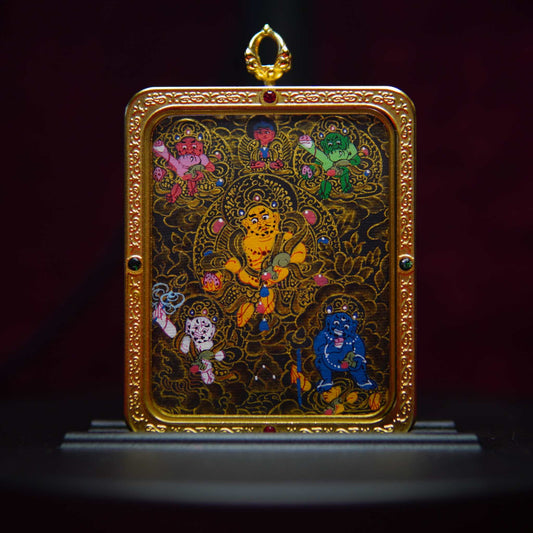
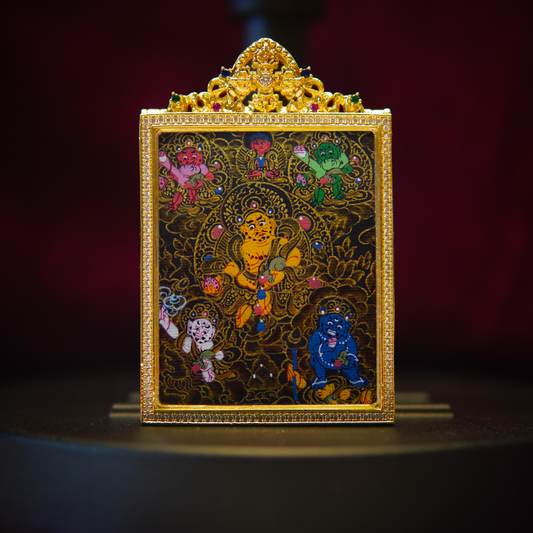
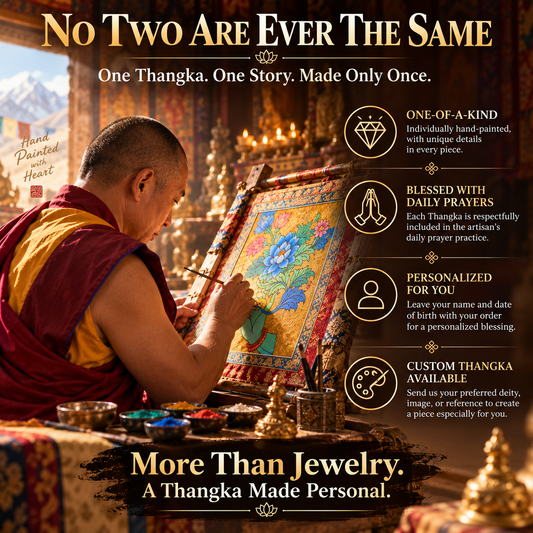
At ZenDo Thangka, Green Tara imagery is painted as miniature hand-painted Thangka art.
Reducing the scale creates an entirely different challenge.
The expression must remain recognizable. The posture needs to remain clear. Lotus flowers, garments, ornaments, clouds, and architectural details must all fit within a space small enough to hold between your fingers.
[IMAGE: Hand holding the miniature Green Tara Thangka]
Seeing the painting beside a human hand immediately reveals its scale.
From a distance it looks like a colorful image.
Up close, individual painted lines and tiny details become visible.
That contrast — miniature scale, intricate detail — is part of what makes these pieces unusual.
 Green Tara Mantra
People discovering Green Tara often encounter her mantra:
Om Tare Tuttare Ture Soha
The mantra belongs to a living Buddhist practice and carries meanings that extend beyond a simple translation or decorative phrase.
Different Buddhist traditions and teachers may offer deeper explanations of its meaning and practice.
Its close association with Green Tara also reminds us of something important: Green Tara is not simply an artistic subject.
The imagery belongs to a much larger Buddhist tradition that has been preserved through teachings, practice, and art.
From Green Tara Thangka to Wearable Art
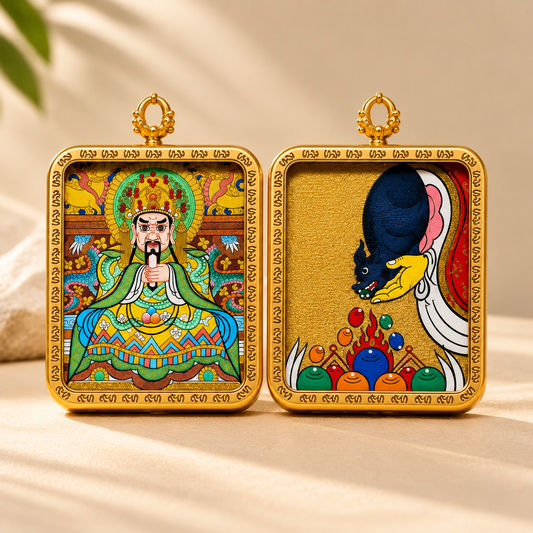
A miniature Green Tara painting can also become something unexpectedly personal: wearable art.
When placed within a pendant setting, the painting remains the visual focus.
This makes a hand-painted Thangka pendant different from jewelry based primarily on an engraved Buddhist symbol or printed image.
The artwork itself is the centerpiece.
[IMAGE: Finished Green Tara Thangka pendant]
For someone drawn to Green Tara, it may serve as a personal reminder of compassion, courage, and readiness to help.
For someone interested in Tibetan Buddhist art, it offers another way to appreciate miniature painting and craftsmanship.
And because each piece is painted by hand, small variations naturally occur from one painting to another.
Rather than making every piece identical, those differences reveal something important:
the presence of the artist's hand.
What Green Tara Can Remind Us Of
Green Tara's symbolism is richer than a simple promise of good luck or protection.
Her image brings together calmness and movement, compassion and courage, contemplation and action.
Perhaps that is why Green Tara continues to resonate with people across cultures.
Her imagery leaves us with a simple but meaningful question:
When compassion is needed, are we ready to act?
Explore Hand-Painted Green Tara Thangka Art
Discover our miniature Green Tara Thangka, painted by hand and transformed into wearable Tibetan-inspired art.
Explore the Green Tara Thangka Pendant →