Why Are a Sword and a Book Floating Beside Tsongkhapa?
chenHenry⚔️ Why Does a Buddhist Monk Have a Sword?
Look closely at a traditional Thangka of Je Tsongkhapa.
He is dressed as a monk.
His hands form a teaching gesture.
His expression is calm.
Nothing about him looks like a warrior.
And yet, beside him appears something unexpected:
a sword.
On the other side is a book.
In many traditional depictions, both appear upon lotus blossoms beside Tsongkhapa rather than being held directly in his hands.
They are not decorative additions.
Together, they tell you something essential about Tsongkhapa's identity: his close association with wisdom, Buddhist learning, philosophical understanding and teaching.
Once you understand the sword and the book, the entire Thangka becomes easier to read.

🪷 Who Was Je Tsongkhapa?
Je Tsongkhapa (1357–1419) was one of the most influential teachers and scholars in Tibetan Buddhist history and the founder of the Gelug tradition.
He became renowned for extensive study, philosophical writing, monastic discipline and an approach that brought scholarship and contemplative practice together.
This is important because Tsongkhapa's Thangka imagery reflects exactly those qualities.
His portrait isn't simply telling us:
“This was an important monk.”
The surrounding symbols tell us what kind of master he was understood to be.
The sword and scripture are especially significant because they connect Tsongkhapa visually with Manjushri, the bodhisattva of wisdom.
⚔️ What Does the Sword Beside Tsongkhapa Mean?
The sword is not a weapon in the ordinary sense.
It is the Sword of Wisdom, one of the most recognizable attributes of Manjushri.
In Buddhist iconography, Manjushri's flaming sword symbolizes wisdom cutting through ignorance, confusion and mistaken understanding.
That makes the image much more interesting.
A sword is sharp.
It separates one thing from another.
Used symbolically, it becomes an ideal image for discernment—the ability to distinguish clearly rather than remain trapped in confusion.
This is why a sword can appear beside a peaceful Buddhist scholar without turning him into a warrior.
It represents a different kind of cutting:
clarity cutting through ignorance.
For Tsongkhapa, whose legacy is deeply connected with Buddhist philosophy and rigorous study, that symbolism is particularly appropriate.
📖 What Is the Book Beside Tsongkhapa?
The other major clue is the book.
In iconography connected with Manjushri, the scripture is commonly associated with the Prajñāpāramitā, or Perfection of Wisdom teachings.
So the sword and book work together.
The sword represents wisdom in its penetrating, discerning form.
The scripture represents wisdom preserved, studied, taught and transmitted.
One cuts through confusion.
The other gives wisdom a textual and teaching tradition.
For a figure such as Tsongkhapa—famous for scholarship, philosophical analysis and teaching—the pairing feels almost like a visual summary of his life's work.
This also explains why Learning and Wisdom are much more appropriate descriptions of Tsongkhapa symbolism than generic terms such as “good luck.”
🪷 Why Are the Sword and Book Resting on Lotus Flowers?
Look more closely and another detail appears.
The sword and scripture are often not floating by themselves.
They emerge with lotus blossoms beside Tsongkhapa.
The lotus is one of the most familiar symbols in Buddhist visual culture and is widely associated with purity and awakening.
Its natural growth provides the metaphor: the flower rises from muddy water yet blooms above the surface.
In Tsongkhapa imagery, the lotus also provides an elegant visual support for the attributes of wisdom.
So the composition brings several layers together:
Lotus → purity and awakening
Sword → wisdom cutting through ignorance
Book → wisdom studied and transmitted
The result is not simply a portrait.
It is a carefully constructed statement about Buddhist learning.
🧠 What Does Manjushri Have to Do With Tsongkhapa?
Quite a lot.
Tsongkhapa is closely associated in Tibetan tradition with Manjushri, the bodhisattva of wisdom.
This relationship helps explain why Manjushri's familiar attributes—the sword and wisdom scripture—appear beside him in Thangka paintings.
For someone new to Tibetan Buddhist art, this creates a useful connection.
If you already know Manjushri, you may recognize the sword immediately.
Then you see the same visual language beside Tsongkhapa.
The image is effectively telling you:
Pay attention to wisdom.
This is also why different Buddhist figures can share certain symbols without being the same deity.
Tsongkhapa is not Manjushri simply because the sword appears beside him.
The imagery expresses their traditional connection.
🙏 What Are Tsongkhapa’s Hands Doing?
The sword and book attract attention, but Tsongkhapa's hands provide another clue.
He is commonly depicted making a teaching gesture, reinforcing his identity as a great Buddhist teacher.
This matters because the entire composition works together.
The scholar's hat tells us something.
The monastic robes tell us something.
The teaching gesture tells us something.
The sword and book tell us something.
Taken together, the Thangka communicates:
study → understanding → practice → teaching.
That sequence fits Tsongkhapa far better than treating each symbol as an isolated “spiritual benefit.”
👀 How Can You Recognize Tsongkhapa in a Thangka?
Once you know the clues, Tsongkhapa becomes much easier to identify.
Look for:
🟡 Yellow Scholar's Hat — one of his most recognizable visual features
🙏 Teaching Gesture — reflecting his role as a Buddhist master and teacher
⚔️ Sword of Wisdom — associated with Manjushri and wisdom cutting through ignorance
📖 Wisdom Scripture — associated with Buddhist learning and the Perfection of Wisdom tradition
🪷 Lotus Blossoms — supporting the sword and scripture in many traditional compositions
🧘 Monastic Robes — emphasizing Tsongkhapa's identity as a monk and scholar
Once these details become familiar, you stop seeing “a monk surrounded by decorative objects.”
You begin reading the image.
📿 Why Carry a Tsongkhapa Thangka?
Tsongkhapa's imagery makes this pendant especially meaningful for people whose lives center around learning, teaching or sustained practice.
Students.
Teachers.
Researchers.
Meditators.
Buddhist practitioners.
People beginning a serious new field of study.
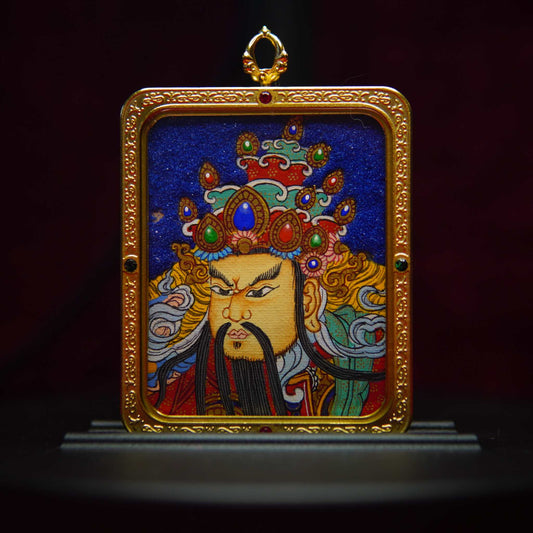
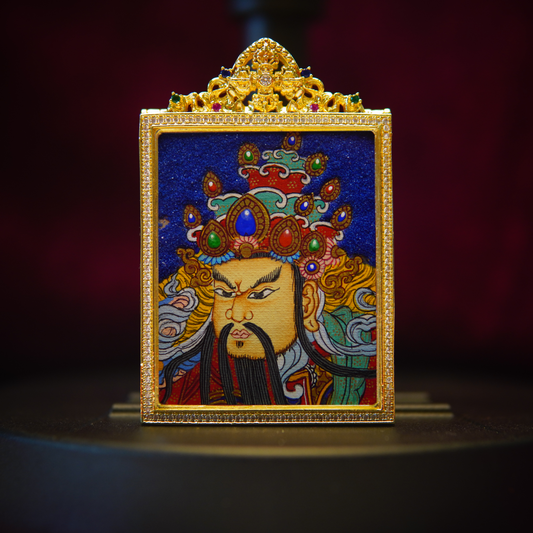
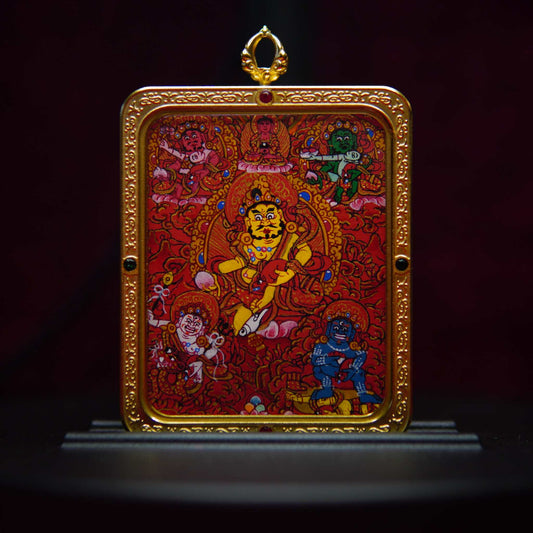
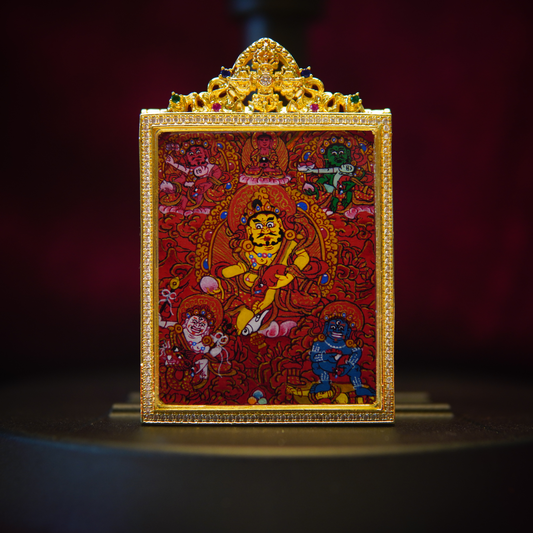
Our hand-painted Je Tsongkhapa Tibetan Thangka pendant brings the yellow hat, teaching gesture, lotus imagery and wisdom symbols into a miniature painting only a few centimeters across.
Each piece is individually painted by hand, so subtle differences in color and fine details naturally occur.
For practitioners, Tsongkhapa may have specific devotional significance.
For others, the imagery can serve as a reminder of something simpler:
understanding takes study, and study takes patience.
→ Explore the Hand-Painted Je Tsongkhapa Thangka Pendant

And if you've ever wondered about that unmistakable yellow hat:
→ Why Do Tibetan Buddhist Monks Wear Yellow Hats?
❓Quick Questions
Why does Tsongkhapa have a sword beside him?
The sword is associated with Manjushri's Sword of Wisdom, symbolizing wisdom cutting through ignorance and confusion.
What is the book beside Tsongkhapa?
It is connected with the Buddhist wisdom scripture traditionally associated with Manjushri, commonly identified with the Prajñāpāramitā or Perfection of Wisdom teachings.
Is Tsongkhapa the same as Manjushri?
No. Tsongkhapa is a historical Tibetan Buddhist master. However, Tibetan tradition closely associates him with Manjushri, which helps explain the presence of Manjushri's sword and scripture in his iconography.
What does a Tsongkhapa Thangka represent?
Tsongkhapa imagery is especially associated with wisdom, learning, Buddhist teaching, disciplined practice and spiritual development.