Why Is White Mahakala Associated With Wealth if Mahakala Is a Wrathful Protector?
chenHenry💰 He Doesn't Look Like a Wealth Deity
White Mahakala doesn't look like the kind of figure most people would associate with prosperity.
His expression is fierce.
He has multiple arms.
He holds ritual implements.
His appearance belongs unmistakably to the dramatic visual world of Tibetan Buddhist protectors.
There are no piles of coins and no smiling god of fortune.
And yet White Mahakala—particularly the White Six-Armed form—is traditionally associated with prosperity, increase and supportive conditions, while retaining Mahakala's powerful protective character.
So why would a wrathful Buddhist protector become connected with wealth?
The answer begins with an important distinction:
Prosperity is not necessarily the same thing as “getting rich.”

🤍 Who Is White Mahakala?
White Mahakala is a distinctive form of Mahakala associated with both protective activity and practices connected with increase, prosperity and supportive conditions.
Mahakala appears in numerous forms across Tibetan Buddhist traditions.
Many people first encounter him through dark or black wrathful forms, so the appearance of a white Mahakala can be surprising.
But the color isn't simply an artistic preference.
Different tantric forms can emphasize different activities and functions.
White Mahakala is particularly notable because his imagery brings together two ideas that may initially seem unrelated:
protection and prosperity.
This combination is one reason the White Six-Armed Mahakala has become especially recognizable.
💰 Why Is White Mahakala Associated With Wealth?
The easiest explanation would be:
White Mahakala is a Buddhist wealth god.
But that is too simple.
His prosperity associations are better understood through the tantric category of increase—activity connected with increasing favorable conditions, resources, merit, well-being and support.
Material resources can certainly be part of that.
After all, people need food, shelter, tools and economic stability.
Monasteries need resources.
Communities need support.
Practitioners need conditions that allow them to study and practice.
So prosperity has a place within religious life.
The important difference is that wealth is not necessarily treated as an end in itself.
Resources can also be understood in terms of what they make possible.
This gives White Mahakala's wealth symbolism a different tone from a simple promise of financial gain.
🌿 Does Prosperity Just Mean Money?
Not necessarily.
This is probably the most important distinction for understanding White Mahakala.
Modern advertising often reduces prosperity to a bank balance.
But “supportive conditions” can be much broader.
They can include:
💰 Material Resources — the practical means needed to sustain life and activity
🌿 Supportive Conditions — circumstances that allow important work or practice to continue
📈 Increase & Development — the growth of beneficial conditions rather than accumulation for its own sake
🤝 Support & Opportunity — access to people, circumstances and resources that make progress possible
🪷 Spiritual Support — conditions that make study, practice and generosity possible
This doesn't mean every modern interpretation should be projected backward into Buddhist tradition.
But it does help explain why “prosperity” is a better word than simply “money.”
👹 Why Is a Wealth-Associated Deity Still Wrathful?
This is where White Mahakala differs dramatically from the image many people have of a wealth deity.
He is still Mahakala.
His fierce appearance has not disappeared simply because this form is associated with prosperity.
In Tibetan Buddhist iconography, wrathful imagery can express powerful protective and obstacle-removing activity rather than uncontrolled anger.
So White Mahakala brings together:
increase + protection
rather than:
wealth + gentleness.
This is why his appearance remains fierce.
The prosperity activity doesn't erase his role as a protector.
If anything, the combination makes the symbolism more distinctive.
Resources are being considered alongside the protection of beneficial conditions.
🛡️ What Does Protection Have to Do With Prosperity?
Imagine building something without protecting it.
A business grows, but its foundations are weak.
A person gains resources but cannot manage them.
An opportunity appears but disappears because the conditions supporting it are unstable.
Prosperity and protection are not automatically the same thing, but they can complement one another.
White Mahakala's traditional imagery brings those ideas unusually close together.
This is why the figure can resonate with people who are not simply interested in “wealth,” but in the broader idea of building and sustaining favorable conditions.
Again, a Thangka should not be presented as a guarantee that those conditions will appear.
The symbolism offers a framework, not a financial promise.
👐 Why Does White Mahakala Have Six Arms?
The White Six-Armed Mahakala is one of the distinctive iconographic forms associated with this deity.
Multiple arms are common in tantric Buddhist art and form part of a visual language expressing different activities and attributes.
Each hand and ritual implement belongs to the specific iconographic tradition of the deity.
This is where careful interpretation matters.
It is tempting to look at every object and assign a modern benefit:
this object attracts money,
this one brings customers,
this one removes competitors.
That kind of explanation quickly becomes inaccurate.
A better approach is to understand the composition as part of an established tantric iconographic system rather than as a collection of magical tools.
🎨 Why Is White Mahakala Actually White?
Color in tantric Buddhist art can be connected with different modes of activity.
White Mahakala's color is especially associated with the increasing or enriching dimension of his activity.
This is also why the white form should not simply be interpreted as:
white = peaceful.
Look at the image.
The face remains fierce.
The multiple arms remain.
The protector imagery remains.
White changes the activity being emphasized; it does not turn Mahakala into a peaceful Buddha.
That distinction becomes especially useful when comparing White Mahakala with darker Mahakala forms.
→ White Mahakala vs Black Mahakala: What's the Difference?
💼 Why Does White Mahakala Appeal to Business Owners and Entrepreneurs?
It isn't difficult to see why the symbolism has modern appeal.
Anyone building a business thinks constantly about:
resources,
growth,
opportunity,
obstacles,
risk,
and sustainability.
Those concepts overlap naturally with the modern language of prosperity and protection.
That doesn't mean White Mahakala should be turned into:
“the Buddhist deity for entrepreneurs.”
His traditional meaning is much older and more specific.
But someone choosing a symbolic object for a new business, career transition or ambitious project may find the combination of prosperity, protection and overcoming obstacles particularly meaningful.
The same can apply to a graduation, new job or major new beginning.
📿 White Mahakala in Miniature Thangka Art
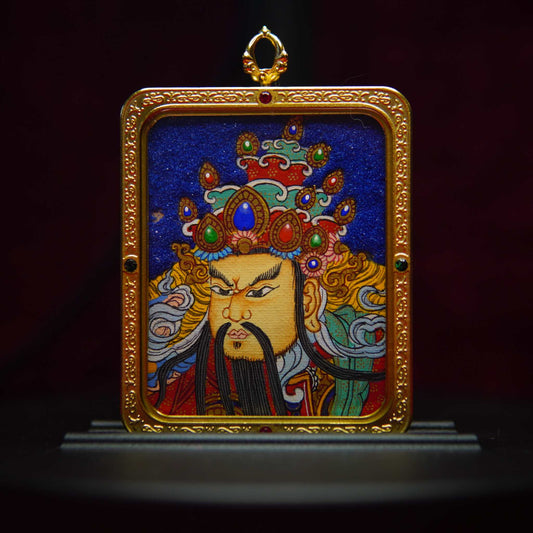
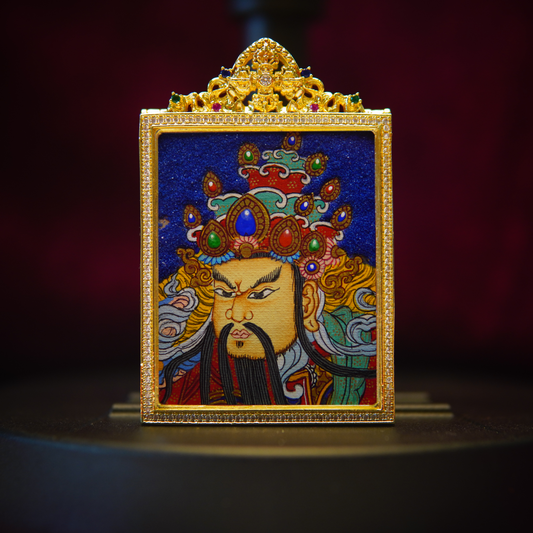
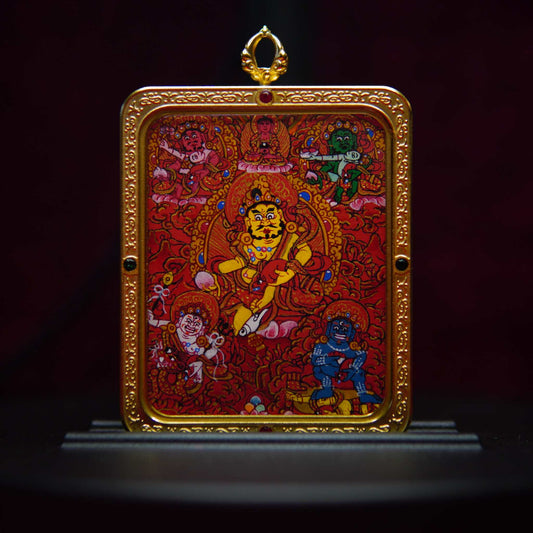
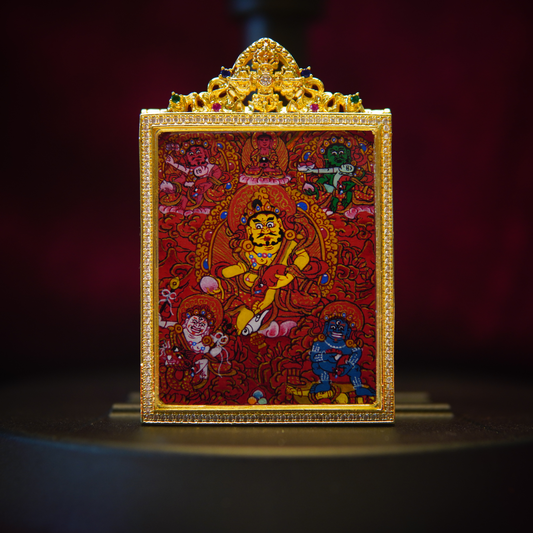
Our hand-painted White Six-Armed Mahakala Tibetan Thangka pendant brings this distinctive protector imagery into a miniature painting only a few centimeters across.
The fierce expression, six arms, ritual implements, flowing garments and richly detailed gold-toned composition are individually painted by hand.
For Buddhist practitioners, White Mahakala may carry specific religious significance.
For collectors and others drawn to Tibetan Buddhist art, the image can represent a particularly unusual combination:
prosperity without separating it from protection, and growth without separating it from responsibility.
Each miniature Thangka is hand-painted, so subtle differences in linework, color and fine detail naturally occur.
→ Explore the Hand-Painted White Six-Armed Mahakala Thangka Pendant

❓Quick Questions About White Mahakala
What does White Mahakala represent?
White Mahakala is particularly associated with prosperity, increase, supportive conditions and protective activity within Tibetan Buddhist traditions.
Is White Mahakala a wealth deity?
White Mahakala has strong associations with prosperity and increase, but describing him only as a “wealth god” oversimplifies his role as a Mahakala protector.
Does White Mahakala make you rich?
A White Mahakala image should not be presented as guaranteeing financial wealth. Its traditional associations concern prosperity, increase and supportive conditions within a Buddhist religious context.
Why does White Mahakala have six arms?
The six arms belong to the iconography of the White Six-Armed Mahakala form and carry specific ritual and symbolic attributes within the tradition.