Why Is Yamantaka Shown Embracing a Consort? The Meaning Behind Tantric Union
chenHenry☯️ Why Is Yamantaka Embracing Another Figure?
Yamantaka already looks complicated enough on his own.
A fierce buffalo-like head.
Multiple eyes and arms.
Flames.
Ritual implements.
Wrathful expressions.
Then you notice something else.
Yamantaka is embracing another figure.
For someone encountering Vajrayana Buddhist art for the first time, the combination can be confusing.
Why would one of Tibetan Buddhism's fiercest-looking tantric deities appear in such an intimate embrace?
Is the image romantic?
Is it sexual?
And who is the figure beside him?
The answer lies in the tantric Buddhist imagery of union, often discussed through the Tibetan term Yab-Yum.
In this context, the embrace isn't simply about two figures being together.
It expresses something much more abstract:
the inseparability of method and wisdom.
👹 Who Is Yamantaka?

Yamantaka is a major wrathful deity of Vajrayana Buddhism closely associated with Manjushri, the bodhisattva of wisdom.
His name is commonly interpreted in relation to overcoming Yama, the Lord of Death, which is why Yamantaka is often called the “Conqueror of Death.”
His terrifying appearance is intentional.
The buffalo-headed form, multiple arms, flames, fierce expressions, and ritual attributes belong to the visual language of wrathful tantric Buddhism.
But wrathful does not simply mean: angry.
And it certainly doesn't mean: evil.
The fierce form represents a particular kind of powerful enlightened activity.
This becomes especially important when trying to understand why Yamantaka can appear in union with a consort.
🪷 Who Is Yamantaka’s Consort?
In important tantric forms, Yamantaka or Vajrabhairava may be depicted in union with a female consort.
The exact identity and iconographic details depend on the specific tantric form and lineage, so it is better not to identify every female figure in every Yamantaka image from appearance alone.
For someone viewing the artwork as a non-specialist, the more important first step is understanding why the consort is there at all.
She is not simply a romantic partner added to the composition.
The union belongs to a sophisticated tantric symbolic system.
And that brings us to Yab-Yum.
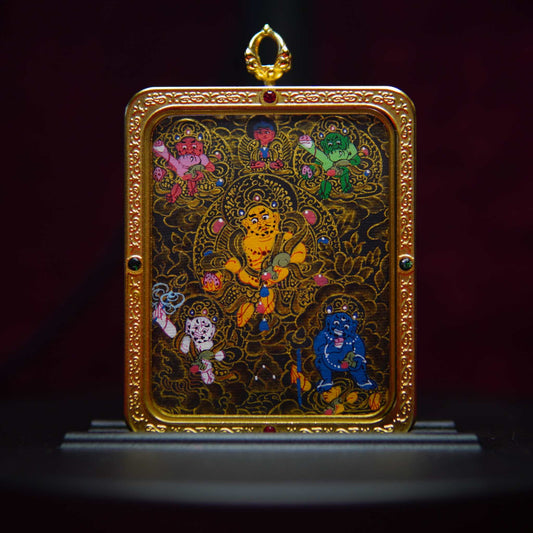
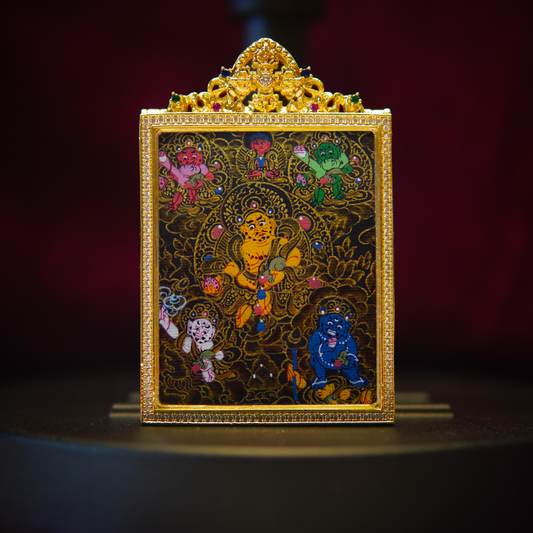
Hand-Painted Yamantaka Thangka Pendant
 ☯️ What Does Yab-Yum Mean?
Yab-Yum is a Tibetan expression commonly used for tantric Buddhist imagery in which a male deity appears in union with a female consort.
Literally, yab means “father” and yum means “mother.”
But the literal translation does not explain the religious meaning.
Within Vajrayana Buddhist symbolism, the figures can express complementary aspects of the path.
The male figure is commonly associated with method or skillful means, including compassionate enlightened activity.
The female figure is associated with wisdom, particularly insight into the nature of reality.
The embrace visually communicates that these two are not ultimately separate.
This is why Yab-Yum imagery appears in more than one tantric Buddhist tradition.
You may encounter union imagery in Thangkas of Guhyasamaja, Chakrasamvara, Hevajra, and certain forms connected with Yamantaka.
The deities are different.
The iconography is different.
But the broader visual language of union appears across Vajrayana art.
🧠 What Do “Method” and “Wisdom” Have to Do With an Embrace?
Imagine trying to represent a philosophical idea in a painting.
You could write:
Wisdom and compassionate method must be inseparable on the path to awakening.
But a Thangka does not need to write that sentence.
It can show union.
Wisdom without effective compassionate activity would be incomplete.
Activity without wisdom would also be incomplete.
Tantric art makes this relationship physical and immediately visible.
The figures aren't merely placed beside each other.
They are joined.
That intimacy is exactly what gives the image its symbolic power.
👁️ Is Yamantaka’s Tantric Union Sexual?
The imagery deliberately uses sexual union.
Pretending otherwise doesn't help someone understand the painting.
But reducing it to erotic art is equally misleading.
Tantric union imagery uses sexuality within a specific Vajrayana religious and symbolic context.
The embrace can communicate non-duality and the inseparability of complementary aspects such as method and wisdom.
This is why a Yamantaka with Consort Thangka should not be marketed as:
“a Buddhist love charm.”
Nor should it be described as a symbol designed to improve someone's romantic life.
That would confuse two very different kinds of Buddhist imagery.
If you're looking specifically for Buddhist imagery connected with love and desire, a figure such as Ragaraja (Aizen Myoo) belongs to a very different religious and symbolic story.
Yamantaka's union imagery is tantric—not romantic.
🔥 Why Does Such an Intimate Image Look So Terrifying?
This is where Yamantaka becomes especially interesting.
Modern viewers often put visual ideas into separate categories:
Love looks gentle.
Wisdom looks peaceful.
Wrath looks violent.
Union looks intimate.
Yamantaka does not follow those categories.
The deity can be simultaneously:
wrathful,wise,in union,and associated with powerful tantric activity.
In Vajrayana iconography, these are not necessarily contradictions.
The wrathful form expresses forceful activity.
The union expresses inseparability.
The connection with Manjushri places wisdom at the heart of the imagery.
The result is deliberately intense.
Hand-Painted Yamantaka Thangka Pendant
 🎨 How to Read a Yamantaka with Consort Thangka
You don't need to identify every tiny ritual implement to begin reading the painting.
Start with the major visual clues.
🐃 Buffalo-Headed Form — connects Yamantaka imagery with Yama and the theme of conquering death
☯️ Consort in Union — points toward tantric union and the inseparability of method and wisdom
🔥 Flames — reinforce the wrathful and transformative atmosphere
👐 Multiple Arms — belong to the deity's complex tantric iconography
👁️ Fierce Expression — communicates powerful activity rather than peaceful contemplation
⚔️ Ritual Implements — have specific meanings within particular iconographic traditions
Once you understand those relationships, the image changes.
It no longer looks like a collection of bizarre details.
It begins to read like a visual language.
📿 Why Choose a Yamantaka with Consort Thangka?
For Vajrayana practitioners, Yamantaka belongs to specific tantric traditions and practices.
For collectors and people studying Tibetan Buddhist art, the image offers another kind of value.
It brings together several major Vajrayana themes within a single composition:
🧠 Wisdom
☯️ Method and Wisdom in Union
🔥 Transformation
🛡️ Wrathful Activity
⚡ Overcoming Obstacles
Our hand-painted Yamantaka with Consort Tibetan Thangka pendant preserves this complex imagery in miniature form, with the deity, consort, multiple arms, flames, and ritual details individually painted by hand.
Subtle differences in linework and color naturally occur from piece to piece.
→ Explore the Hand-Painted Yamantaka with Consort Thangka Pendant

But there is still another puzzle:
Why combine such an intimate image of union with one of Buddhism's most terrifying wrathful forms?
→ Why Does Yamantaka Combine Tantric Union With Wrathful Imagery?
❓Quick Questions
Why is Yamantaka shown with a consort?
In tantric forms, the union with a consort belongs to Vajrayana symbolism and can express the inseparability of method and wisdom.
What does Yab-Yum mean?
Yab-Yum is a Tibetan term commonly used for tantric imagery depicting a male deity in union with a female consort.
Is Yamantaka with Consort a love symbol?
Not primarily. The union belongs to tantric Buddhist symbolism and should not be reduced to ordinary romance or attraction.
Is Yamantaka the same as Vajrabhairava?
The terms are closely connected. Vajrabhairava is an important tantric form within the broader Yamantaka tradition.