Why Does Zaki Lhamo Look So Fierce? The Story Behind Tibet’s Mysterious Fortune Protector
chenHenryShe Doesn't Look Like Most People's Idea of a Buddhist Goddess
Huge eyes.
A dark face.
A fierce expression.
An elaborate crown.
Sometimes an open mouth and an almost intimidating stare.
Then comes the surprising part:
Zaki Lhamo is widely associated by devotees with good fortune, prosperity, protection, and successful endeavors.
That creates an obvious question.
Why does a figure connected with fortune look so frightening?
Is she angry?
Is she evil?
Or are we simply reading her image through the wrong visual language?
For someone encountering Zaki Lhamo for the first time, understanding her face is one of the best ways to begin understanding the figure herself.
 Who Is Zaki Lhamo?
Zaki Lhamo, also spelled Zaki Lamo or Zhaki Lhamo, is a distinctive female protector figure associated with Tibetan Buddhist devotional culture and widely connected by devotees with protection, prosperity, and good fortune.
Her popularity is particularly interesting because she does not look like the peaceful Buddhist figures many Western viewers encounter first.
Compare her with Green Tara.
Or White Tara.
Their faces are serene and graceful.
Zaki Lhamo's image can feel completely different.
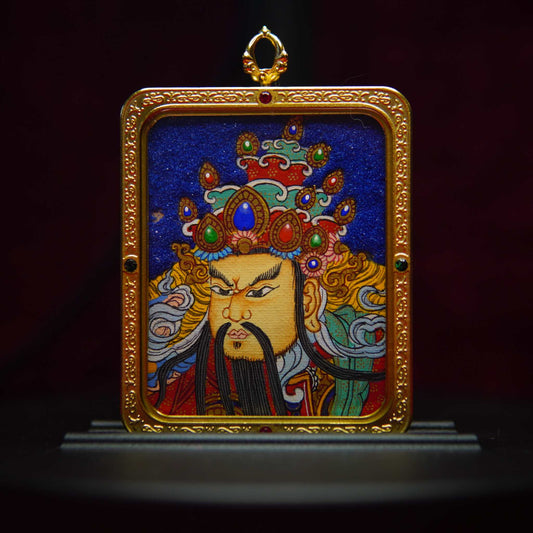
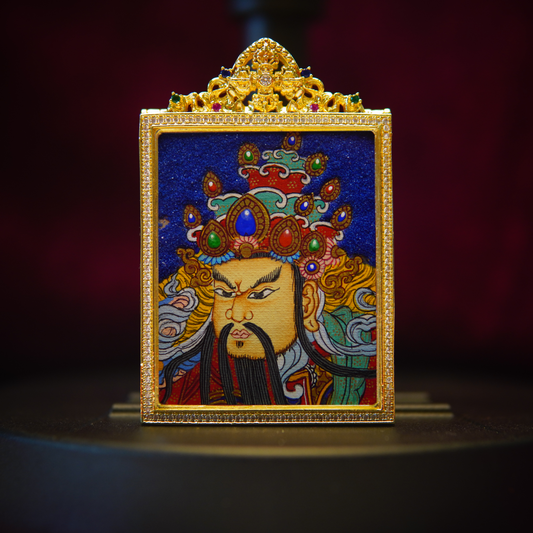
Her eyes command attention.
Her face can appear fierce.
Her ornaments are dramatic.
The entire image feels alert and powerful.
This is one reason simply calling her a:
“wealth goddess”
doesn't explain very much.
Her identity also needs to be understood through the language of protection and devotional practice.
Why Are There Different Spellings of Zaki Lhamo?
If you've searched for her online, you may already have noticed something confusing.
You might see:
Zaki Lhamo
Zaki Lamo
Zhaki Lhamo
Zhaki Lamo
These are not necessarily four different figures.
They reflect different attempts to represent Tibetan names in the Latin alphabet, along with variations that have become common through English and Chinese-language usage.
For shoppers, this matters because searching only one spelling can make it seem as if very little information exists.
For our collection, we use Zaki Lhamo consistently as the primary English spelling while recognizing the common alternatives.
 Why Does Zaki Lhamo Look So Fierce?
The first thing to understand is:
Fierce does not automatically mean evil.
This is a recurring challenge when Western viewers first encounter Tibetan Buddhist art.
Large eyes.Dark colors.Fangs or exposed teeth in some figures.Flames.Skulls.
Intense facial expressions.
Popular culture teaches us to associate these things with villains or monsters.
Tibetan and Himalayan sacred art developed within a very different symbolic world.
A powerful protector does not necessarily need to look gentle.
A fierce appearance can communicate:
vigilance,authority,protection,and an active response to harmful or difficult conditions.
This does not mean every fierce Buddhist figure has exactly the same meaning.
Zaki Lhamo should still be understood through her own devotional history rather than simply borrowing explanations from Mahakala or Palden Lhamo.
But the larger lesson remains important:
Do not identify the moral character of a Buddhist figure from facial expression alone.
Is Zaki Lhamo Evil?
No. Zaki Lhamo is revered as a protector figure, not as an evil or demonic being.
Her intimidating appearance can easily create the wrong impression for someone unfamiliar with the tradition.
This is why context matters.
If you saw only the face without the name, you might interpret it through modern horror imagery.
Once you know that devotees approach Zaki Lhamo in connection with protection, fortune, prosperity, and favorable circumstances, the image begins to tell a different story.
The fierce face no longer means:
“danger is coming from her.”
It can instead be understood within a protective visual language.
Is Zaki Lhamo a Goddess?
You will often find Zaki Lhamo described online as a:
Tibetan goddess
or even:
Tibetan wealth goddess.
Those phrases are understandable shorthand for English-speaking audiences.
But they can flatten a more complicated religious identity.
For someone learning about her for the first time, female protector is often a more useful starting point than simply “goddess.”
Why?
Because “wealth goddess” makes her sound as if her only purpose is to deliver money.
Her devotional identity also involves themes of:
protection,fortune,favorable conditions,and powerful presence.
So Zaki Lhamo goddess may be a useful search phrase.
It should not become the entire explanation.
 👁️ Why Are Zaki Lhamo's Eyes So Striking?
Look at your Zaki Lhamo Thangka again.
The eyes are difficult to ignore.
In many miniature depictions, they become the visual center of the entire painting.
Large.Direct.Alert.Almost confrontational.
It is tempting to invent an easy modern explanation such as:
“Her eyes help you see financial opportunities.”
That sounds good in an advertisement.
But it should not be presented as traditional Buddhist symbolism without evidence.
A more careful way to understand the visual effect is through ideas such as vigilance, powerful presence, and protector imagery.
The eyes make the figure feel awake.
Watching.
Present.
And in a miniature painting only a few centimeters wide, preserving that expression becomes one of the artist's biggest challenges.
Why Is Zaki Lhamo's Face So Dark?
The dark facial tones are another reason she is immediately recognizable in many depictions.
But just as with Black Jambhala, we should avoid turning color into a simplistic universal dictionary.
Dark does not automatically mean:
evil,anger,or misfortune.
The color belongs to the particular visual identity and artistic tradition of the figure.
More importantly, the dark face works together with:
the eyes,the crown,the mouth,the ornaments,and the surrounding composition.
Sacred art should be read as a complete image rather than as isolated color psychology.
Why Do Zaki Lhamo Thangkas Look So Different From One Another?
This question is especially relevant when you look at a collection like ours.
One Zaki Lhamo may have a large frontal face.
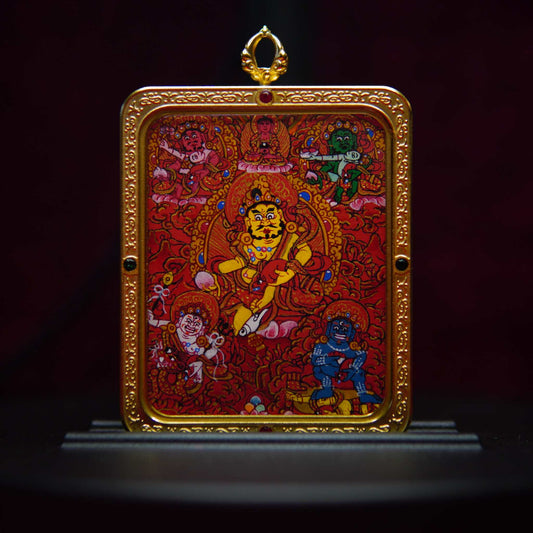
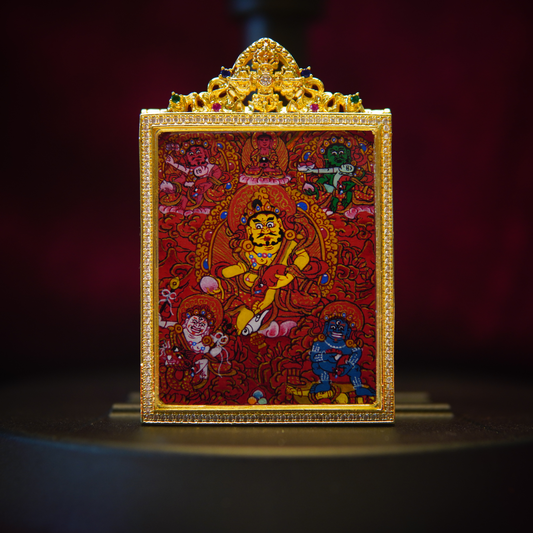
Another may show more of the body.
One composition may be dominated by black and gold.
Another may use red, turquoise, green, and blue.
Some are rectangular.
Others are round.
So are they really depicting the same figure?
They can be.
Hand-painted Thangka imagery is not a modern logo system where every representation must be pixel-for-pixel identical.
Different compositions can reflect:
different artists,
different iconographic arrangements,
different visual traditions,
different proportions,
and the practical challenges of miniature painting.
This is why identification should focus on the complete iconographic identity, not whether every painting looks exactly like the previous one.
 How Can You Recognize Zaki Lhamo in a Thangka?
Because designs vary, no single feature should be treated as an absolute test.
But several recurring visual clues can help.
👁️ Striking Eyes
Often among the most visually dominant features.
👑 Elaborate Crown
Rich crown and head ornaments appear prominently in many compositions.
🖤 Dark Facial Tones
A recognizable feature in many popular Zaki Lhamo images.
👹 Powerful Expression
Her appearance is noticeably more forceful than peaceful Tara imagery.
💎 Rich Ornamentation
Jewelry, decorative patterns, and vivid details contribute to her distinctive visual identity.
🎨 Strong Color Contrast
Black, red, gold, turquoise, green, and blue often create a particularly dramatic composition.
The complete combination matters.
Why Does Zaki Lhamo Become So Striking in Miniature Art?
Your rectangular Zaki Lhamo paintings measure approximately 4 × 5 cm, while the round paintings are only about 3.5 cm in diameter.
That is an extremely small space.
Yet the artist still needs to preserve:
the eyes,the expression,the crown,the jewelry,the mouth,the facial colors,and the surrounding patterns.
This is one reason Zaki Lhamo works so well as miniature art.
Her face is highly distinctive.
When successfully preserved at tiny scale, it remains immediately commanding.
The viewer does not need a huge painting to feel the presence of the image.
 Why Is Zaki Lhamo Associated With Good Fortune?
This is where her modern devotional popularity becomes especially interesting.
Zaki Lhamo has become strongly associated by devotees with:
💰 prosperity,
🍀 good fortune,
📈 successful endeavors,
🛡️ protection,
and favorable conditions.
For someone seeing her fierce appearance first, that connection can feel surprising.
How did a figure who looks this intimidating become so closely connected with fortune and prosperity?
That question deserves its own story.
→ Why Do Business Owners Pray to Zaki Lhamo? How She Became Associated With Wealth & Good Fortune
Why Carry a Zaki Lhamo Thangka?
For devotees, Zaki Lhamo can carry specific religious and personal significance.
For others interested in Tibetan and Himalayan sacred art, her image offers something dramatically different from peaceful Buddha or Tara imagery.
She may resonate through themes of:
💰 Prosperity
🍀 Good Fortune
🛡️ Protection
👁️ Vigilance
⚡ Strength
The pendant should not be presented as a guaranteed financial tool.
Its value lies in the religious, symbolic, artistic, and personal meaning carried by the image.
Zaki Lhamo in Hand-Painted Miniature Thangka Art
Our hand-painted Zaki Lhamo Tibetan Thangka pendants are available in multiple compositions, including rectangular paintings measuring approximately 4 × 5 cm and round paintings measuring approximately 3.5 cm in diameter.
Each piece is individually painted by hand.
That means differences in:
expression,eyes,crown,colors,linework,and surrounding details are natural.
No two need to be exactly alike.
And with Zaki Lhamo, those variations are especially fascinating because the face remains the center of attention.
→ Explore the Hand-Painted Zaki Lhamo Tibetan Thangka Pendant

Quick Questions About Zaki Lhamo
Who is Zaki Lhamo?
Zaki Lhamo is a distinctive female protector figure associated with Tibetan Buddhist devotional culture, widely connected by devotees with protection, fortune, prosperity, and favorable circumstances.
Why does Zaki Lhamo look so fierce?
Her powerful appearance should be understood within a protector-oriented sacred visual language rather than as evidence that she is evil.
Is Zaki Lhamo evil?
No. She is revered as a protector figure by devotees.
Is Zaki Lhamo a wealth goddess?
“Wealth goddess” is sometimes used as convenient English shorthand, but female protector associated with prosperity and good fortune provides a more nuanced description.
Are Zaki Lhamo and Zhaki Lhamo the same?
Zaki Lhamo, Zaki Lamo, Zhaki Lhamo, and Zhaki Lamo can be encountered as variant English spellings rather than automatically referring to different figures.
Why do Zaki Lhamo Thangkas look different?
Different artists, compositions, visual traditions, and miniature formats can produce significant variations while preserving the figure's recognizable iconographic identity.