8 Mini Thangka Benefits: Spiritual Meaning, Protection & Good Fortune
TapitaIn Tibetan Buddhist culture, a Thangka is much more than a painting. It is a sacred art form that carries centuries of spiritual teachings, blessings, and symbolic meaning.
A mini Thangka brings this tradition into a small, portable form. Some are kept in personal shrines, while others are crafted as hand-painted pendants that can be worn close to the heart.
So, what are the benefits of a mini Thangka?
From blessings and protection to prosperity, wisdom, and inner peace, these miniature artworks hold special significance for many Buddhist practitioners and collectors.
Here are eight traditional benefits and meanings associated with mini Thangkas.
1. Blessings, Purification & Positive Karma
One of the most important spiritual meanings of a Thangka is its connection to blessings and the purification of negative karma.
In Tibetan Buddhism, images of Buddhas and bodhisattvas are often used as objects of devotion, offerings, and contemplation.
Practitioners may believe that sincerely contemplating these sacred images, reciting prayers, and performing virtuous actions can help purify negative karma and accumulate merit.
A mini Thangka can serve as a personal reminder of these practices.
Rather than being a magical object that automatically removes negative karma, its spiritual significance is traditionally connected to faith, intention, and Buddhist practice.
For many believers, carrying a sacred image represents a heartfelt wish for blessings, peace, and a more compassionate life.
2. Spiritual Protection & Peace
Protection is another reason people are drawn to Tibetan Buddhist imagery.
Certain Buddhas, bodhisattvas, and Dharma protectors are traditionally associated with overcoming fear, obstacles, and harmful influences.
Green Tara, for example, is widely revered for her compassionate activity and association with protection from fear.
Mahakala, a powerful protector in Tibetan Buddhism, symbolizes the protection of Buddhist teachings and the removal of obstacles to spiritual practice.
Some believers choose miniature images of these figures as expressions of devotion and prayers for safety.
A mini Thangka featuring a protective deity can also remind the wearer to face life's difficulties with courage and awareness.
These protective meanings belong to religious tradition and should not be understood as guarantees against physical harm or misfortune.
3. Prosperity, Wealth & Good Fortune
Among the most popular themes in Tibetan Buddhist art are prosperity and abundance.
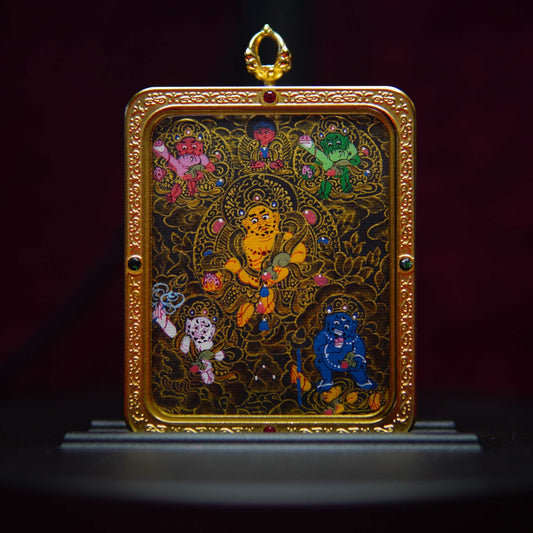
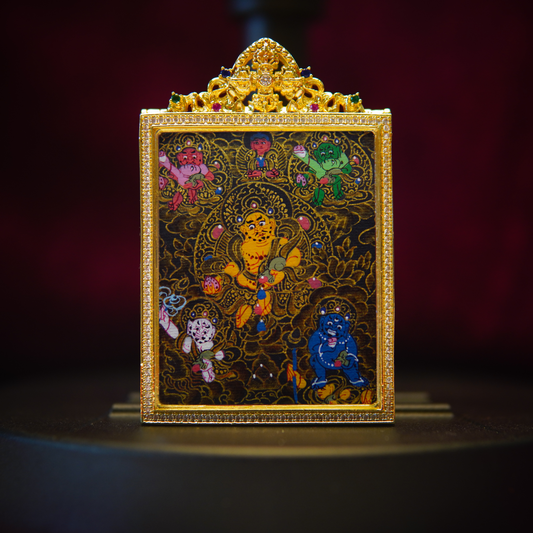
Yellow Jambhala, one of the well-known wealth deities in Tibetan Buddhism, is associated with prosperity, generosity, and the alleviation of poverty.
White Jambhala and other forms of Jambhala also carry distinctive spiritual meanings within Buddhist traditions.
For some practitioners, images of these deities express aspirations for financial stability, favorable circumstances, and the ability to help others.
Importantly, wealth practices in Buddhism are often connected with generosity rather than personal enrichment alone.
A hand-painted Jambhala mini Thangka may therefore represent both material aspirations and the cultivation of a generous heart.
It is not a promise of financial gain, but a meaningful symbol of prosperity within its religious context.
4. Wisdom, Clarity & Personal Growth
Wisdom is central to Buddhist teachings, and many Thangka paintings depict figures associated with knowledge and understanding.
Manjushri, the Bodhisattva of Wisdom, is one of the most recognizable examples.
He is often shown holding a flaming sword that symbolizes the wisdom that cuts through ignorance.
For students, scholars, and people facing important decisions, Manjushri's image may represent an aspiration for clearer thinking and deeper understanding.
A miniature Manjushri Thangka can serve as a reminder to approach challenges with patience, learning, and thoughtful judgment.
In Buddhist practice, wisdom develops through study, reflection, and cultivation—not simply through possession of a sacred image.

Healing & Spiritual Protection Thangka Necklace
Ancient Buddhist energy shield for modern stress
5. Health, Healing & Well-Being
Health and well-being are deeply meaningful themes in Tibetan Buddhist art.
Medicine Buddha, often depicted with a deep blue body, is associated with healing and the alleviation of suffering.
Devotional practices involving Medicine Buddha may include prayers and aspirations for the health of oneself and others.
White Tara is also associated with longevity, compassion, and wishes for well-being.
For some people, a mini Thangka featuring these figures becomes a deeply personal object, especially when thinking about parents, family members, or loved ones.
Such imagery can express love, concern, and hopes for a long and peaceful life.
These are spiritual associations, not medical treatments. A Thangka pendant should never replace professional healthcare.
6. Zodiac Guardian Buddhas & Personal Protection
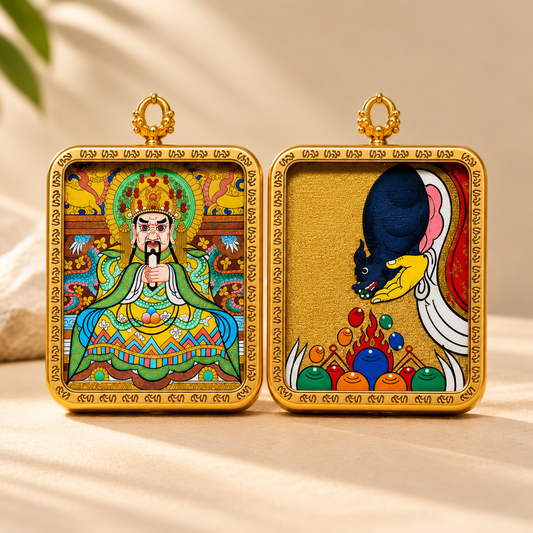
In some East Asian Buddhist cultural traditions, people choose a guardian Buddha or bodhisattva according to their Chinese zodiac sign.
These figures are commonly called Zodiac Guardian Buddhas, or Benming Fo (本命佛).
Many people wear images of their associated guardian figure as a symbol of spiritual connection, protection, and auspicious wishes.
This tradition is particularly familiar to audiences in Taiwan, Hong Kong, and other Chinese-speaking communities.
However, zodiac guardian associations are not universal across all Buddhist traditions, and they should not be confused with a single established Tibetan Buddhist system.
For people who value this custom, a hand-painted miniature image can become a meaningful personal keepsake.
The choice is often guided by cultural tradition, individual belief, and personal connection to the figure.

Zodiac Guardian Buddha
Find your Zodiac Guardian Buddha, a meaningful thangka pendant that brings sacred art and personal symbolism close to your heart.
7. Meditation, Mindfulness & Inner Harmony
Traditional Thangkas have long served as visual supports for Buddhist teaching and contemplation.
Their carefully arranged compositions, symbolic colors, and sacred figures can help practitioners reflect on religious teachings.
Some advanced Tibetan Buddhist visualization practices involve specific deity images and require appropriate instruction.
For everyday use, a mini Thangka may serve as a simple reminder to slow down, cultivate compassion, or return attention to one's intentions.
A small Green Tara pendant might remind someone to act with kindness.
A Manjushri pendant may encourage thoughtful reflection.
In this sense, the benefit lies not only in the image itself but also in how the person engages with its meaning.
For home display, the artwork's colors and composition may also contribute to a peaceful, contemplative atmosphere.
8. Artistic Beauty, Cultural Heritage & Collectible Value
Beyond spiritual meaning, a mini Thangka is also a remarkable form of miniature art.
Traditional Thangka painting demands precision, patience, and an understanding of Buddhist iconography.
Creating these details on a tiny pendant can be especially challenging.
The delicate facial expressions, lotus petals, ornaments, and symbolic objects require careful brushwork.
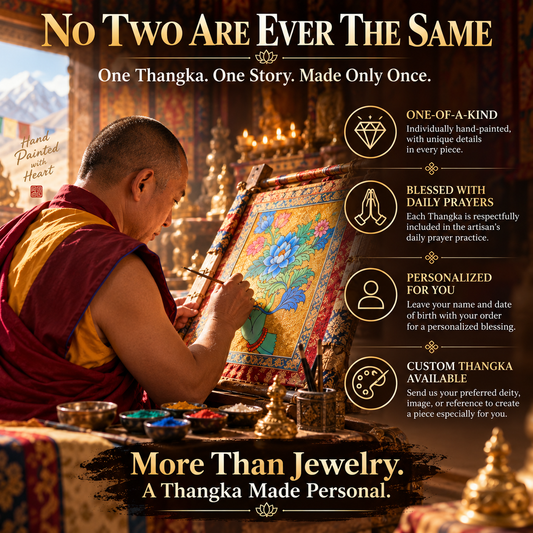
Some miniature Thangka pendants are individually hand-painted, making each piece distinctive.
For collectors, the appeal may come from the craftsmanship, cultural heritage, rarity, and artistic quality of the work.
A well-executed hand-painted mini Thangka can be appreciated as wearable art as well as a meaningful religious image.
Its collectible value depends on the quality of the painting, materials, condition, provenance, and individual artistic merit.
How to Choose the Right Mini Thangka
The best mini Thangka is not necessarily the one associated with the greatest number of benefits.
Instead, consider what matters most to you.
If compassion and courage resonate with you, Green Tara may be meaningful.
If you value wisdom and learning, Manjushri may be a natural choice.
If you wish to express hopes for health and longevity, Medicine Buddha or White Tara may hold special significance.
If prosperity and generosity are important to you, you may be drawn to Yellow Jambhala.
For those interested in collecting, craftsmanship and the authenticity of the painting are equally important considerations.
Take time to understand the figure, appreciate the artist's work, and choose a piece that genuinely speaks to you.
Final Thoughts: A Small Thangka With Deep Meaning
The traditional benefits of a mini Thangka extend across many aspects of life: blessings, protection, prosperity, wisdom, health, meditation, and cultural connection.
For Buddhist practitioners, these meanings are rooted in faith and religious practice. For art lovers, miniature Thangkas offer an opportunity to appreciate the beauty and complexity of Tibetan painting.
A mini Thangka does not need to promise miracles to be meaningful.
Its value can be found in the spiritual aspirations it represents, the traditions it preserves, and the extraordinary skill required to create it.
At Zendo Thangka, we celebrate hand-painted Tibetan Thangka pendants as meaningful works of wearable art. Our double-sided miniature paintings bring together Buddhist imagery, detailed craftsmanship, and individual artistic character.
Explore our hand-painted Thangka pendants and discover the figure and artwork that resonate with you.