Mahakala in Tibetan Buddhism: Meaning, Protection & Thangka Symbolism
chenHenryThe first time you see Mahakala in a Tibetan Thangka, he may not look like a figure associated with protection.
His eyes are wide. Flames rise behind him. Skulls, ornaments and fierce expressions may surround his dark form. Depending on the depiction, he may hold ritual implements or appear in a dynamic, almost intimidating posture.
To someone unfamiliar with Tibetan Buddhist art, the natural question is:
Why does a Buddhist protector look so wrathful?
That question is actually a good place to begin.
Mahakala's fierce appearance is not meant to represent evil. In Tibetan Buddhism, he is known as a powerful protector, and his wrathful imagery expresses something very different: the forceful removal of obstacles and the uncompromising protection of Buddhist teachings and practice.
Understanding that changes the way we look at a Mahakala Thangka.

Who Is Mahakala?
Mahakala is one of the best-known protector figures associated with Tibetan Buddhism.
His name comes from Sanskrit: maha means “great,” while kala can refer to “time” or “black,” which is why the name is sometimes rendered as “Great Black One.”
There is no single Mahakala image.
Different Tibetan Buddhist traditions depict Mahakala in different forms, with variations in the number of arms, posture, implements, attendants and surrounding figures. Some forms are closely associated with particular lineages and practices.
That is worth remembering when looking at Mahakala art online.
Two paintings can look noticeably different and still both depict Mahakala.
What connects them is not one fixed visual formula, but his role as a wrathful protector.
Why Does Mahakala Look So Wrathful?
This is probably the most interesting part of Mahakala's imagery.
In everyday life, anger and aggression are usually negative qualities. So a fierce Buddhist figure can initially seem contradictory.
But wrathful imagery in Tibetan Buddhist art should not be read in the same way as ordinary human anger.
Mahakala's terrifying appearance is traditionally understood as protective rather than malicious.
The flames, intense eyes and powerful posture communicate an energy capable of confronting obstacles directly.
You could think of the visual language this way:
A peaceful figure expresses compassion through serenity.
A wrathful protector expresses compassionate activity through strength and fearlessness.
The appearance changes. The purpose is not cruelty.
This is also why describing Mahakala simply as a “god of anger” or a “demon” misses the point entirely.
What Does Mahakala Symbolize?
Mahakala is most strongly associated with protection.
Within Tibetan Buddhist traditions, his role is connected with protecting the Dharma and removing obstacles to spiritual practice.
For someone approaching Mahakala primarily through art rather than religious practice, his imagery can still carry a powerful idea:
some obstacles cannot simply be ignored. They have to be faced.
This helps explain why Mahakala imagery feels so different from the calm visual language many people associate with Buddhism.
His Thangka does not ask the viewer to look away from difficulty.
It confronts it.
That is part of what gives Mahakala paintings their extraordinary visual presence.
Looking Closely at a Mahakala Thangka
A Mahakala Thangka can feel visually overwhelming at first.
That is intentional.
Dark blues or blacks may dominate the central figure. Around him are often vivid reds, oranges and golds. Flames create movement while ornaments, crowns and ritual objects fill the composition with detail.
Instead of trying to understand everything at once, start with a few elements.
The Dark Body
Mahakala is frequently depicted in very dark blue or black.
The color is one of his most recognizable characteristics and contributes to the forceful visual presence of the figure.
The Fierce Expression
Wide eyes, exposed teeth and an intense expression immediately distinguish Mahakala from peaceful Buddhist figures.
The expression is not there simply to frighten the viewer. It belongs to the visual language of wrathful Buddhist iconography.
The Flames
Fire often surrounds wrathful figures in Tibetan Buddhist paintings.
Visually, it makes the entire composition feel active rather than still.
Within the iconography, flames are connected with transformative and purifying activity — the sense that obstacles are not merely avoided, but consumed or overcome.
The Skull Imagery and Ornaments
Some Mahakala forms include skull crowns or other imagery that can appear unsettling to someone encountering Tibetan Buddhist art for the first time.
These details should not be separated from their religious context or treated simply as “dark aesthetics.”
They belong to a symbolic system concerned with impermanence, transformation and the overcoming of attachment.
The exact meaning of individual elements can also depend on the particular form of Mahakala being depicted.
There Is More Than One Form of Mahakala
This matters especially when buying or studying a Mahakala Thangka.
You may encounter two-armed, four-armed or six-armed forms, as well as other distinct manifestations. White Mahakala is another well-known form and looks dramatically different from the dark wrathful imagery many people first associate with the name.
Different forms can have different iconography and lineage associations.
So rather than assuming every Mahakala painting should look identical, it is better to look closely at the actual artwork.
How many arms are shown?
What does the figure hold?
What appears beneath or around him?
Are there attendants?
What color is the body?
These details are part of the identity of the image.
This is one reason we avoid treating Buddhist figures as interchangeable decorative motifs.
In a detailed Thangka, the details matter.
Mahakala Mantra and Buddhist Practice
If you search for Mahakala online, you will also quickly encounter references to Mahakala mantras.
It is important to separate appreciating Buddhist art from undertaking Buddhist practice.
Mahakala practices vary across Tibetan Buddhist traditions, and some practices belong within specific lineage, initiation or teaching contexts.
For that reason, we do not present a Mahakala mantra as a generic formula for protection or promise that repeating certain words will automatically produce a particular result.
Someone interested in the religious practice itself is better served by learning from a qualified teacher within the relevant Buddhist tradition.
For us, this distinction is important.
A Thangka can be appreciated as extraordinary art while still respecting the religious tradition from which its imagery comes.

Painting Mahakala in Miniature
Mahakala is particularly challenging to paint at miniature scale.
Look at a full-sized traditional Thangka and there may already be an extraordinary amount happening within the composition: multiple arms, small ritual implements, flames, jewelry, facial details, crowns and surrounding figures.
Now reduce that image to something that can fit in the palm of a hand.
[IMAGE: Hand holding the miniature Mahakala Thangka]
The face still needs to remain expressive.
The eyes need to remain distinct.
The flames cannot simply become an orange blur.
Tiny ornaments and outlines still have to be painted individually.
This is the part of miniature Thangka art that photographs often struggle to communicate.
Seeing the painting beside a person's fingers immediately gives the work a different sense of scale.
What looked like a printed illustration suddenly becomes something much more surprising:
a painting made small enough to carry.
From Mahakala Thangka to Wearable Art
Once placed inside a pendant setting, the miniature painting becomes wearable.
But the painting should remain the center of attention.
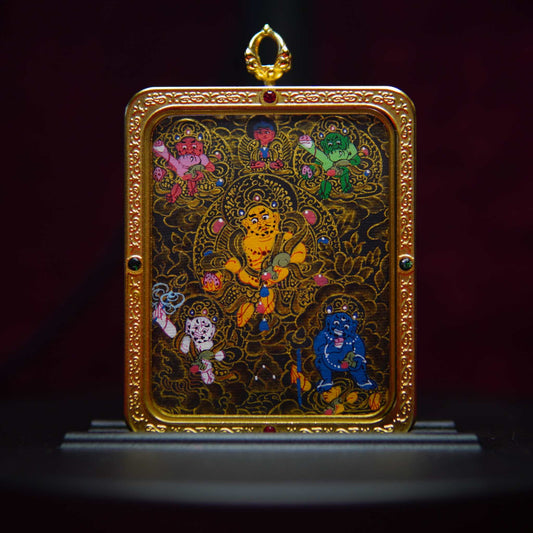
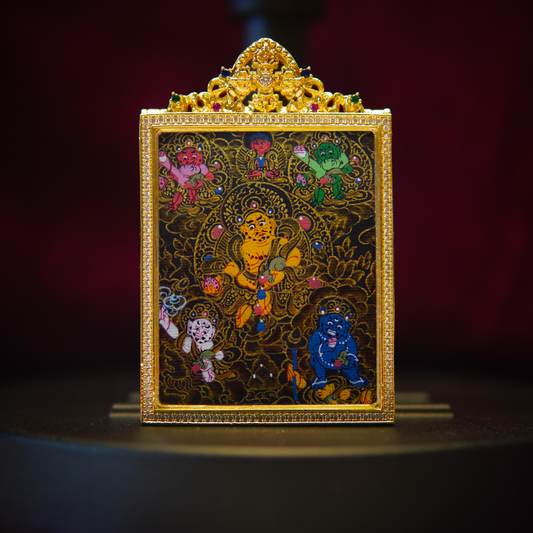
[IMAGE: Finished Mahakala Thangka pendant]
This is what we find interesting about hand-painted Thangka pendants.
The idea is not simply to place a Buddhist symbol on a necklace.
It is to take a detailed miniature painting — with all of its color, expression and individual brushwork — and create a way for that artwork to be carried.
Because each painting is made by hand, small differences naturally appear between pieces.
A flame may curve slightly differently.
A line around an eye may be finer.
The colors and tiny ornamental details may vary.
Those differences are part of the work.
They remind us that someone actually painted it.
A Different Way to See Mahakala
Mahakala is easy to misunderstand if we look only at his fierce expression.
Spend a little longer with the image and a different idea begins to emerge.
The frightening appearance is not the opposite of protection.
It is the visual language of protection expressed with force.
That is what makes Mahakala such a compelling subject in Tibetan Buddhist art.
His image is not quiet.
It is not designed to disappear into the background.
It demands attention — and then asks the viewer to look beyond appearance.
Explore Hand-Painted Mahakala Thangka Art
Explore our miniature Mahakala Thangka paintings and pendants, individually painted by hand and created as wearable Tibetan-inspired art.
Explore Mahakala Thangka Pendants →