Why Is Medicine Buddha Blue? The Meaning Behind His Lapis Lazuli Color
chenHenry💙 Why Is This Buddha Blue?
Buddhas aren't usually blue.
Then you meet the Medicine Buddha.
His body is an unmistakable deep blue—sometimes so intense that even someone who knows almost nothing about Buddhist art can recognize him by color alone.
But the blue isn't an artistic accident.
Medicine Buddha, known in Sanskrit as Bhaiṣajyaguru, is traditionally connected with the radiance of lapis lazuli, the deep-blue precious stone admired across Asia for centuries.
This is why he is often known in English through names connected with Lapis Lazuli Radiance.
So why lapis blue?
What does a precious stone have to do with healing?
And does blue always mean healing in Buddhist art?
The answers reveal much more about Medicine Buddha than color alone.

🪷 Who Is Medicine Buddha?
Medicine Buddha, known in Sanskrit as Bhaiṣajyaguru, is a major Mahayana Buddhist figure traditionally associated with healing, relief from suffering and well-being.
His traditions spread across Asia, including Tibet, China, Japan and other Buddhist cultures.
In Tibetan Buddhist art, he is particularly easy to recognize because of his characteristic blue body.
But the English name “Medicine Buddha” can make him sound more straightforward than he actually is.
He isn't simply a Buddhist version of a doctor.
His imagery belongs to a much broader religious understanding of suffering, healing, compassion and the Buddhist path.
The blue color is one of the first clues.
🔵 Why Is Medicine Buddha Blue?
Medicine Buddha's blue appearance is closely connected with lapis lazuli.
Traditional names and descriptions of his pure realm and radiance are associated with this precious blue stone.
Lapis lazuli was highly valued across ancient Asia.
Its intense blue color was visually extraordinary in a world without modern synthetic pigments, and the stone traveled through long-distance trade networks for centuries.
Against that cultural background, comparing a Buddha's radiance with lapis lazuli communicated something precious, brilliant and extraordinary.
So when Medicine Buddha appears blue in a Thangka, the color isn't simply saying:
“Blue feels calming.”
It connects the image with a much older Buddhist religious vocabulary.
 💎 Why Lapis Lazuli?
Lapis lazuli has an unusual appearance.
Deep blue dominates the stone, often interrupted by tiny gold-colored inclusions.
Even today, it looks almost celestial.
Historically, its rarity and beauty helped make it a highly valued material across several civilizations.
That makes it easy to understand why lapis became powerful religious imagery.
Medicine Buddha's lapis connection conveys brilliance and preciousness while making his appearance immediately distinctive.
This also explains why English descriptions sometimes call him the:
Medicine Buddha of Lapis Lazuli Radiance
or use related translations of his traditional titles.
The important point is not that wearing blue stone automatically creates healing.
The lapis association belongs to the identity and sacred imagery of Bhaiṣajyaguru himself.
🌿 Does Blue Mean Healing in Buddhism?
Not every blue Buddhist figure is a healing deity.
This is an important distinction.
Once people learn that Medicine Buddha is blue and associated with healing, it is tempting to create a simple rule:
Blue Buddha = Healing Buddha.
Buddhist iconography doesn't work that way.
Other Buddhist figures can also appear blue.
Akshobhya, for example, is strongly associated with blue imagery.
Wrathful tantric figures such as Yamantaka may also appear blue.
They are not Medicine Buddha.
Color is therefore a clue, not a complete identification system.
To recognize Medicine Buddha properly, you need to look at the entire image:
his posture,hand gestures,objects,throne,and surrounding iconography.
 🥣 What Is Medicine Buddha Holding?
One of Medicine Buddha's most recognizable attributes is a medicine bowl, commonly shown in his lap.
This immediately reinforces his healing identity.
In many traditional depictions, his other hand is associated with a medicinal plant, often identified in Buddhist art and literature with myrobalan.
These details are important because they help distinguish Medicine Buddha from another blue Buddhist figure.
The combination becomes much more useful than color alone:
Blue body + medicine bowl + medicinal imagery = strong Medicine Buddha identification clues.
Once you learn these details, looking at a Thangka becomes a different experience.
You stop seeing:
“a blue Buddha.”
You begin recognizing Bhaiṣajyaguru.
🌿 Why Does Medicine Buddha Hold a Medicinal Plant?
The plant reinforces the relationship between Medicine Buddha and healing.
Traditional Buddhist imagery often represents abstract religious ideas through concrete objects.
A medicinal plant is immediately understandable.
Illness exists.
Medicine responds to illness.
But within Buddhism, suffering is not limited to physical disease.
That is where the symbolism begins to expand.
The plant may first lead the viewer toward physical medicine, but the larger religious story concerns the alleviation of suffering.
This is one reason Medicine Buddha can resonate with people going through very different kinds of difficult periods—not only physical illness.
🧠 Is Medicine Buddha's Blue Color Supposed to “Heal” You?
This is where modern spiritual language sometimes goes beyond the Buddhist tradition.
You may encounter claims such as:
“Medicine Buddha's blue frequency heals your cells.”
or:
“The blue vibration cures disease.”
Those are not claims we need in order to appreciate Medicine Buddha.
His blue color has a rich traditional meaning through lapis lazuli imagery.
That is already interesting.
A Thangka can be used devotionally or as a focus for meditation without being turned into a medical device.
This distinction matters particularly when Medicine Buddha imagery is worn as jewelry.
The pendant can carry religious, artistic or symbolic significance.
It should not be sold as a substitute for healthcare.
👀 How Can You Recognize Medicine Buddha in a Thangka?
Start with a few major clues.
💙 Lapis-Blue Body
His most immediately recognizable visual feature.
🥣 Medicine Bowl
Frequently shown resting in his lap.
🌿 Medicinal Plant
An important attribute in many depictions.
🪷 Lotus Throne
Medicine Buddha commonly appears seated in a peaceful Buddhist posture.
✨ Halo & Sacred Surroundings
Traditional compositions may include halos, flowers, attendants, landscapes or other sacred imagery.
Individual paintings can vary.
But once you know the main clues, Medicine Buddha becomes surprisingly easy to recognize.
📿 Why Carry a Medicine Buddha Thangka?
For Buddhist practitioners, Medicine Buddha imagery can have specific devotional significance connected with healing practices, prayer and meditation.
For someone approaching the image through Buddhist symbolism, it may represent:
🌿 Healing
💙 Well-Being
🪷 Compassion
🧘 Inner Peace
✨ Hope during difficult periods
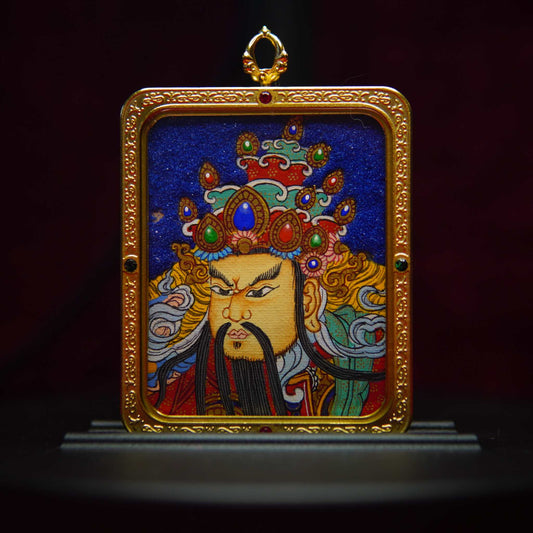
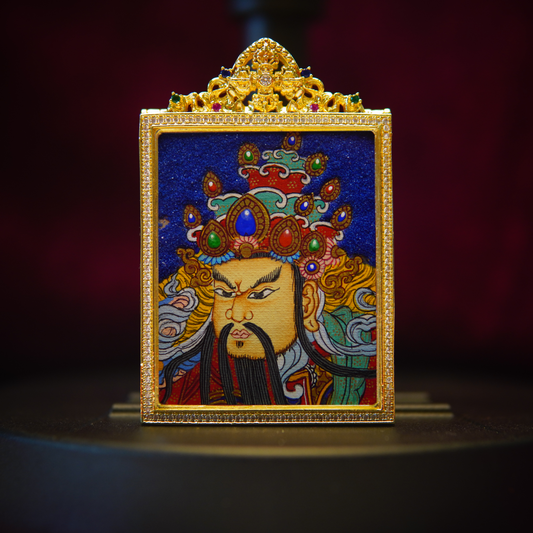
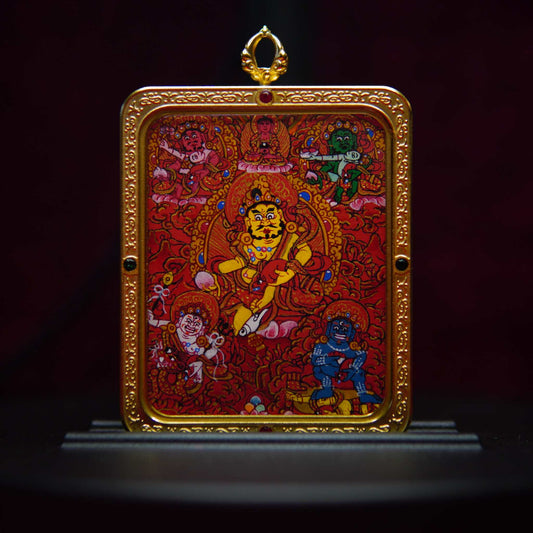
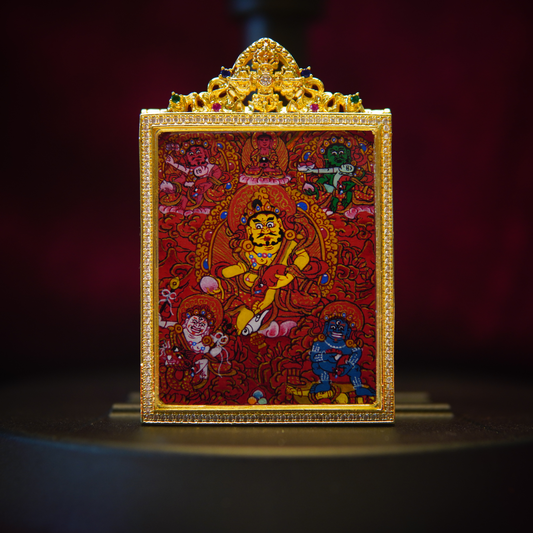
Our hand-painted Medicine Buddha Tibetan Thangka pendant preserves his distinctive lapis-blue form and traditional Buddhist imagery within a miniature painting.
Each piece is individually painted by hand, so differences in expression, linework, color and surrounding details naturally occur.
The more you understand the iconography, the more that blue body becomes something other than a beautiful color.
It tells you who you're looking at.
→ Explore the Hand-Painted Medicine Buddha Thangka Pendant

But the name itself raises an even bigger question:
→ Is Medicine Buddha Really About Physical Healing?
❓Quick Questions About the Blue Medicine Buddha
Why is Medicine Buddha blue?
Medicine Buddha's blue body is traditionally connected with lapis lazuli radiance, an important part of Bhaiṣajyaguru's sacred imagery.
Does blue always represent healing in Buddhism?
No. Other Buddhist figures also appear blue. Color should be interpreted together with the deity's other iconographic attributes.
What does Medicine Buddha hold?
He is commonly depicted with a medicine bowl and medicinal imagery, including a plant traditionally associated with healing.
Is Medicine Buddha also called Bhaiṣajyaguru?
Yes. Bhaiṣajyaguru is the Sanskrit name commonly associated with the figure known in English as Medicine Buddha.