The Surprising Connection Between Manjushri and Yamantaka
chenHenry🧠 These Two Figures Hardly Look Related
Put a Thangka of Manjushri beside one of Yamantaka and they seem to belong to completely different worlds.
Manjushri appears youthful and composed. His famous sword represents wisdom cutting through ignorance.
Yamantaka is another story.
Multiple faces. Multiple arms. Flames. Ritual implements. A terrifying expression. And in the Vajrabhairava form, an unmistakable buffalo head dominates the image.
One looks like the embodiment of wisdom.
The other looks like something designed to frighten you.
And yet Tibetan Buddhist tradition connects them intimately.
Yamantaka is closely associated with Manjushri and is understood within important Vajrayana traditions as a wrathful expression of enlightened wisdom.
So why would wisdom ever need to look this terrifying?
⚔️ Who Is Manjushri?
Manjushri is the Mahayana Buddhist bodhisattva associated with transcendent wisdom.
His iconography is among the most recognizable in Buddhist art.
He is often shown holding a flaming sword in one hand. The sword does not represent ordinary violence; it symbolizes wisdom cutting through ignorance and confusion.
A scripture associated with the Perfection of Wisdom tradition frequently appears with him as another sign of knowledge and insight.
This is why Manjushri is especially meaningful in contexts involving:
learning,
study,
clarity,
philosophical understanding,
and the cultivation of wisdom.
If you only know this peaceful form of Manjushri, Yamantaka can come as quite a shock.

👹 So Who Is Yamantaka?
Yamantaka is a wrathful tantric Buddhist deity closely associated with Manjushri. Vajrabhairava is one of the major forms within the Yamantaka tantric tradition.
The name Yamantaka is connected with the conquest or destruction of Yama, the Lord of Death.
That already tells us this isn't ordinary peaceful imagery.
Yamantaka belongs to the world of Vajrayana wrathful deities, where terrifying forms can represent powerful enlightened activity rather than evil or uncontrolled anger.
This distinction matters.
A frightening appearance does not automatically mean a frightening intention.
In Yamantaka, wrath and wisdom are not presented as opposites.
The fierce form is understood through its relationship with wisdom.
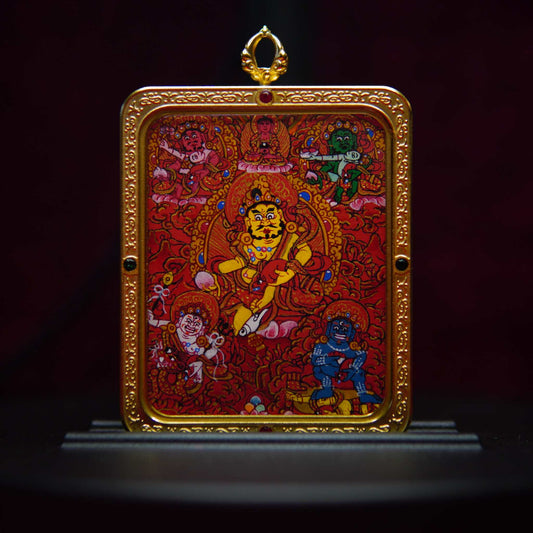
Hand-Painted Yamantaka (Vajrabhairava) Thangka Pendant

🔥 Why Would Wisdom Need a Wrathful Form?
We usually imagine wisdom as calm.
Someone understands.
Someone explains.
Someone teaches.
But Tibetan Buddhist imagery can express enlightened activity in more than one visual mode.
Peaceful imagery may communicate wisdom through serenity and teaching.
Wrathful imagery communicates something more forceful.
An obstacle has to be confronted.
Ignorance has to be cut through.
Fear cannot simply be ignored.
This doesn't mean Manjushri “gets angry” and turns into Yamantaka in the ordinary emotional sense.
A wrathful form belongs to a specific tantric religious context.
The important idea for someone looking at the artwork is that wisdom has not disappeared simply because the face became fierce.
The appearance changed.
The relationship with wisdom remains.
🐃 Why Does Vajrabhairava Have a Buffalo Head?
This is probably the first thing many people notice.
Why would a Buddhist deity have the head of a buffalo?
The answer connects directly with Yama, the Lord of Death, who is himself associated with buffalo imagery.
Yamantaka's terrifying form therefore isn't random fantasy.
The buffalo-headed appearance participates in a visual story about confronting and overcoming death.
That does not mean Yamantaka promises physical immortality.
Everyone dies.
Buddhism is deeply concerned with impermanence and mortality, not with pretending death can simply be avoided.
The symbolism instead points toward a deeper confrontation with death, fear and ignorance.
That is also why the connection with Manjushri becomes so important.
The ultimate weapon in the story is not physical strength.
It is wisdom.
Curious about this part?
→ Why Is Yamantaka Called the “Conqueror of Death”?
👁️ Why So Many Faces and Arms?
A Yamantaka Thangka can be visually overwhelming.
Depending on the form, you may encounter multiple faces, many arms, numerous ritual implements, flames, animals, surrounding figures and a dense network of symbolic details.
This complexity is intentional.
In Vajrayana iconography, multiple limbs and attributes can communicate an expanded range of activity.
But there is an important caution when reading a Thangka:
not every Yamantaka image is identical.
Different forms and traditions have specific iconographic details.
That means we should not look at one product image and invent a meaning for every weapon, animal or tiny figure simply because it appears dramatic.
Good Buddhist art interpretation begins with identifying the actual form.
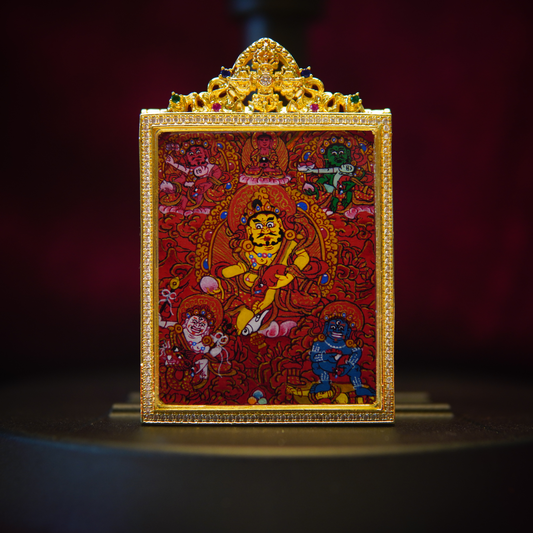
Hand-Painted Yamantaka (Vajrabhairava) Thangka Pendant

🛡️ Is Yamantaka a Protector?
Yamantaka is strongly associated with wrathful activity and the overcoming of obstacles within tantric Buddhist contexts.
This is why modern descriptions frequently use words such as:
Protection
Courage
Overcoming Obstacles
Fearlessness
These can be useful ways to introduce the symbolism to a general audience, but they shouldn't become magical promises.
A Yamantaka pendant is not an insurance policy against danger.
Nor does wearing the image guarantee that obstacles disappear.
For Buddhist practitioners, Yamantaka belongs to specific teachings and practices.
For someone approaching him through Tibetan Buddhist art, the image can also represent something more accessible:
the courage to confront what is difficult rather than pretending it isn't there.
🪷 Manjushri or Yamantaka — Which One Should You Choose?
If you're choosing a Thangka by meaning, these two figures offer an interesting comparison.
Manjushri
🧠 Wisdom
📚 Learning
💡 Clarity
⚔️ Cutting Through Ignorance
Yamantaka
🔥 Wrathful Wisdom
🛡️ Protective Activity
💀 Confronting Mortality and Fear
⚡ Overcoming Obstacles
This isn't a question of which figure is “more powerful.”
They belong to different religious and iconographic contexts.
For a student or someone focused on learning, Manjushri's peaceful wisdom symbolism may feel especially appropriate.
For someone drawn to fierce Vajrayana imagery and themes of confronting fear and obstacles, Yamantaka may resonate differently.
Understanding the symbolism makes the choice more personal.
📿 Yamantaka in Miniature Thangka Art
Our hand-painted Yamantaka (Vajrabhairava) Tibetan Thangka pendant compresses an extraordinarily complex wrathful composition into a miniature painting only a few centimeters across.
Look closely and the first impression of “scary” begins to change.
The faces.
Arms.
Flames.
Ritual imagery.
Buffalo-headed form.
Each belongs to a much larger visual tradition.
Every piece is individually painted by hand, so subtle differences in linework, color and fine details naturally occur.
For practitioners, Yamantaka may carry specific religious significance. For others interested in Tibetan Buddhist art, the pendant can represent the powerful relationship between wisdom, courage and the confrontation of obstacles.
→ Explore the Hand-Painted Yamantaka (Vajrabhairava) Thangka Pendant

❓Quick Questions
Is Yamantaka a form of Manjushri?
Yamantaka is closely associated with Manjushri in Vajrayana Buddhist traditions and is commonly understood as a wrathful expression connected with the bodhisattva of wisdom.
Is Vajrabhairava the same as Yamantaka?
The terms are closely related but should not always be treated as completely interchangeable in every context. Vajrabhairava is a major tantric form within the broader Yamantaka tradition.
Why does Yamantaka look so frightening?
His appearance belongs to the visual language of wrathful Vajrayana Buddhism, where fierce imagery can represent powerful enlightened activity rather than ordinary anger or evil.
Why does Yamantaka have a buffalo head?
The buffalo-headed imagery is connected with Yama, the Lord of Death, and forms part of Yamantaka's symbolism as the conqueror of death.