Why Does Hayagriva Look Terrifying if He Is Connected to Avalokiteshvara?
chenHenry👹 How Can Something This Terrifying Represent Compassion?
Think of Avalokiteshvara and you probably imagine peace.
A serene face.
Lotus imagery.
Graceful posture.
The embodiment of compassion.
Then look at Hayagriva.
Fangs.
Fierce eyes.
Wild hair.
Multiple faces and arms in complex forms.
Skull imagery.
And, most strangely, a horse emerging above his head.
At first glance, the two seem to belong to completely different worlds.
Yet within Vajrayana Buddhist traditions, Hayagriva is closely connected with Avalokiteshvara and compassionate activity.
So how can compassion look this terrifying?
The answer lies in one of the most striking ideas expressed through Vajrayana art:
Compassion does not always have to look gentle.

🪷 Who Is Avalokiteshvara?
Avalokiteshvara is the great Mahayana bodhisattva associated with compassion toward suffering beings.
Across Asia, Avalokiteshvara appears in many forms and under different names.
In Chinese Buddhism, the figure became widely known through Guanyin.
In Tibetan Buddhism, Avalokiteshvara is known as Chenrezig.
Different artistic forms may have:
two arms,four arms,a thousand arms, or other iconographic variations.
Despite these visual differences, compassion remains central to Avalokiteshvara's identity.
This is what makes the relationship with Hayagriva so surprising.
🐴 Who Is Hayagriva?
Hayagriva is a wrathful Vajrayana Buddhist deity characterized by distinctive horse imagery and associated with powerful protective activity.
Unlike peaceful Avalokiteshvara imagery, Hayagriva may appear terrifying.
His body and surrounding imagery can communicate:
force,urgency,movement,and confrontation.
But these visual differences do not necessarily mean the underlying Buddhist purpose has changed from compassion to hatred.
The form changes.
The activity becomes fierce.
Compassion remains central to understanding the connection.
🔥 How Is Hayagriva Connected to Avalokiteshvara?
Hayagriva is closely associated in Vajrayana traditions with Avalokiteshvara and wrathful compassionate activity.
It is tempting to simplify this as:
Hayagriva is “angry Avalokiteshvara.”
But that phrase is too crude.
Ordinary anger usually involves:
ego,frustration,resentment,or hatred.
Wrathful Buddhist activity is not simply an enlightened figure losing his temper.
The fierce imagery communicates forceful activity directed toward obstacles and harmful conditions.
This is why the concept of wrathful compassion is so useful.
❤️ What Is “Wrathful Compassion”?
At first, the phrase sounds contradictory.
Wrathful.
Compassion.
How can both exist at once?
A useful definition is:
Wrathful compassion is compassionate activity represented in a fierce and forceful form when confronting obstacles or harmful conditions.
The purpose matters.
A terrifying expression alone does not equal compassion.
Violence or anger does not become compassionate merely because someone claims good intentions.
Within Vajrayana iconography, the wrathful form belongs to a specific religious framework of enlightened activity.
This distinction is important.
Otherwise “wrathful compassion” can easily become an excuse for ordinary aggression.
👨👩👧 Can Compassion Really Be Forceful?
Consider a simple everyday analogy.
A child steps toward moving traffic.
A parent may suddenly grab the child's arm and pull them backward.
The action is forceful.
The parent's voice may become loud.
Nothing about the moment looks particularly gentle.
But the motivation is not hatred.
It is protection.
This analogy is not a definition of Hayagriva practice, nor does it explain the full tantric tradition.
But it helps a modern viewer understand a basic visual idea:
gentleness and compassion are not always identical.
Sometimes compassionate action can be represented as immediate and uncompromising.
Hayagriva pushes that idea to a dramatic visual extreme.
👹 Why the Fangs and Terrifying Faces?
Wrathful Buddhist art is designed to look powerful.
Hayagriva's fierce face immediately tells the viewer:
This is not passive activity.
Fangs, bulging eyes, wild expressions and dynamic posture create an atmosphere completely different from a peaceful seated Buddha.
The purpose is not simply to scare people.
These features belong to the visual language of wrathful enlightened activity.
That is why reading a Hayagriva Thangka only through modern horror imagery misses the religious context.
The face looks terrifying.
The Buddhist interpretation asks:
What is the wrath directed toward?
🔥 Why the Flames and Dynamic Imagery?
Fire naturally communicates intensity.
It changes what it touches.
It moves.
It consumes.
That makes fiery imagery particularly effective around wrathful Buddhist figures.
In Hayagriva art, flames and dynamic forms reinforce the sense of powerful activity confronting obstacles.
But it would be too simplistic to say:
fire = protection.
The composition works as a whole.
Horse imagery.
Wrathful faces.
Ritual implements.
Flames.
Multiple arms and eyes in certain forms.
Together they create Hayagriva's unmistakable visual identity.
🐴 And Why the Horse?
The horse is so important to Hayagriva that it is reflected in his Sanskrit name.
It is one of the easiest ways to identify him among other wrathful Buddhist figures.
But the horse deserves more than a single paragraph.
Why is it there?
Why does Hayagriva's tradition even include associations with a horse's cry?
We've explored that separately:
→ Why Does Hayagriva Have a Horse Head? The Strange Meaning Behind His Name
Once you understand the horse, the apparently bizarre detail becomes an identifying key.
🛡️ Why Is Hayagriva Associated With Protection?
Hayagriva's fierce activity naturally connects his imagery with protection and the overcoming of harmful or obstructive conditions.
This is also where his connection with compassion becomes especially meaningful.
Protection is not the opposite of compassion.
Protection can be one expression of compassion.
But again, a Thangka pendant should not be marketed as:
“Wear this and nothing bad can happen to you.”
That turns religious symbolism into a supernatural guarantee.
A more accurate interpretation is that Hayagriva's imagery represents a powerful Buddhist tradition of protective, obstacle-confronting and wrathful compassionate activity.
⚡ What Does Hayagriva Mean for Someone Facing a Difficult Period?
For a Vajrayana practitioner, Hayagriva belongs within specific religious teachings and practices.
For someone encountering the deity through Buddhist art, several themes may still resonate symbolically:
🛡️ Protection
⚡ Courage
🔥 Determination
🪷 Compassion
🌿 Facing Obstacles Rather Than Avoiding Them
The image does not promise a life without difficulty.
If anything, Hayagriva's fierce appearance acknowledges that some conditions are difficult.
The symbolism is about the kind of activity brought toward them.
🎨 How to Read a Hayagriva Thangka
Instead of asking:
“What magical benefit does every object provide?”
start with relationships.
🐴 Horse Imagery
Identifies Hayagriva and connects directly with his name and tradition.
👹 Wrathful Face
Communicates fierce activity rather than peaceful contemplation.
🪷 Avalokiteshvara Connection
Places compassion behind the wrathful imagery.
🔥 Flames
Reinforce the atmosphere of intense activity.
👐 Multiple Arms
Appear in complex forms and carry specific tantric attributes.
⚔️ Ritual Implements
Should be interpreted according to the particular Hayagriva form rather than assigned generic meanings.
This approach makes Buddhist art much more interesting.
The image becomes a visual system rather than a collection of “benefits.”
📿 Why Choose a Hayagriva Thangka Pendant?
Hayagriva is particularly compelling for someone who wants Buddhist imagery that does not express compassion through softness alone.
His Thangka brings together ideas that initially seem contradictory:
fierceness and compassion,
protection and wisdom,
wrath and care.
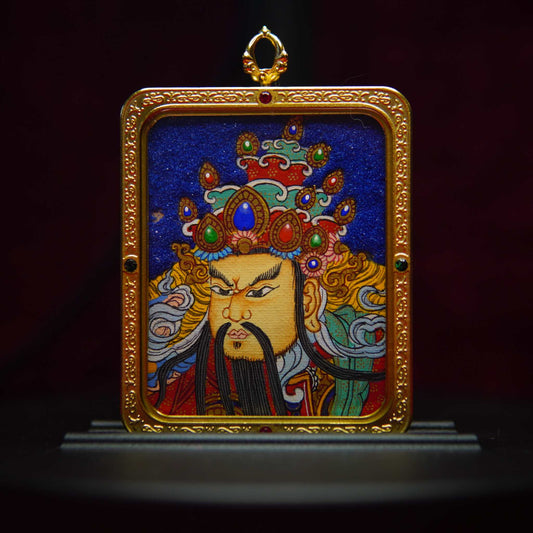
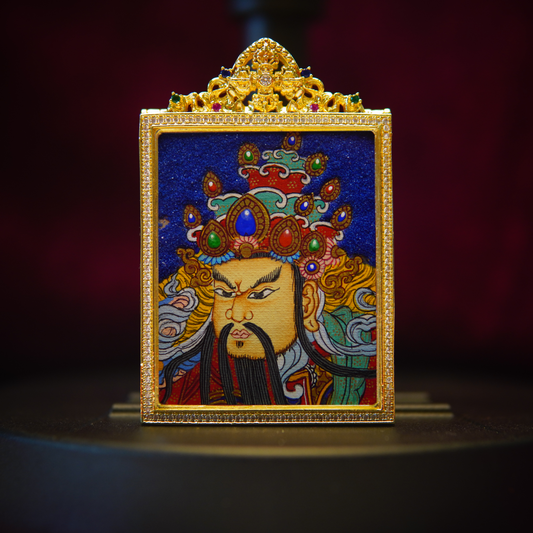
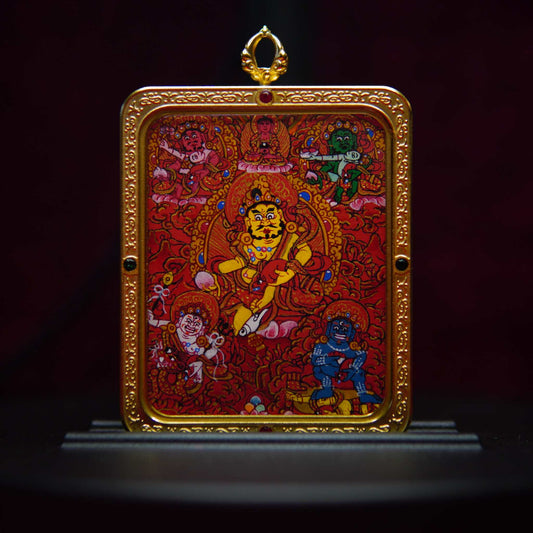
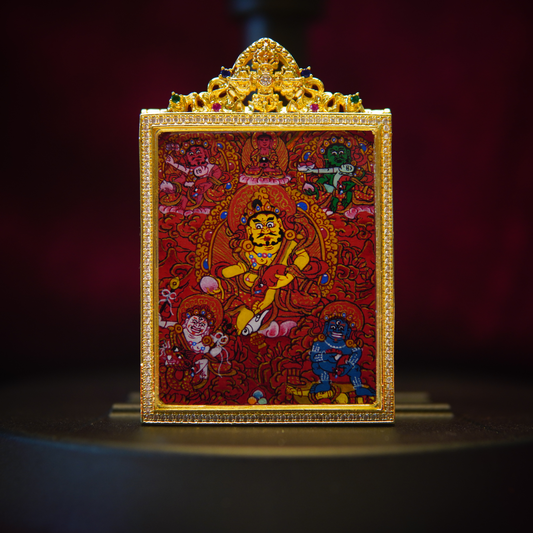
Our hand-painted Hayagriva Tibetan Thangka pendant preserves the deity's dramatic wrathful form, horse imagery, ritual details and richly layered colors within a miniature painting.
Each piece is individually painted by hand, so subtle variations in expression, linework and color naturally occur.
For practitioners, the meaning belongs to Hayagriva's Vajrayana tradition.
For collectors and others drawn toBuddhist art, the image can represent:
🛡️ Protection
⚡ Courage
🔥 Overcoming Obstacles
🪷 Wrathful Compassion
🐴 Hayagriva's Distinctive Horse-Headed Identity
→ Explore the Hand-Painted Hayagriva Tibetan Thangka Pendant

❓Quick Questions About Hayagriva and Avalokiteshvara
Is Hayagriva connected to Avalokiteshvara?
Yes. In Vajrayana Buddhist traditions, Hayagriva is closely associated with Avalokiteshvara and can be understood through the framework of powerful or wrathful compassionate activity.
Is Hayagriva simply an angry Avalokiteshvara?
That description is too simplistic. Hayagriva's wrathful appearance belongs to a specific Vajrayana religious and iconographic context. It should not be equated with ordinary anger.
Why does Hayagriva look terrifying?
His fierce appearance expresses the visual language of wrathful activity—powerful activity directed toward obstacles and harmful conditions.
What is wrathful compassion?
Wrathful compassion describes compassionate activity expressed through a fierce or forceful form rather than a peaceful one. In Hayagriva imagery, this helps explain how a terrifying appearance can coexist with a connection to Avalokiteshvara.
Why is Hayagriva associated with protection?
Hayagriva's Vajrayana traditions emphasize powerful protective and obstacle-confronting activity, making protection one of the major themes associated with his imagery.
Why does Hayagriva have a horse head?
The horse is central to Hayagriva's identity and even to the meaning of his Sanskrit name. It is one of the clearest visual features used to recognize him in Buddhist art.