Vaishravana vs Jambhala: Are They the Same Buddhist Wealth Deity?
chenHenry💰 Two Buddhist Wealth Deities—or Two Names for the Same Figure?
Vaishravana is associated with wealth.
Jambhala is associated with wealth.
Both appear in Tibetan Buddhism.
Both are connected with prosperity and treasure.
And both may even appear with that very strange Buddhist wealth symbol:
a mongoose producing jewels.
So the obvious question is:
Are Vaishravana and Jambhala actually the same deity?
A simple “yes” is too easy.
A simple “no” is also misleading.
Their histories and iconographic traditions are closely connected, while Tibetan Buddhist art and practice also distinguish particular names, forms and contexts.
Understanding that relationship reveals something important:
Buddhist wealth imagery is a family of interconnected traditions—not a modern catalog of unrelated “money gods.”
 👑 Who Is Vaishravana?
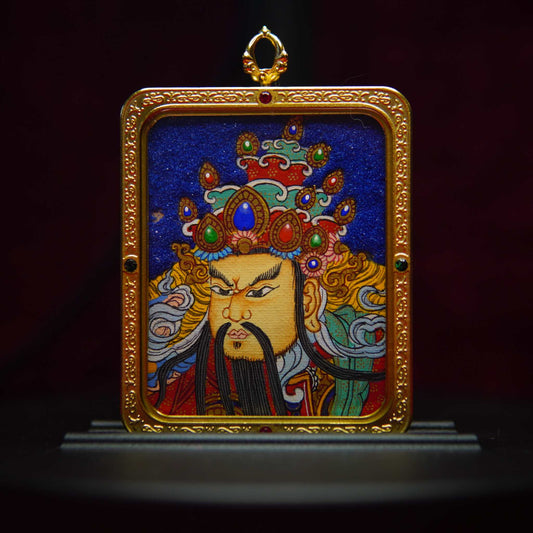
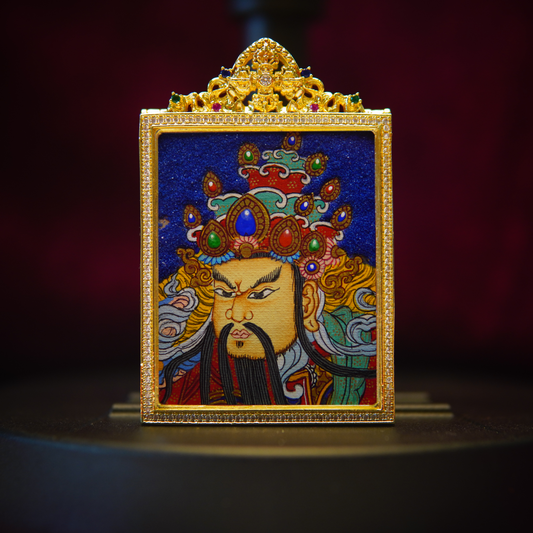
Vaishravana (Vaiśravaṇa) is a major Buddhist guardian and wealth-associated deity whose identity combines prosperity with protection and authority.
He is also known within the tradition of the Four Heavenly Kings and is associated with the northern direction.
In Tibetan Buddhist wealth imagery, however, his prosperity identity becomes especially prominent.
This is why Chinese-speaking audiences may encounter wealth-focused descriptions of him as 财宝天王.
Vaishravana's visual character can feel royal and martial.
This combination is important:
wealth + guardianship
He represents more than treasure alone.
💰 Who Is Jambhala?
Jambhala refers to important Buddhist wealth-deity forms in Vajrayana traditions, associated with prosperity, material support and the alleviation of poverty or difficult material conditions.
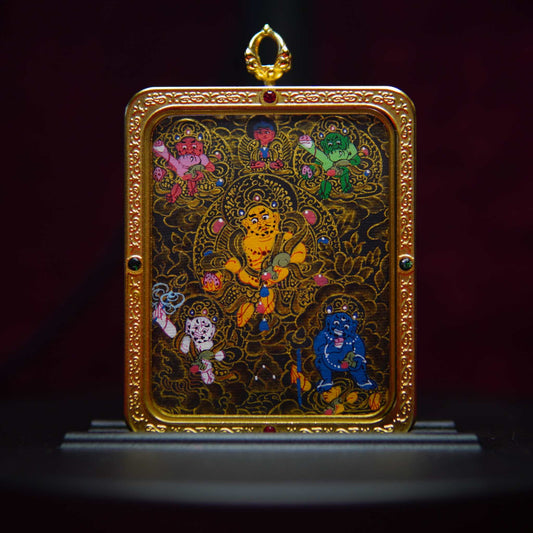
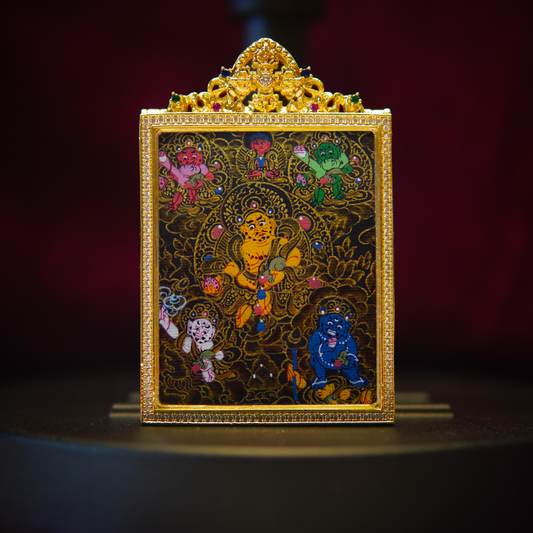
People often first encounter Yellow Jambhala, but Tibetan Buddhist traditions also contain forms described as:
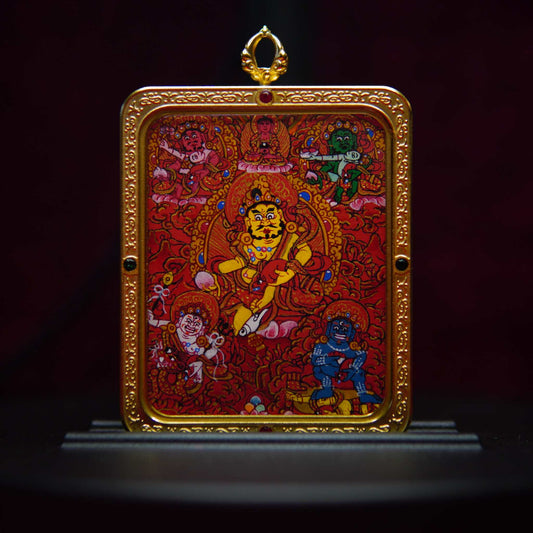
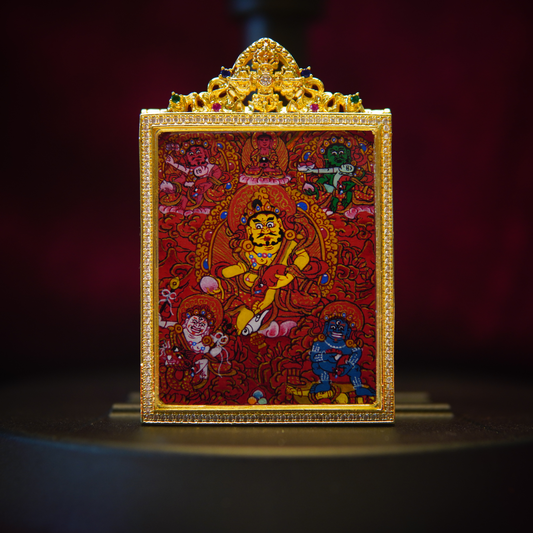
🟡 Yellow Jambhala

Yellow Jambhala Thangka Pendant Necklace
🔴 Red Jambhala

Red Jambhala Thangka Pendant Necklace
🟢 Green Jambhala

Green Jambhala Thangka Pendant Necklace
⚪ White Jambhala

White Jambhala Thangka Pendant Necklace
⚫ Black Jambhala

Black Jambhala Thangka Pendant Necklace
The different colors and forms can emphasize different activities and iconographic traditions.
So Jambhala itself already refers to something more complex than one generic image of a “wealth god.”
🤔 Is Jambhala the Same as Vaishravana?
They are closely related, but the most accurate answer depends on the specific textual, artistic and practice context.
This is where many online descriptions become too simplistic.
Some sources and traditions strongly connect Jambhala with Vaishravana, and particular Jambhala forms may be understood within this broader wealth-deity relationship.
At the same time, Tibetan Buddhist art and practice use distinct names and iconographic forms that should not simply be collapsed into one interchangeable product label.
So instead of saying:
“Vaishravana and Jambhala are completely different gods.”
or:
“They are exactly the same thing.”
a better starting point is:
They belong to closely connected Buddhist wealth-deity traditions whose identities overlap but can be distinguished by specific form and context.
That nuance matters.
Especially when identifying a Thangka.
🐾 Why Do Vaishravana and Jambhala Both Have a Mongoose?
This is one of the strongest visual clues to their relationship.
Both can appear with a treasure-producing mongoose.
The animal is associated with jewels, abundance and wealth.
That shared attribute isn't proof that every Vaishravana and every Jambhala image is identical.
But it shows that their iconographic worlds overlap.
If you want the full story of the animal:
→ Why Does Vaishravana Carry a Jewel-Spitting Mongoose?
And if you've seen the mongoose in a Yellow Jambhala image, you can compare how the same wealth symbol appears within different compositions.
🛡️ Why Does Vaishravana Feel More Like a Guardian?
Because guardianship is central to his broader Buddhist identity.
Vaishravana is not only associated with treasure.
His connection with the Four Heavenly Kings and protective authority gives him a particularly strong guardian dimension.
This is often visible in the art itself.
Royal appearance.
Powerful posture.
Armor or martial imagery in certain forms.
A sense of command.
For someone looking at Vaishravana specifically as 财宝天王, this creates an important distinction:
wealth is paired with guardianship.
 🌈 Why Are There Five Jambhalas?
The multiple Jambhala forms are one reason simply asking:
“Is Jambhala Vaishravana?”
doesn't solve everything.
Jambhala traditions include multiple color forms with different iconographic and activity associations.
For example, in a simplified overview:
Yellow Jambhala is especially well known for prosperity and material support.
Red Jambhala can be connected with magnetizing activity.
Green Jambhala can be associated with accomplishing activity.
White and Black forms have their own traditional contexts as well.
These distinctions deserve their own guide rather than being compressed into one paragraph.
→ The Five Jambhalas Explained: What Do Their Different Colors Mean?
This creates a much clearer map of the Buddhist wealth-deity landscape.
💎 Why Does Buddhism Have Wealth Deities at All?
This is the deeper question behind both Vaishravana and Jambhala.
Isn't Buddhism supposed to warn against attachment?
Why have deities associated with wealth?
Because:
wealth and greed are not identical.
Resources can relieve material hardship.
They can feed families.
Support communities.
Fund religious practice.
Provide education.
Make generosity possible.
The Buddhist concern is not solved simply by having nothing.
Our relationship with resources matters.
This is why reducing Buddhist wealth figures to:
“deities who make you rich”
misses much of the religious context.
📊 Vaishravana vs Jambhala at a Glance
| Vaishravana | Jambhala | |
|---|---|---|
| Core Association | Wealth + Guardianship | Wealth + Material Support |
| Buddhist Identity | Major guardian and wealth-associated deity | Wealth-deity forms in Vajrayana traditions |
| Protection | Strong guardian identity | Varies by form and context |
| Mongoose Imagery | Common in wealth iconography | Common in several Jambhala depictions |
| Multiple Color Forms | Specific forms exist | Especially known through Yellow, Red, Green, White & Black forms |
| Relationship | Closely connected with Jambhala traditions | Closely connected with Vaishravana traditions |
| Exactly Interchangeable? | Context matters | Context matters |
The important point is not to force a perfect modern category onto a complex Buddhist tradition.
🤔 Which Should You Choose: Vaishravana or Jambhala?
Don't begin with:
Which one is stronger for money?
That turns Buddhist art into competing financial tools.
Begin with the symbolism.
Vaishravana may especially resonate if you're drawn to:
💰 Wealth
🛡️ Protection
👑 Guardianship
💎 Treasure & Stability
Jambhala may especially resonate if you're drawn to:
💰 Prosperity
🌿 Material Support
🤲 Abundance & Generosity
🌈 Different Jambhala Forms and Activities
And if you're interested in a specific Jambhala, look at that form individually rather than treating all five colors as interchangeable.
🟡 What About Yellow Jambhala?
Yellow Jambhala is particularly important because he is one of the Jambhala forms most strongly associated in popular understanding with prosperity and abundance.
Hismongoose imagery is also one of the most recognizable details in his iconography.
This is why someone comparing Yellow Jambhala and Vaishravana may feel that the two are especially close.
But when choosing a piece of art, the complete composition still matters.
Don't identify a deity from the mongoose alone.
Look at:
the body color,posture,crown,ritual attributes,surrounding figures,mount,and overall iconographic form.
The mongoose is a clue.
It is not the entire identity.
🧭 How Should You Choose a Buddhist Wealth Thangka?
Instead of asking only:
“Which one attracts the most wealth?”
try asking three different questions.
First: Which deity or tradition am I actually drawn to?
Vaishravana's combination of prosperity and guardianship may feel very different from a particular Jambhala form.
Second: What does the painting actually depict?
A hand-painted Thangka has value partly because the iconographic details identify a specific sacred figure.
Third: What do I want the piece to represent?
For one person, that may be abundance.
For another, stability.
For another, generosity.
For another, the combination of prosperity and protection.
The symbolism becomes more personal once you understand the image rather than simply choosing whichever product promises the strongest “wealth benefit.”
🎁 Why Vaishravana Can Be a Meaningful Gift
Vaishravana's combination of wealth and guardianship makes the image particularly easy to connect with important new beginnings.
A Vaishravana Thangka may be meaningful for:
a new business,a promotion,a new home,a career milestone,a major project,
or someone taking greater responsibility for a family or organization.
The message does not need to be:
“This will make you rich.”
It can be much more meaningful:
“May you have the resources to build what matters—and the wisdom to protect and use them well.”
That gives the gift a story beyond ordinary “good luck” jewelry.
🎨 Why the Difference Matters in a Hand-Painted Thangka
If Vaishravana and Jambhala were simply interchangeable labels for:
wealth
then much of the artwork would stop mattering.
But Thangka painting is iconographic art.
Tiny details help tell you:
who the figure is,
which form is represented,
what tradition the imagery belongs to,
and what the composition is communicating.
That matters even more in a miniature pendant.
An artist may have only a few centimeters to preserve:
the face,crown,attributes,animals,ornaments,and surrounding sacred imagery.
Once you understand those details, you're no longer buying:
“a Buddhist money pendant.”
You're choosing a specific hand-painted Buddhist figure with a particular identity and visual tradition.
📿 Vaishravana in Miniature Thangka Art
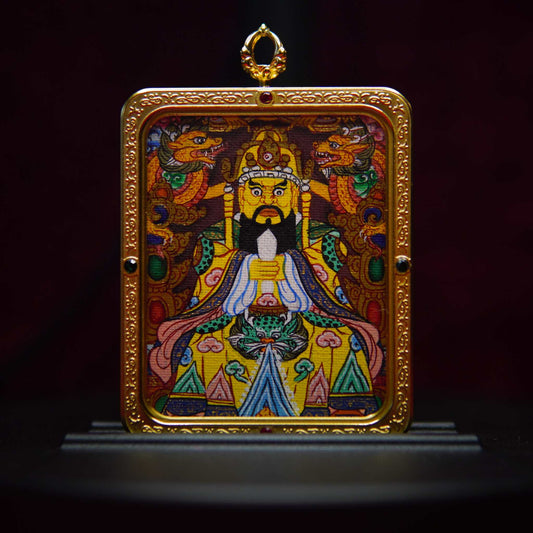
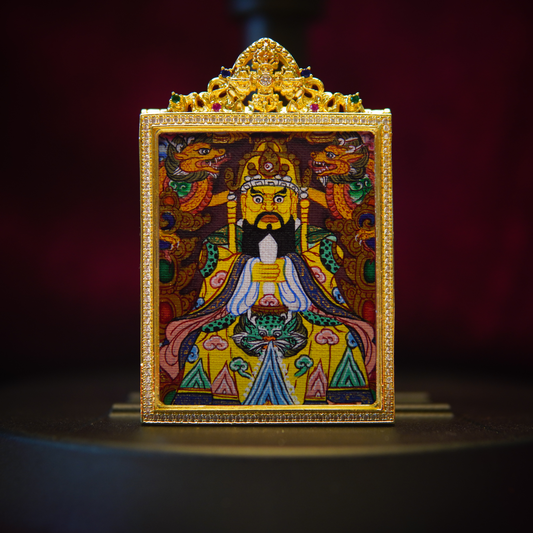
Our hand-painted Vaishravana Tibetan Thangka pendant portrays the wealth-associated guardian in richly detailed miniature Buddhist artwork.
Across the available designs, Vaishravana may appear in different compositions, with variations in posture, sacred attributes, surrounding figures, colors and fine details.
Each piece is individually painted by hand, so subtle differences in expression and linework are natural.
For Buddhist practitioners, Vaishravana may carry specific devotional significance.
For others interested in Tibetan Buddhist symbolism, his imagery brings together a distinctive combination of:
💰 Wealth
💎 Abundance
🛡️ Protection
👑 Guardianship
🤲 Generosity
→ Explore the Hand-Painted Vaishravana Tibetan Thangka Pendant

If you're more drawn to Jambhala, you can also explore the individual Yellow, Red, Green, White and Black Jambhala forms rather than treating them as one interchangeable wealth deity.
❓Quick Questions: Vaishravana vs Jambhala
Are Vaishravana and Jambhala the same deity?
Their traditions are closely related and can overlap, but treating every Vaishravana and Jambhala form as completely interchangeable is too simplistic. The specific textual, artistic and practice context matters.
What is Vaishravana associated with?
Vaishravana is strongly associated with wealth, prosperity, guardianship and protection in Buddhist traditions.
What is Jambhala associated with?
Jambhala forms are especially associated with wealth, prosperity, material support and the alleviation of hardship, with different forms carrying different traditional emphases.
Why do both Vaishravana and Jambhala have a mongoose?
The treasure-producing mongoose belongs to a broader Buddhist and South Asian wealth iconography and appears in traditions associated with both figures.
Which is better for wealth: Vaishravana or Jambhala?
Rather than ranking them, it is more accurate to understand their specific forms and symbolism. Vaishravana strongly combines wealth with guardianship, while Jambhala traditions include several prosperity-associated forms with different activities.
Is Vaishravana the same as the Four Heavenly Kings?
Vaishravana is one of the Four Heavenly Kings, traditionally associated with the northern direction. “Four Heavenly Kings” refers to the group, not to Vaishravana alone.